

The Wheel Strategy is a systematic options trading approach that cycles between selling cash-secured puts (CSPs) and covered calls (CCs) on stocks you genuinely want to own, generating premium income while potentially acquiring shares at a discount.
That’s it. No magic. No secret sauce.
Just a disciplined, repeatable process — which is precisely why it works when executed correctly, and precisely why most people fail at it.
Table Of Contents
What is The Wheel Strategy?
Let me say this loud for those in the back:
The Wheel Strategy is not passive income. Instead, it’s active portfolio management with a premium collection overlay.
You are making deliberate decisions about which stocks to own, at what prices, and when.
The “passive” part is that you’re not staring at charts all day (but you are thinking carefully about every position you take on, typically once or twice a week).
I like to think of The Wheel Strategy as getting paid while waiting for your limit buy order to be filled.
Think about that for a second.
Let’s take a look at the current chart for SSRM:
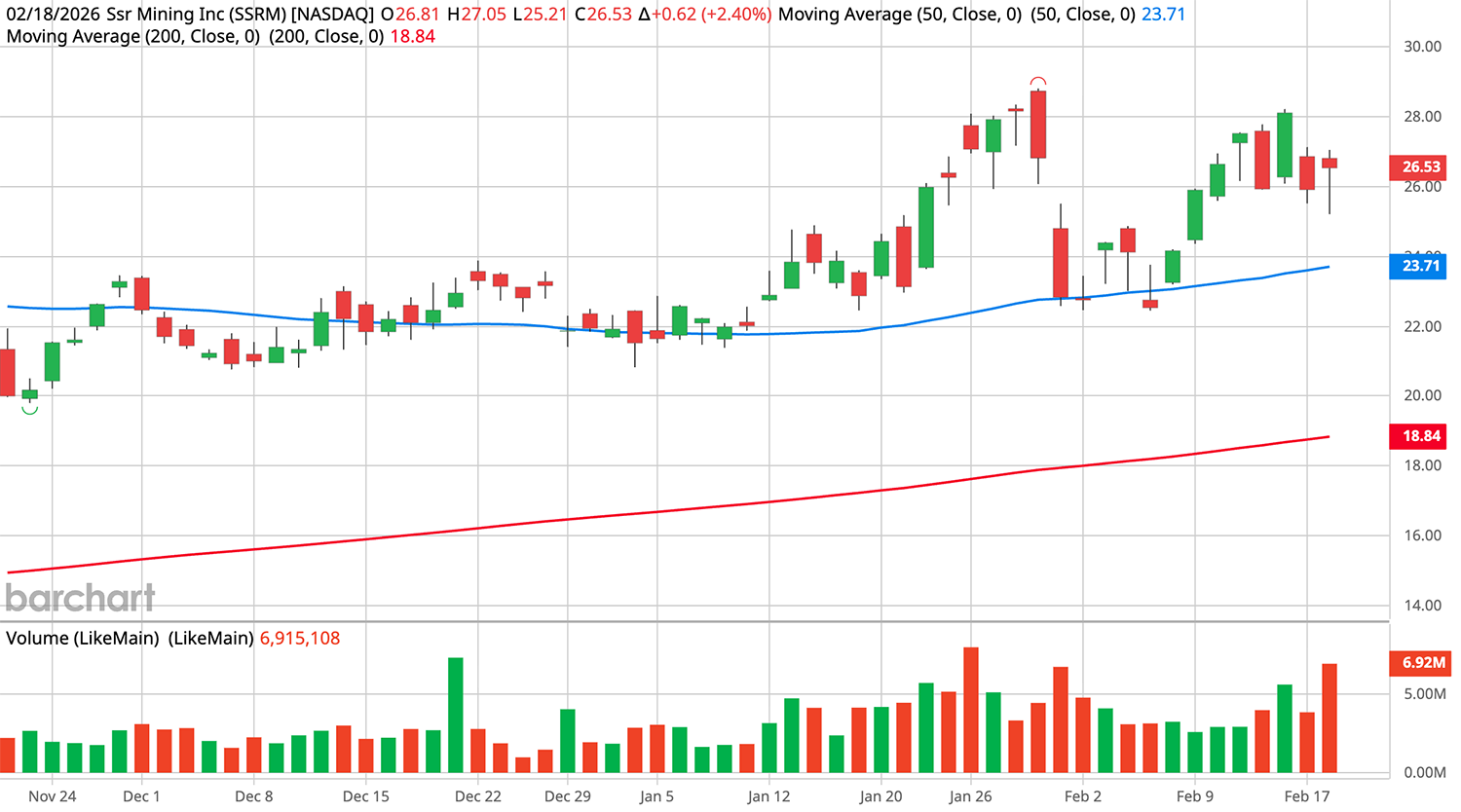
As we can see, SSRM is trading at $26.53.
If we want to enter right now, we could use a market order.
A more experienced trader may decide to wait for a dip, so they may choose to set a limit order at $22 (just above the 50MA) and wait for the fill.
Of course, the price may never drop back to $22, and that limit order just sits there, collecting dust.
But what if we could instead get paid to wait for that limit order to be filled?
That’s effectively what the Cash-Secured Put phase of The Wheel Strategy is doing.
We can sell a CSP at the $22 strike, collect the premium upfront, thereby getting paid to wait for our order to fill.
And if it never does, at least we received some money for being patient.
That’s the fundamental idea. The Wheel formalizes it into a repeatable system.
Cash-Secured Puts (CSPs) and Covered Calls (CCs)
There are two core options components to The Wheel Strategy:
- Cash-Secured Puts (CSPs): You take on the obligation to buy 100 shares at a specific price (the strike) for a set period of time, collecting premium upfront for that commitment. If the stock closes below your strike at the expiration of the contract, the buyer can put those shares to you, triggering assignment (see note below). “Cash-secured” means you have the capital reserved to make that purchase.
- Covered Calls (CCs): Once you own shares, you sell someone the right to buy them from you at a specific strike price (typically above your cost basis). You collect more premium upfront. If the stock rises above your strike by expiration, your shares get called away at that price (but that’s okay, because you sold the CC above your cost basis, you have profit locked in). If strike does not close above the strike, you keep the premium and sell another call, or you simply hold the stock until you are ready to sell it.
Note: Technically, American-style options can be exercised at any time before expiration — but early assignment is rare in practice. For simplicity, we’ll treat expiration as the trigger throughout this guide.
Makes sense, right?
But here’s the catch — The Wheel Strategy only works if the stock underneath the options is one you’d genuinely want to own.
The moment you start running this on garbage stocks (meme stocks, over-valued growth stocks) to collect high premium, the strategy breaks down completely.
How The Wheel Strategy Works (The Basic Cycle)
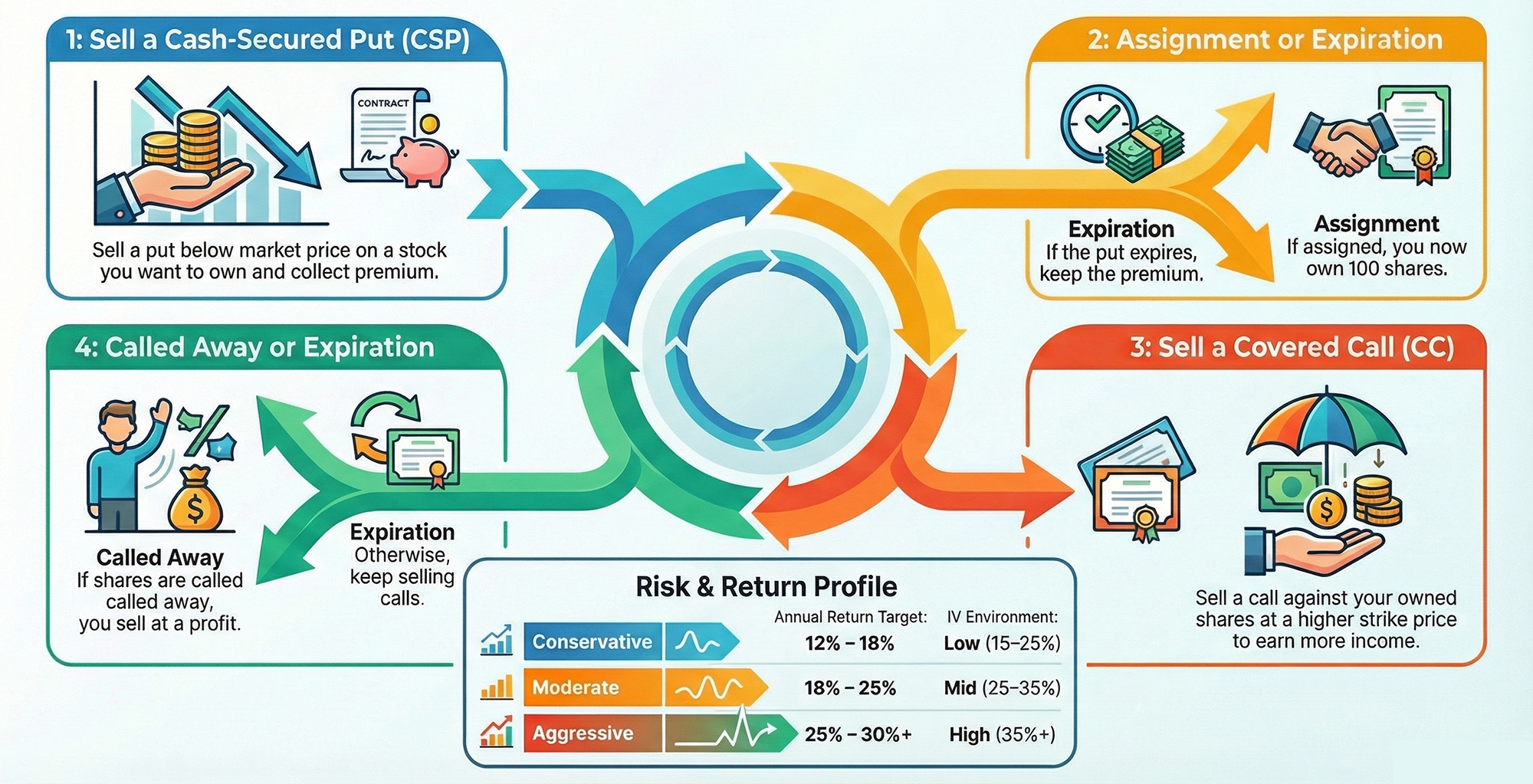
Let’s walk through the four-phase cycle. This is the engine that powers The Wheel.
Phase 1: Sell a Cash-Secured Put (CSP)
Here is the basic process of selling a Cash-Secured Put:
- You identify a stock you want to own.
- You sell a put option at a strike price below the current market price — ideally a price where you’d genuinely be happy to own shares.
- You collect premium immediately.
- That premium is yours to keep regardless of what happens next.
The result?
You’re now obligated to buy 100 shares if the stock falls to your strike by expiration.
Phase 2: Assignment or Expiration
There are now two scenarios:
- The put expires worthless. The stock stayed above your strike. You keep the full premium. Back to Phase 1 above (i.e., sell a CSP). Rinse and repeat. This is the “fast cycle.”
- You get assigned. The stock fell below your strike at expiration. You now own 100 shares at your predetermined price (i.e., the strike). Your effective cost basis is the strike price minus the premium you collected. Move to Phase 3.
Phase 3: Sell a Covered Call (CC)
Now you own 100 shares of the stock. If this were a standard investment, we’d just let these shares sit and hopefully the stock appreciates in value.
But we’re running The Wheel Strategy, so here is what you do instead:
- You sell a call option at a strike price above your cost basis, ideally at or above the price where you’d be happy to sell.
- You collect more premium.
- That premium further reduces your effective cost basis.
But since you sold a Covered Call, you’re now obligated to sell your 100 shares if the stock rises to your call strike by expiration.
Phase 4: Called Away or Expiration
We’re now at the final stage of The Wheel Strategy.
Two outcomes are possible here:
- The call expires worthless. The stock stayed below your call strike at expiration. You keep the premium and still own the shares. Back to Phase 3. Sell another covered call.
- Shares get called away. The stock rose above your call strike at expiration. Someone exercises their option and you are now required to sell your 100 shares at the strike price. You keep all premiums collected along the way. Back to cash. Back to Phase 1.
In general, a complete Wheel looks something like this:
CSP → Assignment → CC → Called Away → Repeat
The “Wheel” name comes from the continuous cycling.
In a well-run portfolio, you’re never fully in cash or fully deployed, you’re always somewhere in the cycle across multiple positions.
Only Wheel Stocks You Truly Want to Own

This is the most important principle in the entire strategy.
Everything else is mechanics.
This here is the foundation.
The Wheel only works on stocks you’d genuinely want to hold in your portfolio for a 6-12 month period.
I see the same thing over and over again when traders discover The Wheel:
- They look up the highest premium options available
- They immediately start selling CCs on the most volatile names they can find (remember, high volatility equals higher premium collected)
- …and then the whole thing crashes and burns
This is how accounts die.
The market doesn’t offer you anything for free. The premium is high on those stocks because the risk is high.
Implied volatility reflects the market’s expectation of how much a stock can move…
…and meme stocks, unprofitable high-growth names, and speculative biotechs move a lot.
When they move against you and you get assigned, you’re stuck owning something that can drop dramatically (40-60%) with no fundamental reason to bounce back.
The lesson here lies in discipline:
Before you sell a single put, ask yourself:
Would I genuinely want to own 100 shares of this company at this price?
If the honest answer is “no”, or even “maybe”, that stock doesn’t qualify.
What does qualify? Value stocks with strong, defensible fundamentals:
- Consistent earnings and free cash flow
- Manageable debt levels
- Durable competitive advantages
- Reasonable valuations (P/E, P/B, EV/EBITDA)
- Upgraded quarterly guidance
- And don’t forget: A business you actually understand!
Remember:
- The goal is to avoid assignment, to collect premium and let puts expire worthless.
- But if assignment happens, you’re okay.
- Because you researched the company.
- Because you chose the strike price deliberately.
- Because you’d genuinely be comfortable holding those shares while you sell covered calls to work your way back out.
That psychological safety net is the difference between a bad week and a portfolio crisis.
Does that sound like you?
If you’ve been assigned on stocks you’d never voluntarily own — if you’ve found yourself stuck in a position, watching a name you only picked for the premium crater through your strike — this is the principle you need to internalize before anything else.
Assignment is Not a Failure
I’ll be honest here.
The first time I got assigned, I panicked.
My put was approaching expiration, the stock was sitting right at my strike, and I was refreshing my brokerage app like it owed me money.
When the assignment notification arrived, my stomach dropped.
Then I remembered:
- I had researched this company.
- I had chosen that strike because I thought the stock represented genuine value at that price.
- I had collected premium that reduced my cost basis below market.
- I owned shares of a good business at a price I’d predetermined.
There was genuinely nothing to panic about.
Assignment anxiety is pervasive in options trading communities. You’ll see it on Reddit constantly, traders treating assignment like a catastrophic failure, desperately rolling positions to avoid it at all costs.
Some of those rolls are just digging a deeper hole.
Here’s the key reframe:
Assignment is rotation, not crisis.
- When you get assigned, you’ve simply moved from the CSP phase to the CC phase.
- Your capital is deployed differently, but it’s working the same job (i.e., collecting premium).
- The transition is natural, not a problem to solve.
Expiration Is Ideal, But Don’t Stress
Now, that doesn’t mean we want assignment.
We prefer to keep the premium, stay liquid, and cycle quickly back to new positions.
A put expiring worthless is the cleanest outcome.
But when assignment happens on a properly-selected stock at a properly-selected strike, it’s a scheduled event in the cycle, not an emergency.
The traders who get destroyed by assignment didn’t follow the core philosophy:
- They sold puts on stocks they’d never want to own, for premium that seemed too good to pass up.
- When they get assigned on those names, they’re stuck holding something they can’t confidently sell covered calls against, with no real fundamental floor underneath.
Follow the philosophy, then assignment becomes manageable.
Who Is The Wheel Strategy For?

Account Size Requirements
Your amount of capital determines what’s actually possible.
$10K-$20K: Viable, But Constrained
With $10-20K in capital you are in a great place to learn The Wheel Strategy, but you will find yourself quite constrained.
- But the math is unforgiving
- One assignment can tie up 50% or more of your total capital
- Diversification is nearly impossible (you might manage 1-4 concurrent positions at most)
A second assignment while you’re already in the CC phase can lock up virtually your entire account.
Think of a $10K-$20K account as a “learning account”.
You’re paying for education with real stakes, which is valuable.
But don’t expect portfolio-level diversification or meaningful income at this size.
$25K-$50K: The Sweet Spot for Beginners
At this level the strategy starts working as designed.
- You can run 4-6 positions, enough for meaningful diversification
- You can access stocks up to around $500/share
- But typically you’ll want to keep them in the $40-90/share range to be able to diversificate
- One or two assignments won’t paralyze the portfolio; you can continue cycling through CSPs on your undeployed capital while managing assigned positions
The $25K threshold has additional significance for US traders: it’s the Pattern Day Trader (PDT) minimum for margin accounts.
If you’re using a cash account (which is common for the Wheel), this doesn’t apply directly, but it signals the right general size to be taken seriously by brokerages.
$50K-$100K+: Optimal Range for Retail Traders
True diversification becomes possible at the $50-100K range.
- 8-12 simultaneous positions across different sectors
- Access to higher-quality, higher-priced stocks (which are often better Wheel candidates than their cheap counterparts)
- At this scale, assignment becomes a rotation event
- You might get assigned on two positions simultaneously and still have plenty of cash to cycle through new CSPs
- Position sizing (5-10% of portfolio value per position) provides genuine risk management
This is the range where the strategy’s compounding effect becomes meaningful.
Time Commitment
Once your systems are in place, the Wheel requires roughly one hour per week.
Here’s how that breaks down:
- 20 minutes: Screen for new CSP candidates (if you have cash to deploy)
- 15 minutes: Review existing positions and check technical setups
- 10 minutes: Roll or close positions approaching expiration
- 10 minutes: Scan for upcoming earnings and ex-dividend dates on current holdings
- 5 minutes: Check overall portfolio Greeks and cash allocation
It’s not day trading.
You’re not watching charts intraday or refreshing quotes every hour.
You’re not stuck to your screen, riding every market up and down, stressed out of your mind, haven’t pooped in days, with a bottle of antacids next to you.
Instead, it’s weekly portfolio management — disciplined, methodical, genuinely manageable for working professionals.
Yes, the time cost goes up temporarily when you’re learning:
- Researching new stocks
- Building your watchlist
- Understanding each company
That front-loaded work is what makes the weekly routine fast once you’re running.
Personality Types That Thrive

The Wheel rewards two specific personality types.
(If you don’t see yourself in one of these, that’s useful information.)
The Systematic Operator
This person runs the Wheel like a business:
- They have a screening checklist and they follow it every time — no exceptions for “gut feelings” or “hot tips.”
- They pre-determine position sizing and won’t violate it even when a trade looks obvious.
- They can execute rolls or stop losses mechanically without emotional attachment to outcomes.
- They keep records of their trades so they can study them and learn from the.
The Systematic Operator doesn’t need the trade to feel exciting. They’re optimizing a process, not chasing a feeling.
The Patient Value Investor
This person is a “finance nerd”:
- They can actually read 10-Ks.
- They can explain, in plain language, why a specific company at a specific price represents genuine value.
- They understand balance sheets well enough to distinguish quality businesses from value traps.
- When they get assigned, their reaction is “Okay, I own a good company at a fair price” (i.e., they don’t panic)
The Patient Value Investor is comfortable holding through assignments for months if that’s what the situation requires. They’re playing a long game.
Do These Personas Sound Like You?
One of them should, at least partially.
If neither resonates…
- If you want fast gains
- Get bored quickly
- Or can’t sit through a drawdown without making emotional adjustments
…then the Wheel will fight you every step of the way.
Who Should Avoid The Wheel Strategy

Do yourself a favor and be honest here. If any of these personas sound like you then I would not recommend The Wheel Strategy to you.
The “To The Moon” Trader
If you’re looking for 10-bagger potential, meme stock action, or YOLO plays, the Wheel will disappoint you.
It’s structurally designed to cap your upside in exchange for premium income.
Traders who want explosive gains will hate this strategy.
They’ll feel like they’re leaving money on the table every time a stock rockets past their call strike.
They’re right. That’s the trade-off.
The Undisciplined Trader
This one stings because it describes most of us (at some point) in our investing/trading career.
- The undisciplined trader can’t stick to position sizing when a trade “feels right.”
- They chase premium in stocks they’d never actually want to own.
- They “revenge trade” after a loss, doubling down on a broken name just to “get their money back.”
- They move strikes around based on emotion rather than rules.
The Wheel requires mechanical execution:
- When you’re in a drawdown, you follow the rules
- When a stock is running against you, you follow the rules
- Emotion doesn’t enter the equation
If that level of discipline sounds exhausting, this strategy will grind you down.
The Poor Stock Picker
This might be the most important category (and the one most people won’t admit to).
If you can’t read a balance sheet, the Wheel will eventually punish you.
- Not immediately
- Probably not in the first few months
- But eventually you’ll sell a put on something that looks cheap but is actually a value trap
- You’ll get assigned on a company whose fundamentals are deteriorating.
- And you’ll spend the next several months selling covered calls on a stock that just keeps going lower
The strategy demands genuine stock analysis skills.
If you don’t have them yet, develop them first (or at least be very honest with yourself about what you don’t know).
The Panic-Prone Personality
Some people cannot handle the psychological weight of assignment.
The moment they own shares in a declining stock, they catastrophize.
They make emotional exits at exactly the worst times, selling assigned shares at a loss right before the stock recovers, just to relieve the anxiety.
Remember, while assignment is not the desired outcome, the act of getting assigned is still baked into this strategy.
If the thought of owning a stock trading below your cost basis for weeks or months will drive you to irrational decisions, the Wheel isn’t a good fit.
No shame in that, it just means a different approach suits your temperament better.
What Returns Can You Expect From The Wheel Strategy?
These ranges reflect my own trading experience with The Wheel Strategy. I’ve done my best to provide realistic expectations (and not some “guru fantasy”).
Your results will depend on stock selection quality, IV environment, and how well you stick to your rules.
| Tier | Annual Return | Monthly Return | IV Environment | What It Looks Like |
|---|---|---|---|---|
| Conservative | 8–12% | 0.7–1.0% | 15–25% | Quality value stocks, defensive position sizing, some cash during uncertainty |
| Moderate | 12–20% | 1.0–1.7% | 25–35% | Mix of value and growth, active management, willing to work through assignments |
| Aggressive | 20–35%+ | 1.7–2.9%+ | 35%+ | Higher-IV quality stocks, tighter strikes, 80–90% capital deployment |
Most experienced Wheel Strategy practitioners land in the “moderate” range.
The conservative tier is where disciplined beginners end up (at least, the ones who have the discipline to stick to the rules). Not flashy, but compounding at 10% annually doubles your capital in about seven years.
The aggressive tier is achievable, but most people who think they’re running it are just taking more risk, not generating more alpha.
Let’s talk about what kills returns:
- Poor stock selection: Value traps, deteriorating fundamentals
- Chasing premium: Selling puts on stocks you’d never want to own
- Undercapitalization: One assignment creates concentration risk that distorts everything
- Emotional rolling: Constantly rolling down and out on losers, extending duration indefinitely
- Ignoring market regime: Running full exposure in an obvious topping market
My point is this:
The returns are real, but they come from discipline and stock selection — not from the mechanics alone.
The mechanics are simple. The discipline is hard.
Remember, this isn’t “passive income” where you can set it and forget it. The Wheel Strategy is active portfolio management with a premium collection overlay.
Anyone promising otherwise is selling something.
How Long Does a Wheel Cycle Take?

The Fast Cycle (No Assignment): 2-4 Weeks
- You sell a 30-45 DTE CSP
- The stock cooperates, stays above your strike
- You close the position early at 50-80% profit
- Back to cash, back to screening
Total cycle time: 2-4 weeks depending on when you take profit.
If you’re never assigned and markets are grinding higher, you could theoretically run 12-20+ cycles per year per position.
The annualized velocity is significant.
But here’s the reality check:
This only happens consistently when markets are trending up and your stock selection is clean.
You will not avoid assignment forever!
Typical Cycle (With Assignment): 10-16 Weeks
Here’s how a typical Wheel cycle may look.
- Phase 1 (CSP to Assignment, 4-6 weeks):
- You sell a 30-45 DTE CSP
- The stock pulls back, approaches your strike
- Maybe you roll out 2-4 weeks for additional credit, trying to avoid assignment
- Eventually the stock trades through your strike and you get assigned
- Phase 2 (Working Out of Assignment, 6-10 weeks):
- You sell your first covered call 30-45 DTE at your breakeven or above
- The stock doesn’t cooperate immediately
- You roll the CC out for additional net credit
- You sell another 30-45 DTE call
- With each roll, each new CC, your cost basis creeps lower as premium accumulates
- Finally the stock rallies above your call strike
- Shares get called away, back to cash
That’s 10-16 weeks for one complete cycle on one position.
In a diversified portfolio, you’re running multiple cycles simultaneously (some in the fast phase, some in the assignment phase, some in the CC phase).
Portfolio-level income smooths out considerably compared to any single position.
Set realistic expectations going in. The Wheel builds wealth through consistency over time, not through rapid-fire profits.
What You Need Before Starting The Wheel Strategy
Before you sell your first put, make sure you have:
- Adequate capital: Minimum $10K, preferably $25-50K+ to enable real diversification
- An options-approved brokerage account: Typically requires options approval for cash-secured puts and covered calls (Schwab, Fidelity, Robinhood, etc. provide this type of access for most retail accounts, you typically just need to request access if you do not already have it).
- Basic options mechanics knowledge: Understand puts, calls, assignment, expiration, premium, strike prices. If these terms are still fuzzy, start there first.
- A stock selection framework: You need a repeatable process for identifying which stocks qualify for the Wheel. “This looks cheap” is not a framework.
- Written rules you’ll follow: Entry criteria, exit criteria, position sizing, maximum positions. Write them down before you need them. You will need them.
- Time for weekly management: About an hour per week, every week. Consistency matters more than intensity.
The mechanics of the strategy are straightforward.
Building the discipline around them, including the rules, the stock selection process, the psychological preparation for assignment, is where the real work lives.
Is The Wheel Strategy Right for You?
The Wheel Strategy is a systematic, disciplined approach to generating premium income on stocks you genuinely want to own.
- It rewards patience
- It punishes emotion
- It requires real capital, real stock analysis skills, and a real commitment to following your rules even when the market is testing them
- It is not passive income.
- It’s not a money printer.
- And it’s not for everyone.
But for the trader who wants a structured, repeatable process (who’s tired of random YouTube tips and Reddit plays that leave them assigned on stocks they can’t explain, stuck in positions they don’t know how to manage) the Wheel offers something different.
A system. Discipline. A framework you can actually learn to operate with trust and confidence.
Disclaimer
WheelMetrics is an educational resource, not financial advice. WheelMetrics is not a registered investment advisor, broker-dealer, or financial planner. Everything here, including articles, newsletters, stock screening results, options setups, market commentary, is for educational and informational purposes only. Options trading carries substantial risk, and you can lose some or all of your capital. You're solely responsible for your own investment decisions. Consult with a qualified financial advisor before making any trades.