 by
by 
The Wheel Strategy is a systematic options trading approach that cycles between selling cash-secured puts (CSPs) and covered calls (CCs) on quality stocks you genuinely want to own, collecting premium at every stage of the cycle.
That’s, effectively, the strategy in one sentence.
Could you learn the mechanics in an afternoon? Absolutely.
Will that alone make you profitable? Not even close.
The mechanics are simple. Discipline is what separates profitable Wheel practitioners from blown accounts.
I’ve been running the Wheel long enough to know this from experience:
- I’ve chased premium on garbage stocks
- I’ve been assigned on names I had no business owning
- I’ve learned the hard way through painful drawdowns
The strategy itself wasn’t broken, I just had not learned the discipline to properly run it.
If you’ve found yourself reflecting on your trading strategy, thinking something along the lines of:
I do well for a bit and then I get hit out of nowhere.
…you’re not alone. That pattern is almost always a discipline problem, not a strategy problem.
This guide is the map I wish I’d had when I started.
Table Of Contents
What Is the Wheel Strategy?
At its core, the Wheel is a cycle.
You sell a cash-secured put on a stock you’d genuinely want to own. If the put expires worthless, you keep the premium and sell another. If you get assigned, you own the shares and transition to selling covered calls against them until they’re called away.
Then you start over.
I like to think of it as getting paid while waiting for your limit buy order to fill.
Could you just set a limit order at a price you like and wait? Sure. But what if you could collect income while you wait for that price to come to you?
That’s effectively what the CSP phase is doing.
And if the order never fills? You still collected the premium for being patient. That money is yours regardless.
That’s the fundamental idea. The Wheel formalizes it into a repeatable system with two core components:
- Cash-Secured Puts (CSPs): You sell the obligation to buy 100 shares at a specific price (the strike), collecting premium upfront for that commitment. “Cash-secured” means you have the capital reserved to make that purchase if assigned.
- Covered Calls (CCs): Once you own shares, you sell someone the right to buy them from you at a specific strike price (typically above your cost basis), collecting more premium. If the stock rises past your strike, shares get called away at a profit.
Together, these two components create the continuous cycle:
- CSP premium lowers your cost basis going in
- CC premium lowers it further once you own shares
- By the time you exit, you’ve collected income at every stage
But here’s the catch that trips up nearly every new Wheel trader:
The Wheel only works if the stock underneath the options is one you’d genuinely want to own (typically for 6-12 months, sometimes more).
The moment you start chasing premium on garbage stocks (meme stocks, over-valued growth names, speculative biotechs), the strategy breaks down completely.
The premium is high on those names because the risk is high.
The market isn’t offering you free money. It’s compensating you for risk that can (and will) materialize.
When that risk materializes and you get assigned, you’re stuck owning something that can drop 40-60% with no fundamental reason to bounce back.
Before you sell a single put, ask yourself:
Would I genuinely want to own 100 shares of this company at this price for 6-12+ months time horizon?
If the honest answer is “No”, or even “Maybe”, that stock doesn’t qualify.
What does qualify?
Quality value stocks with:
- Strong fundamentals
- Defensible businesses
- Consistent earnings
- Manageable debt
- Reasonable valuations
- Increasing forward guidance
And, most importantly, companies you actually understand.
Finally, the Wheel is not passive income. It’s active portfolio management with a premium collection overlay.
You’re making deliberate decisions about which stocks to own, at what prices, and when.
It requires weekly monitoring, disciplined stock selection, and rules-based decision making.
Anyone promising otherwise is selling something.
Assignment is also not a failure. It’s rotation. When you get assigned, your capital moves from cash to shares, but it’s still working the same job (i.e., collecting premium). The transition is natural, not a crisis to solve.
For the full introduction to the strategy, including the “getting paid to wait” mental model and who the Wheel is (and isn’t) for, see What is The Wheel Strategy?.
How the Wheel Strategy Works Step by Step
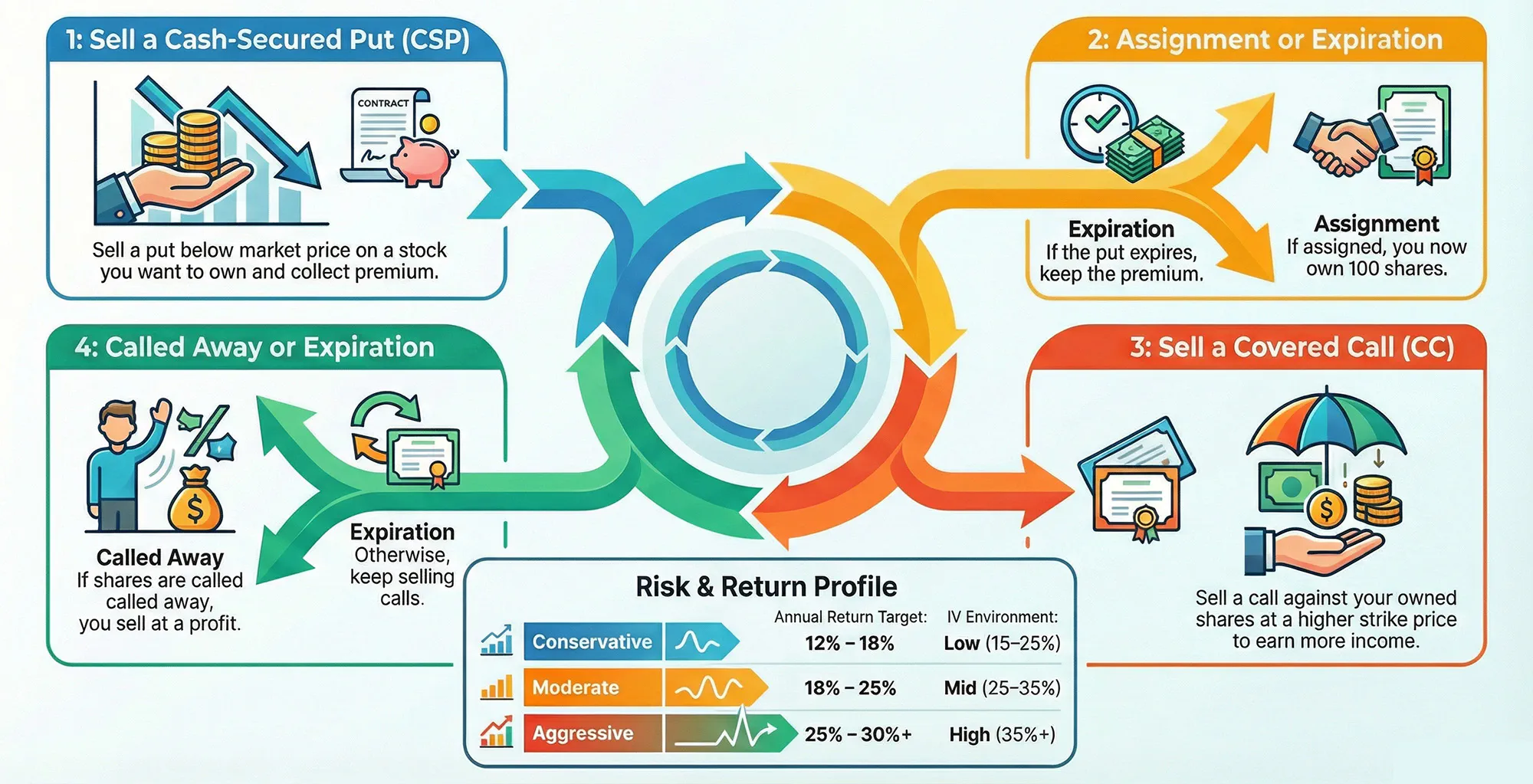
The Wheel runs in four phases. Two are actions (selling options). Two are decision points (responding to what the market did).
That distinction matters. Phases 1 and 3 are where you do something. Phases 2 and 4 are where you respond to what the market handed you.
Phase 1: Sell a Cash-Secured Put
You identify a stock you want to own, sell a put at a strike price below the current market price, and collect premium upfront. Your broker locks the capital needed to buy 100 shares at that strike (hence “cash-secured”).
Capital reserved = Strike x 100 x Number of Contracts
The premium is yours to keep regardless of what happens next. Whether the stock goes up, sideways, or down, that premium belongs to you.
Phase 2: Assignment or Expiration
Two outcomes are possible in Phase 2:
- Put expires worthless: Stock stayed above your strike. You keep the full premium. Back to Phase 1. This is the “fast cycle,” and the ideal outcome.
- You get assigned: Stock fell below your strike at expiration. You now own 100 shares per contract at your strike price. Your effective cost basis is the strike minus the premium you already collected. Move to Phase 3.
Phase 3: Sell a Covered Call
You now own 100 shares of the stock. Instead of just sitting on them and hoping they appreciate, you sell a call at a strike above your adjusted cost basis.
You collect more premium, further reducing your effective entry price. You’re now obligated to sell your shares if the stock rises above the call strike at expiration.
The whole point of selling CCs in this phase is to generate additional premium while locking in a profitable exit if the shares are called away.
Phase 4: Called Away or Expiration
Again, two outcomes are possible:
- Call expires worthless: Stock stayed below your call strike. You keep the premium. Sell another call (back to Phase 3).
- Shares get called away: Stock rose above your strike at expiration. You sell at the strike price (and keep all premiums collected across both phases). Back to cash. Back to Phase 1.
A complete Wheel cycle looks like this:
CSP → Assignment → CC → Called Away → Repeat
The “Wheel” name comes from the continuous cycling.
A Worked Example
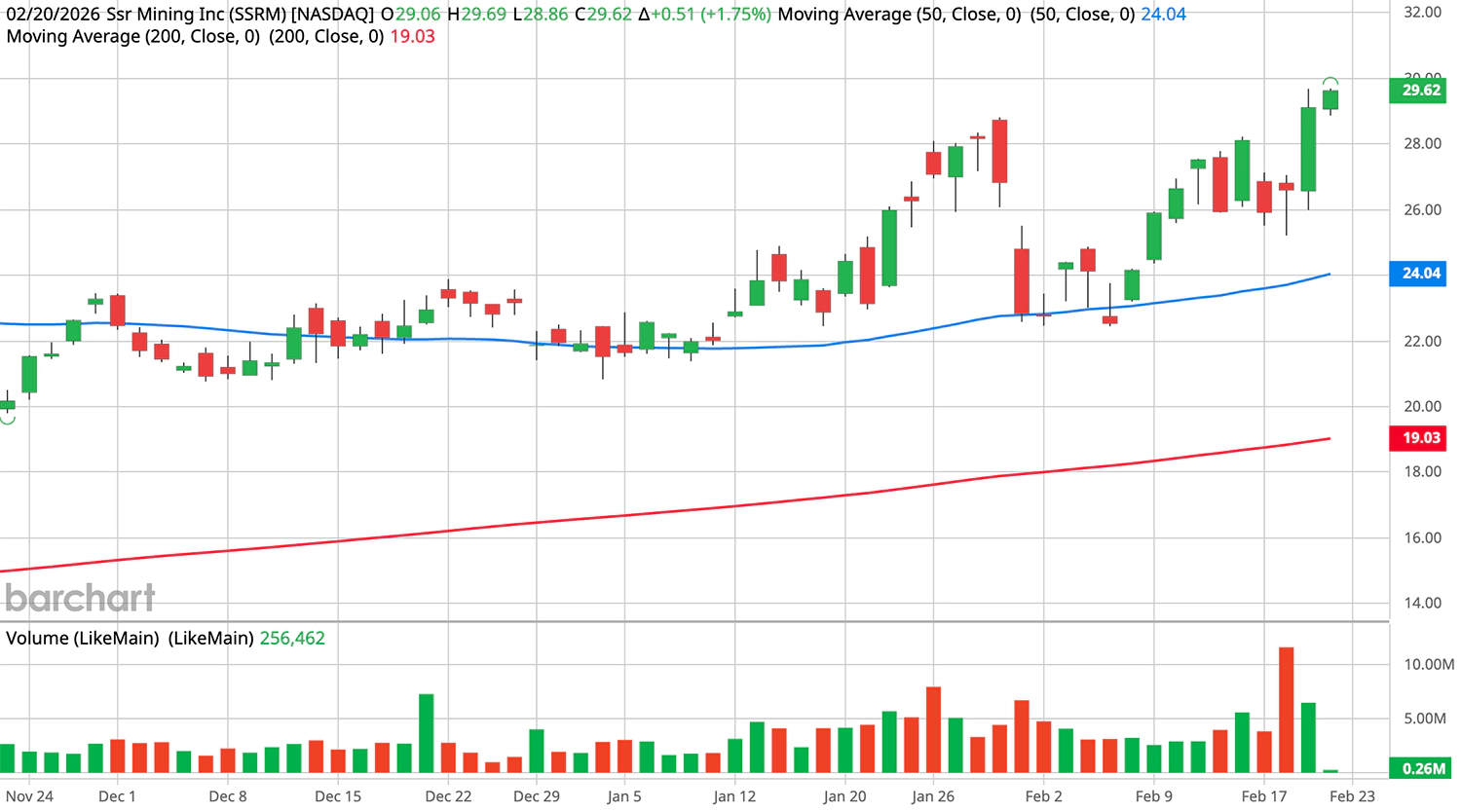
Here’s what a complete cycle looks like with real numbers, using SSRM (a gold mining stock).
CSP Phase:
SSRMis trading at ~$29.38- We have a $50,000 account and sell 2 CSP contracts at the $27 strike
- Premium collected: $1.21 x 200 shares = $242
- Capital secured: $27 x 200 = $5,400 (10.8% of the account, a healthy position size)
- Adjusted cost basis: $27.00 - $1.21 = $25.79 per share
Assignment:
SSRMdrops below $27 at expiration and we get assigned 200 shares- The $5,400 already reserved converts from cash to shares (no additional capital needed)
- We own 200 shares at an effective entry of $25.79
Covered Call Phase:
SSRMstabilizes around $27.00- We sell 2 covered calls at the $28 strike, collecting $0.60 x 200 = $120
- New adjusted cost basis: $25.79 - $0.60 = $25.19 per share
Called Away:
SSRMrallies past $28 and shares get called away at $28.00- Exit price: $28.00, adjusted cost basis: $25.19
- Profit per share: $2.81
- Total profit: $562 (~10.4% return on capital over 8-12 weeks)
Not bad for a trade that initially went against us, resulting in assignment.
In summary:
- The premium cushioned the entry
- Assignment was rotation, not crisis
- And the cycle generated a meaningful return even when the stock pulled back through our strike
In a well-run portfolio, you’re never fully in cash or fully deployed. You’re always somewhere in the cycle across multiple positions:
- Some in the CSP phase, collecting premium while waiting
- Some working through assignment, selling covered calls
- Some nearing exit, about to start the cycle again
Portfolio-level income smooths out considerably compared to any single position.
For the full walkthrough with all decision points, rolling mechanics, and profit analysis, see The Wheel Strategy: Step-by-Step.
How Much Capital Do You Need for the Wheel Strategy?

Your account size doesn’t just determine how much you can earn. It determines how much risk you’re taking with every single trade.
When you sell a cash-secured put, your broker locks strike x 100 of your capital as collateral until the position closes. That capital cannot be used for anything else.
This constraint is why account size matters so much.
Here’s what’s actually possible at each level:
| Tier | Capital | Positions | Reality |
|---|---|---|---|
| Learning | $10K-$20K | 2-4 | Viable but severely constrained; one assignment ties up 50%+ of capital; treat as a learning account |
| Sweet Spot | $25K-$50K | 4-6 | Strategy starts working as designed; meaningful diversification begins; one assignment doesn’t paralyze the portfolio |
| True Diversification | $50K-$100K | 8-12 | Real portfolio management; sector diversification possible; assignment becomes a rotation event |
| Full Portfolio | $100K+ | 12-20+ | Full capacity; can be selective and patient; compounding becomes meaningful |
A $10K account with a single $100 strike CSP isn’t running the Wheel. That’s a single bet on a horse to win wearing a Wheel Strategy jockey outfit.
Don’t let this dissuade you though.
At $10K-$20K, you can absolutely learn the mechanics with real money (which I typically recommend over paper trading).
But understand that one assignment can lock up 50% or more of your capital.
A second assignment can freeze the account entirely.
Think of a $10K-$20K account as a learning account. You’re paying for education with real stakes, which is valuable. But don’t expect portfolio-level diversification or meaningful income at this size.
The sweet spot for most beginners is $25K-$50K. Enough to run 4-6 positions on quality stocks. Enough that one assignment doesn’t destroy your ability to keep cycling.
One or two assignments won’t paralyze the portfolio, and you can continue deploying capital into new CSPs while managing assigned positions.
At $100K+, the strategy operates at full capacity. True sector diversification becomes possible. Assignment becomes a routine rotation event.
And the compounding effect of reinvested premiums starts to become genuinely meaningful.
Position Sizing and Dry Powder
Position sizing keeps you alive when things go wrong (and they will, eventually).
I typically recommend the following capital allocation per trade:
- 5% of portfolio: Low conviction or uncertain conditions
- 10-15% of portfolio: Standard default for most positions
- 15-20% of portfolio: High conviction only
Never exceed 20% of total capital in a single position, regardless of how certain you feel.
Secondly, experienced Wheel practitioners don’t stay 100% deployed.
They keep 10-20% in cash (dry powder) for three reasons:
- Market dips that create exceptional entry prices
- A stock you’ve been watching that finally hits your target strike
- Unexpected assignments that suddenly tie up capital
Capital is a variable. Discipline is the constant. Don’t confuse the two.
A trader with $25K and iron discipline will outperform a trader with $250K and none (ask me how I know).
For the full capital breakdown with position math at each tier, see How Much Capital Do You Need for The Wheel Strategy?.
What Returns Can the Wheel Strategy Realistically Generate?

The honest answer is:
“It depends.”
Returns are driven by five variables:
- Stock selection
- Broad market performance
- Delta discipline
- The volatility environment
- Your own emotional control (the one that matters most)
But “it depends” isn’t helpful, so here are the three risk tiers with realistic ranges:
| Risk Profile | Expected Return | Delta Range | Bad Year Drawdown | Time Investment |
|---|---|---|---|---|
| Conservative | 8-12% annualized | 20-25 | 10-15% | 1-2 hrs/week |
| Moderate | 12-20% annualized | 25-35 | 15-25% | 3-5 hrs/week |
| Aggressive | 20-35%+ annualized | 40+ | 30-50%+ | Daily |
Most skilled Wheel practitioners land in the moderate range (12-20%).
The conservative tier is where disciplined beginners land. Not flashy. Not cocktail-party material.
But compounding at 10% annually doubles your capital in about seven years. That’s real money generated by a system, not by luck or guru tips.
And if you can do it with better rist-adjusted returns that the S&P 500, so much the better.
The aggressive tier is achievable, but most people who think they’re running it are just taking more risk, not generating more alpha (you might want to have antacids set to auto-ship on your Amazon account).
No investment comes with guaranteed returns, and the Wheel is no exception. Even the “risk-free” US Treasury carries inflation risk, interest rate risk, and policy risk.
If the safest investment on earth has risk baked in, expect the Wheel to carry risk too.
What Kills Returns
The mechanics won’t fail you often, but discipline will.
These are the return killers:
- Poor stock selection: Value traps, deteriorating fundamentals, stocks you don’t understand
- Chasing premium: Selling puts on stocks you’d never want to own because the premium looks juicy
- Undercapitalization: One assignment creates concentration risk that distorts everything
- Emotional rolling: Constantly rolling down and out on losers, extending duration indefinitely
- Ignoring market regime: Running full exposure in an obvious bear market
Poor stock selection and chasing premium are two of the biggest return killers I see by Wheel traders, and is the primary reason why I publish my list of the best stocks for The Wheel Strategy every Monday morning.
The S&P 500 Question
The S&P 500 has historically returned roughly 10% annualized.
So, could you just buy SPY and call it a day? Absolutely you could.
The Wheel’s goal is to beat that, either through higher absolute returns (moderate/aggressive tiers) or better risk-adjusted returns (conservative tier with lower drawdowns).
If you can’t consistently achieve at least one of those over time, go passive, and just hold SPY, QQQ, and DJI.
Seriously. No shame in it.
One more thing. Options held less than one year are taxed as short-term capital gains (22-37%+ depending on your bracket).
A 15% pre-tax return might be 10-11% after taxes.
The Wheel is particularly powerful in IRA or Roth IRA accounts where tax drag disappears entirely.
For the full returns analysis with tier-by-tier breakdowns, see What Returns Can The Wheel Strategy Generate?.
What Are the Risks of the Wheel Strategy?

Every trading strategy has risk. The Wheel is no exception.
I’ve made enough of these mistakes to fill a therapist’s notebook:
- Held positions too long because I “knew” they’d bounce back
- Over-sold delta after a hot streak
- Watched premium income evaporate because I convinced myself a stock wouldn’t gap down
Here’s the full risk taxonomy, ordered from most to least severe:
| Risk | Severity | What It Means |
|---|---|---|
| Risk of Ruin | Critical | Taking such excessive risk that you lose so much capital that you can no longer trade |
| Behavioral Risk | Critical | Overconfidence and emotional decisions destroying your account |
| Equity Downside | High | Full downside exposure minus a small premium buffer |
| Gap Risk | High | Large overnight gaps that overwhelm premium collected |
| Correlation/Concentration | High | Multiple positions failing together in a drawdown |
| Strategy Drift | High | Gradual, quiet deviation from your own rules |
| Assignment Lock-Up | Medium | Capital trapped in shares, reducing flexibility |
| Volatility Regime | Medium | Low IV environments that reduce your edge |
| Liquidity Risk | Medium | Poor fills and difficult exits on illiquid options |
| Opportunity Cost | Low | Underperformance in strong bull markets due to capped upside |
| Tax Friction | Low | Short-term gains taxed at your ordinary income rate |
Every other risk on this list feeds into risk of ruin if left unchecked.
That’s the one that truly matters… losing so much capital that you can neither continue trading nor realistically recover.
Remember, a 50% drawdown requires a 100% gain just to get back to breakeven.
The drawdown math is not in your favor. Be careful with the risks you take.
Behavioral Risk Is the Silent Killer
You can’t see behavioral risk on a chart or in a spreadsheet. It lives in the space between your ears.
This is the one that blows up accounts.
Not market crashes. Not gap risk. Your own decisions.
It creeps in after a good month, after a winning streak, after you start believing you’ve “figured this thing out”.
Confidence becomes overconfidence.
You push the delta a little higher.
You skip the stock analysis on a name because “the premium is too good to pass up.”
(Hint: The premium was not, in fact, too good to pass up.)
There’s a razor-thin line between confidence and overconfidence:
- Confidence says: “I have a system. I trust the process”
- Overconfidence says: “I’m on a roll. Let me push the delta a little higher this time”
One keeps you in the game. The other gets you carried out.
Red Flags That Your Wheel Is Going Off the Rails
Watch for these warning signs:
- You’re selling puts on stocks you wouldn’t want to own at any price
- You’re increasing delta after winning streaks
- You’re rolling to avoid admitting a mistake
- You’re fully deployed with no cash reserve
- You stopped following your written rules two weeks ago and haven’t noticed
If three or more of these apply to you right now, stop trading and reassess.
Drawdown Recovery Math
The math is brutally asymmetric:
| % Loss | % Gain Needed to Recover | Reality Check |
|---|---|---|
| 10% | 11% | Normal pullback. Recoverable in a few months |
| 25% | 33% | Stings, but achievable within 6-18 months |
| 50% | 100% | You need to double your remaining capital. Likely 4-6 years of flawless trading |
| 75% | 300% | Near impossible for most traders. Account is effectively crippled |
The traders who survive long-term aren’t the ones who avoid risk. They’re the ones who respect it.
For the full risk breakdown with worked examples and detailed mitigation strategies, see Understanding Risks with The Wheel Strategy.
Wheel Strategy Myths That Will Cost You Money

The Wheel’s popularity has spawned a mountain of half-truths, oversimplifications, and flat-out myths that can blow up your account if you take them at face value.
Because the strategy sounds simple (sell puts, collect premium, repeat), people assume it is simple. They skip the nuance. They ignore the risk.
Here are the seven most dangerous myths. Each one is capable of costing you real money.
“The Wheel Is a Low-Risk Income Strategy”
This is the foundational myth. The one that spawns all the others.
The Wheel is a long-equity strategy with limited downside protection. Risk isn’t eliminated. It’s deferred and masked by small, frequent wins.
Most CSPs you sell will expire worthless, letting you keep the premium. But one bad assignment can wipe out months (or even years) of gains.
“You Can’t Lose Much Because Puts Are Cash-Secured”
“Cash-secured” means you have the cash to buy shares if assigned.
It does not mean you’re protected from a 40% drop.
You have nearly identical downside exposure as owning the stock outright, minus the small premium buffer.
“The Wheel Is Passive Income”
The Wheel requires at minimum 1 hour per week of active management (screening, monitoring, rolling, managing assignments).
The moderate and aggressive tiers demand 3-5+ hours.
Anyone calling it “passive” is either uninformed or selling something.
“Assignment Means the Trade Went Wrong”
Assignment is part of the strategy, and, by itself, does not indicate failure.
The real risk is what you’re assigned, at what price, in what market.
If you followed the rules (quality stock, appropriate strike, proper sizing), assignment is rotation, not failure.
The traders who get destroyed by assignment are the ones who sold puts on stocks they’d never voluntarily own.
“The Wheel Always Beats Buy-and-Hold”
In strong bull markets, buy-and-hold often outperforms because covered calls cap your upside.
Effectively, you keep selling winners and re-entering at higher prices.
The Wheel shines in sideways to mildly bullish markets. It is not an all-weather strategy.
“Higher IV Always Means Better Wheel Trades”
High IV is often a warning, not a gift.
The market isn’t stupid. If a stock is offering 5% weekly premium, ask yourself why before you sell that put.
(Spoiler: the market knows something you might not.)
“Meme Stocks Offer the Best Wheel Premiums”
The premium is high because the risk is high.
A juicy $500 premium doesn’t help much when the stock gaps down $50 overnight, dropping your account value by $5,000.
Meme stocks can crater 50-80% and never recover, wiping out years of premium income in a single assignment.
If any of these myths sounded familiar, you’re not alone. Most of us believed at least a few of them when we started.
For the full breakdown of all 15 myths (organized by category), see Common Wheel Strategy Myths and Misconceptions.
Is the Wheel Strategy Right for You?

No strategy is worth forcing, so take a second and give yourself an honest assessment.
Green Light
You’re likely a good fit for the Wheel if:
- You have $25K+ in investable capital (or $10K+ to learn with)
- You can dedicate 1-3 hours per week consistently
- You have a long-term mindset and understand that building wealth takes years
- You understand (or are willing to learn) basic options mechanics
- You’ve handled past market downturns without panic selling
- You’re targeting 10-20% annual returns, not 100%+ moonshots
Yellow Light
Proceed with caution if:
- You have under $10K to invest (concentration risk is extreme)
- You’re not sure how you’d react to a 15-20% drawdown
- Your time commitment is uncertain week to week
- Your primary goal is aggressive returns (20%+) from day one
Red Light
The Wheel is likely not right for you if:
- You’re investing money you can’t afford to lose
- You want passive, hands-off income
- You panic during downturns and make emotional exits
- You’re looking for quick or explosive returns
- You’re not willing to learn options mechanics and stock fundamentals
Knowing a strategy doesn’t fit your situation is a sign of maturity, not weakness.
Quick Self-Assessment
Ask yourself these five questions honestly:
- Do I have at least $10K I can afford to lose entirely?
- Can I dedicate 1-3 hours per week, every week, consistently?
- Can I sit through a 15-20% drawdown without panic selling?
- Am I willing to learn options mechanics and stock fundamentals?
- Am I looking for 10-20% annual returns, or something much higher?
If you answered “no” to questions 1, 3, or 4, the Wheel will fight you every step of the way.
Better to figure that out now than after the damage is done.
If you answered “yes” across the board, you have the raw material. The rest is education, practice, and disciplined execution.
Alternatives for Poor Fits
There’s no shame in choosing a different path:
- Passive index investing: ~10% annualized historically, truly passive, no options knowledge required
- Dividend investing: Simpler, more passive, income-focused
- Covered-calls-only approach: Simpler than the full Wheel, less capital-efficient, but lower complexity
For the full self-assessment with detailed profiles and readiness scoring, see Is The Wheel Strategy Right for You?.
The Wheel Strategy at a Glance
Here’s the complete picture in one table. Bookmark this (your future self will thank you).
| Topic | Key Insight | Common Mistake | Deep-Dive |
|---|---|---|---|
| What It Is | Systematic CSP/CC cycle on quality stocks; active management, not passive income | Treating it as passive income or a risk-free money printer | What is The Wheel Strategy? |
| Step-by-Step Mechanics | Four phases: CSP → Assignment/Expiration → CC → Called Away/Expiration | Skipping the “why” (stock selection) and jumping straight to the “how” (mechanics) | The Wheel Strategy: Step-by-Step |
| Capital Requirements | $25K-$50K sweet spot; $10K viable for learning; $100K+ ideal | Undercapitalization leading to extreme concentration risk | How Much Capital Do You Need? |
| Realistic Returns | 8-12% conservative, 12-20% moderate, 20-35%+ aggressive | Expecting aggressive returns without accepting aggressive risk | What Returns Can The Wheel Strategy Generate? |
| Risks | Behavioral risk and risk of ruin are the most critical; every risk is manageable with discipline | Ignoring behavioral risk because the strategy “feels safe” | Understanding Risks |
| Myths | Not passive, not risk-free, not market-neutral; assignment isn’t failure | Believing the myths and trading accordingly | Myths and Misconceptions |
| Is It Right for You? | Green light if $25K+, disciplined, patient, willing to learn | Forcing the strategy when it doesn’t fit your situation or temperment | Is It Right for You? |
Your Wheel Strategy Learning Path (Where to Go from Here)

Start at the top. Don’t skip ahead.
I designed the following sequence deliberately.
Start at the top. Read each article. Don’t skip ahead.
The concepts layer on each other, and skipping ahead means missing context that makes the later guides click.
- What is The Wheel Strategy? — Start here. Core concept, the “getting paid to wait” philosophy, and who the Wheel is (and isn’t) for
- The Wheel Strategy: Step-by-Step — See the full mechanics in action with a real worked example, including rolling decisions and profit analysis
- How Much Capital Do You Need for The Wheel Strategy? — Understand what’s realistically possible at your account size, from $10K learning accounts to $100K+ full portfolios
- What Returns Can The Wheel Strategy Generate? — Set realistic expectations before you commit capital, with breakdowns by risk tier and time investment
- Understanding Risks with The Wheel Strategy — Know how this can go wrong (and how to mitigate it), from catastrophic blowups to minor tax friction
- Common Wheel Strategy Myths and Misconceptions — Inoculate yourself against the 15 most dangerous half-truths circulating on Reddit and YouTube
- Is The Wheel Strategy Right for You? — The honest self-assessment before you commit capital, with green/yellow/red light profiles and alternatives if the Wheel isn’t your fit
What Separates Successful Wheel Traders from Everyone Else
The Wheel Strategy is mechanically simple but psychologically demanding.
The mechanics are the easy part:
- Sell puts
- Collect premium
- Get assigned
- Sell calls
- Repeat
Anyone can learn the cycle in an afternoon.
The hard part is doing it the same way, every week…especially when your account is in a drawdown and every instinct tells you to deviate.
The most successful Wheel practitioners I’ve encountered look the least impressive on any given day.
No dramatic plays. No hero trades. No stories about the time they turned $5K into $50K overnight.
Just a disciplined, repeatable process, week after week, month after month.
That sounds boring. It is boring. And that’s precisely the point.
The traders who build real wealth aren’t the ones making dramatic moves. They’re the ones who show up, follow the rules, and trust the process even when it feels like nothing is happening.
I’m a big fan of the saying:
Lessons aren’t free, and the good ones are expensive.
I’ve paid for those lessons. This guide is my attempt to save you some of that tuition.
If you’re new here, start by working through the learning path above. Bookmark this page as your home base.
Start conservative. Stay disciplined. Keep learning. And above all, respect the risk.
Your mileage may vary. But if you bring the discipline, the Wheel will do its part.