

The Wheel Strategy carries real risks, from catastrophic account blowups down to minor tax drag, and understanding each one before you trade is the difference between survival and ruin.
Every trading and investing strategy has risk. The Wheel is no exception.
I’ve made enough of these mistakes to fill a therapist’s notebook:
- Held a position too long because I “knew” it would bounce back
- Over-sold delta after a hot streak
- Watched premium income evaporate because I held over earnings, convincing myself the stock wouldn’t gap down
The risks I’m about to walk you through are ordered from most severe to least severe. The critical ones can end your trading career. The low-severity ones are more like friction — annoying, but survivable.
If you’re new to The Wheel, start with What is The Wheel Strategy? and The Wheel Strategy: Step-by-Step to get the mechanics down first.
Table Of Contents
Why Risk of Ruin Is the Only Risk That Truly Matters

Risk of ruin means losing so much capital that you can neither:
- Continue trading (not enough funds to meaningfully trade)
- Fail to recover (lost so much money that it’s mathematically near impossible to get back to break even)
It’s not just financial. It’s psychological.
Most traders who experience ruin don’t come back. Not because they can’t mathematically recover…but because they’re psychologically broken.
They quit.
Or worse, they chase losses and dig the hole deeper.
If you’ve ever heard someone say “I do well for a bit and then I get hit hard out of nowhere”, that’s often the prelude to ruin.
The wins feel earned. The losses feel random. But the math is brutally asymmetric.
Every other risk on this list feeds into risk of ruin if left unchecked.
If you’ve never seen the math before, here’s what drawdown recovery actually looks like:
| % Loss | % Gain Needed to Recover | Reality Check |
|---|---|---|
| 10% | 11% | Normal market pullback. Recoverable within a few months. |
| 20% | 25% | Stings, but achievable within 6-18 months of disciplined trading |
| 30% | 43% | Difficult. Likely 1-2 years of consistent execution. |
| 40% | 67% | Very difficult. Multi-year recovery assuming no further mistakes. |
| 50% | 100% | You need to double your remaining capital. Likely 4-6 years of flawless trading. |
| 75% | 300% | Near impossible for most traders. Account is effectively crippled. |
| 90% | 900% | Game over. You’re starting from scratch. |
Let those numbers sink in.
A 50% drawdown requires a 100% gain just to get back to breakeven. And 75%? You need to triple your remaining capital.
Remember, it can always get worse.
Here’s a worked example:
- Let’s say you start with a $50,000 account and suffer a 50% drawdown
- You’re now sitting at $25,000
- To recover, you need a 100% return on that $25,000, which means generating $25,000 in gains
- Assuming a moderate Wheel practitioner generates 12-20% annualized returns, recovering $25,000 from a $25,000 base would take roughly 4-6 years of flawless execution.
That’s not just a bad trade. That’s a career setback.
And that’s assuming you execute perfectly for half a decade. No emotional decisions. No panic selling. No second catastrophic drawdown while you’re already recovering from the first.
The traders who build real wealth know this: the most important part isn’t the returns, it’s survival.
You need to survive to become rich.
How to Mitigate Risk of Ruin
Follow these steps to help prevent risk of ruin:
- Never risk more than you can afford to lose
- Practice strict position sizing — no more than 10-20% of your account per position
- Keep a cash buffer (approximately 20% of your account) so you always have dry powder
- Cut losses before they become catastrophic — live to trade another day
For a deeper look at position sizing and account allocation, see How Much Capital Do You Need for The Wheel Strategy?.
How Behavioral Mistakes Blow Up Wheel Strategy Accounts

This is one of the most dangerous risks, and it’s almost always the root cause of blown accounts.
The thing is, you can’t see behavioral risk on a chart or in a spreadsheet. It lives in the space between your ears.
Common traps:
- Over-selling delta (a measure of how likely the option is to end up in-the-money) after a winning streak
- Selling puts “because premium looks good” (nearly every Wheel practitioner is guilty of this one)
- Refusing to cut or hedge impaired positions: “I know it will bounce back, just give it more time…” (meanwhile the stock continues to plummet)
- Letting ego override process: “I’ll just keep rolling it down and out”
Have I sold puts just because premium looked juicy? Of course I have. And I’ve got the losses to prove it.
The Wheel feels safe…until it isn’t.
That false sense of security is exactly what makes behavioral risk so dangerous.
It doesn’t announce itself.
It creeps in quietly after a good month, after a winning streak, after you start believing you’ve figured this thing out.
Now, don’t get me wrong — confidence is healthy. But there’s a razor-thin line between confidence and overconfidence.
- Confidence says: “I have a system. I trust the process.”
- Overconfidence says: “I’m on a roll. Let me push the delta a little higher this time.”
One keeps you in the game. The other gets you carried out.
How to Mitigate Behavioral Risk
- Follow a written trading plan with pre-defined rules
- Keep a trading journal to review decisions objectively
- Take breaks after big wins or losses — emotional states lead to bad decisions
Why Equity Downside Is The Wheel Strategy’s Biggest Financial Risk

I don’t care who tells you otherwise, download this one into your trading DNA:
The Wheel Strategy is not market-neutral.
It is a bullish, long-volatility-harvesting strategy. Selling a Cash-Secured Put (CSP) is economically equivalent to agreeing to buy the stock at the strike price minus the premium collected.
For example:
- Let’s say
NVDAis trading at $191.89 - You sell a CSP with a $170 strike for $0.71 in premium
- If assigned, your cost basis is $170 - $0.71 = $169.29, which makes sense because you agreed to buy at $170, and the $0.71 you collected upfront reduces your effective purchase price
- Now let’s say
NVDAdrops to $160 by expiration - You’re assigned 100 shares at a cost basis of $169.29, for a total cost of $16,929
- But current value of those 100 shares is $16,000
- You’re now down $929
That $71 in premium you collected? A rounding error against the loss.
This is the fundamental risk of The Wheel:
Premium provides only limited downside protection. Losses can far exceed multiple months of premium income.
And this example uses a conservative $170 strike, well below the $191.89 trading price.
Imagine what happens with an at-the-money put, or a stock that drops 30-40% instead of 15%.
Could your stomach handle that?
Like I said, the math gets ugly fast.
How to Mitigate Equity Downside Risk
Here are some suggestions on how to mitigate equity downside risk:
- Only wheel stocks you genuinely want to own long-term
- Sell puts at strikes where you’d be happy to buy
- Use lower deltas (20-30 delta) to reduce assignment probability
- Accept that you are synthetically long — pay attention to not only the stock itself, but the overall broad market (i.e., don’t go long when the market is capitulating)
For the full mechanics of selling CSPs and Covered Calls (CCs), see The Wheel Strategy: Step-by-Step.
How Gap Risk Can Overwhelm Your Collected Premium
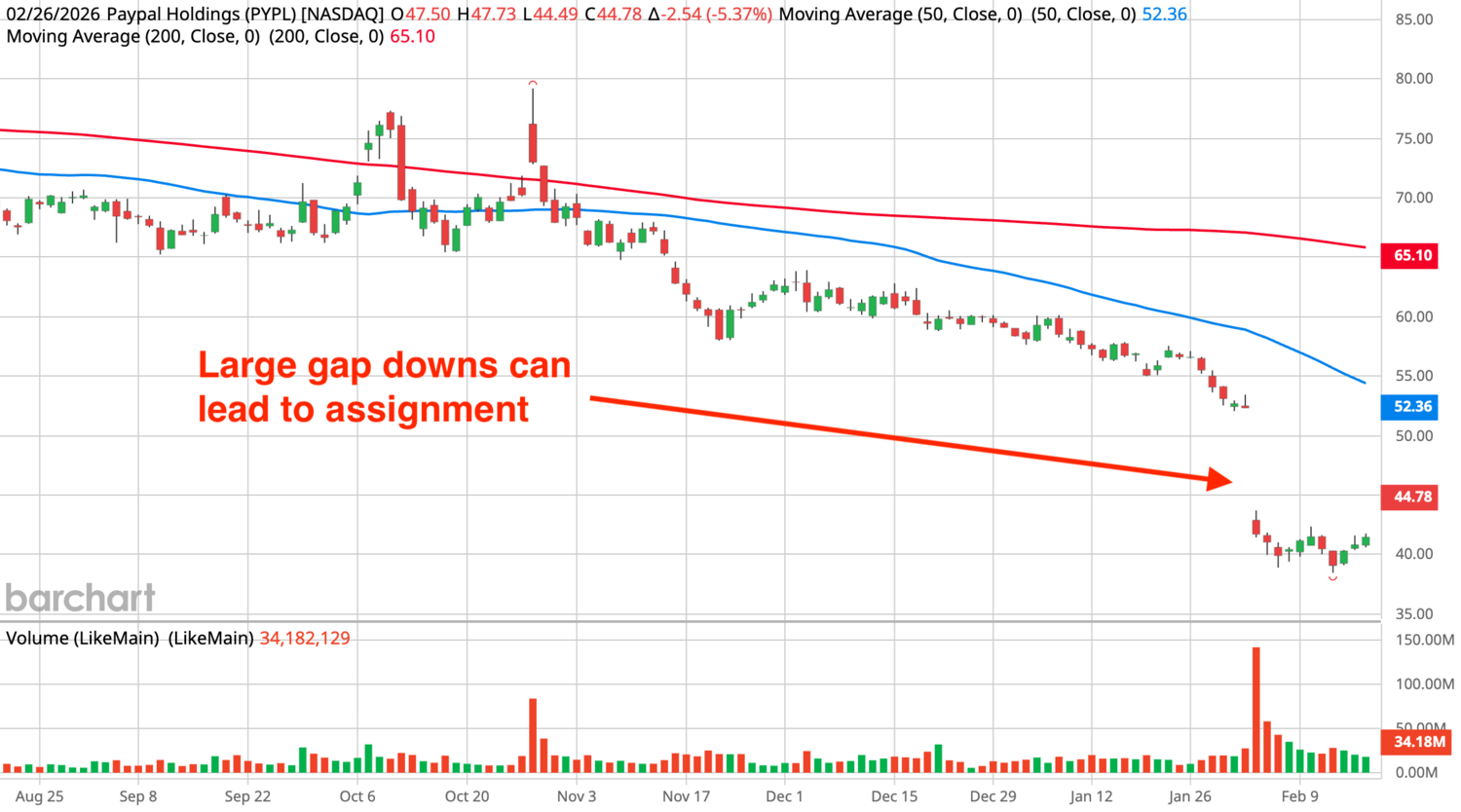
Options don’t protect against discontinuous moves.
Stocks can gap for all kinds of reasons, including:
- Earnings misses
- Lowered corporate guidance
- Regulatory actions
- Fraud or accounting issues
- C-suite drama
- Macro shocks
- Liquidity issues on institutional scale
A single large gap down can:
- Force assignment far above the market price
- Trap capital in a deeply impaired position
- Turn a “high-probability” trade into a multi-month recovery
And here’s the thing: you can’t control any of these events.
But you can control what you wheel.
This is the exact reason I preach only running The Wheel on value stocks rather than heavy growth or meme stocks.
- Growth and meme stocks can collapse and never recover
- Value stocks at least stand a fighting chance due to their strong fundamentals — but your capital could still be impaired for a significant period
Keep in mind the following quote from Warren Buffet:
The stock market is a device for transferring money from the impatient to the patient.
That quote isn’t just wisdom. It’s a survival manual for anyone running The Wheel through a gap event.
If you’re holding a quality value stock that gaps down on a temporary macro shock, patience is your friend:
- The fundamentals haven’t changed
- The market overreacted
- You sell CCs, collect premium, and wait for recovery.
If you’re holding a high-flying meme stock that gaps 40% because the CEO tweeted something unhinged? There may be no recovery to wait for.
How to Mitigate Gap Risk
To avoid gap risk you should:
- Avoid holding positions through earnings unless you’re prepared for assignment
- Stick to quality companies with transparent financials
- Diversify across sectors so one gap doesn’t devastate your portfolio
You can never fully eliminate gap risk. News that shakes markets can happen at any moment.
But you can mitigate the damage by choosing what you wheel wisely.
Why Correlation and Concentration Risk Multiply Your Losses
Many Wheel practitioners unknowingly concentrate risk.
Common pitfalls include:
- Multiple wheels in the same sector
- High beta names that all move together
- “Diversified tickers” that correlate in stress regimes
Different tickers doesn’t mean different risk.
Consider the 2007-2008 housing crisis. Now imagine you were running a Wheel Strategy back then with 5 positions…and 4 of them were in the finance sector.
Not only would you face assignment on all 4, but you’d experience significant drawdown on your account.
Many finance positions eventually bounced back. Some even rose to new highs. But it took years.
Could you psychologically handle that?
Could you sit through months to years of watching those positions bleed while selling CCs for pennies in premium?
Most people can’t. And that’s when behavioral risk and correlation risk compound into risk of ruin.
How to Mitigate Correlation and Concentration Risk
Concentration risk is one of the largest problems associated with a portfolio and is not limited to just The Wheel Strategy.
At any given time, there may only be 2-3 sectors on the market that are performing well.
It’s only natural for positions to cluster around the sectors that are doing well.
Here are some suggestions to avoid concentration risk:
- Limit exposure to any single sector (no more than 2-3 positions per sector)
- Check correlations between positions (“different tickers” doesn’t mean “different risk”)
- Keep some positions in defensive sectors
How Strategy Drift Quietly Destroys Wheel Strategy Returns

The Wheel Strategy is simple…but it’s also easy to abuse.
One common form abuse is strategy drift.
Strategy drift looks like:
- Increasing delta quietly (higher premiums, but also higher assignment and call-away risk)
- Adding earnings exposure “just this once”
- Using margin to juice returns
(Hint: It was never “just this once.” You’re setting yourself up for failure)
This is how Wheels blow up — not with a bang, but with a slow, quiet drift from disciplined to reckless.
One month you’re selling 25 delta on blue chips. Three months later you’re selling 40 delta on earnings plays with margin on garbage meme stocks.
You didn’t make a single dramatic decision. You just drifted.
And here’s what makes drift so insidious: your P&L might actually improve in the short term. Higher delta means more premium. More premium feels like progress.
Until the market corrects and all that accumulated risk collapses on you at once.
How to Mitigate Strategy Drift
To mitigate strategy drift you should:
- Document your strategy rules and review them monthly
- Create a trade journal and review it weekly
- Track your actual delta, position sizes, and earnings exposure over time
- If you’re drifting, stop trading until you recalibrate
Premium juicing is a bad habit, and once you’ve caught the bug, it’s hard to get rid of.
Like your daddy probably told you in high school, “Practice safe Wheeling.”
What Happens When Assignment Locks Up Your Capital

Assignment isn’t a failure, but it changes the game a bit.
Once assigned:
- Capital becomes tied up in stock
- Opportunity cost increases (i.e., you can’t use that capital to harvest premium via new CSPs)
- Recovery can take months or years, depending on how far the stock fell and how slow the broader market recovery is
- Portfolio flexibility drops sharply
Remember, it’s not just about the individual stock. The overall market environment defines how fast you’ll recover.
This is especially painful if:
- Multiple wheels assign simultaneously
- The market enters a prolonged drawdown
A single assignment is manageable. Three or four at once during a correction? That’s how accounts get stuck.
And the psychological weight compounds with the financial weight:
- You’re watching your account bleed
- You’re selling CCs for scraps of premium
- You can’t open new CSP positions because all your capital is tied up in shares
It feels like being trapped. Because, in a very real sense, you are.
How to Mitigate Assignment and Capital Lock-Up Risk
You can’t always prevent assignment. It happens, it’s part of the strategy.
But you can plan for it:
- Keep a cash buffer (~20% of your account) so assignments don’t lock up everything
- Plan for assignment before selling the put (i.e., know your exit strategy)
- Spread expirations across different dates to avoid simultaneous assignments
For more on position sizing and cash allocation, see How Much Capital Do You Need for The Wheel Strategy?.
How Volatility Regimes Affect Your Wheel Strategy Edge
Understanding the relationship between Implied Volatility (IV) and Historical Volatility (HV) is critical for Wheel practitioners.
Here’s the short version:
- IV reflects the market’s expectation of how much a stock is likely to move in the future, as inferred from option prices
- HV measures how much the stock has actually moved in the past
- When IV is meaningfully higher than HV, options tend to be relatively expensive, creating a more favorable environment for option sellers (i.e., us)
The Wheel Strategy is like the Cookie Monster for IV. It feeds on it. The higher the IV relative to HV, the more we can be (safely) fed.
But here’s the risk:
- Let’s say you sell a CSP when IV is low relative to HV
- Then some news event causes IV to spike
- The higher IV drives premiums up
- Which means it now costs more to buy back your CSP and close the position, even if the underlying stock price hasn’t moved.
The result? You took equity risk without being paid adequately for it.
This is the options seller’s version of buying low and selling lower. You entered the position thinking the premium was fair compensation for the risk.
But it wasn’t.
The Wheel thrives when IV is rich relative to HV. When it’s not, you’re picking up nickels in front of something much heavier than a steamroller.
How to Mitigate Volatility Regime Risk
Volatility is part of the stock market. If volatility didn’t exist, none of us would make any money.
However, here is how can protect against too much volatility:
- Check IV vs. HV before entering positions — avoid selling when IV is unusually low
- Be willing to sit in cash when premiums aren’t attractive
- Use IV rank/percentile tools to gauge whether current IV is historically high or low
Why Liquidity and Slippage Risk Matter More Than You Think
Most traders ignore liquidity until it bites them.
Risks include:
- Wide bid/ask spreads
- Poor fills
- Difficulty rolling positions under stress
- Inability to exit without giving back edge
When selling a CSP, you want to fill as close to the ask as possible. As the seller, the ask is the higher price, and you want as much premium as you can get.
When buying back to close, you want a fill as close to the bid as possible. As the buyer, you want to pay as little as possible to close out your position. The bid is the lower price.
Note: If your CSP expires worthless, the exit fill is irrelevant. You keep the full premium without needing to close the position.
With a wide bid/ask spread you have less wiggle room (typically anything over 30% is where Wheelers become cautious).
In an emergency, you don’t just give back your edge. You can go underwater.
Small-cap and meme-adjacent names amplify this risk dramatically. These are the names where bid/ask spreads blow out the moment volatility picks up, precisely when you need to exit the most.
Liquidity is the one risk that only shows its teeth when you’re already in trouble. During calm markets, everything fills fine. During stress, the illiquid names become roach motels — easy to get into, nearly impossible to get out of.
How to Mitigate Liquidity and Slippage Risk
Here are some suggestions on mitigating liquidity and slippage risk:
- Only trade options with tight bid/ask spreads (under 10% is ideal, under 30% is acceptable)
- Stick to liquid names with high options volume
- Avoid small-caps and meme stocks where liquidity evaporates when you need it most
How Opportunity Cost Affects Wheel Strategy Performance

In strong bull markets, CCs cap your upside:
- You’ve sold someone the right to buy your shares at the strike price, so gains above that level belong to them
- Repeated call-aways mean you keep selling stocks that continue climbing, then re-entering at higher prices
- Over time, you can lag significantly behind a simple buy-and-hold approach during strong momentum regimes
Could you just buy and hold instead? Absolutely.
But The Wheel isn’t trying to beat buy-and-hold in every market.
Instead, it’s trying to generate consistent cash flow.
Here’s the thing: this is a feature, not a bug. The Wheel trades explosive upside for steady, and ideally repeatable income through the use of CSPs and CCs.
If that tradeoff doesn’t match your goals, the strategy may not be right for you (your mileage may vary).
In strong bull markets:
- Consider selling calls at higher strikes (lower delta) to capture more of the upside while still collecting some premium
- You’ll earn less premium per contract, but you reduce the chance of getting called away during a rally
- Or, simply let your positions run without selling CCs and apply a trailing stop loss to protect profits
Not every assigned position needs an immediate CC slapped on top of it!
This matters for long-term compounding goals and for benchmarks tied to equity beta and risk-adjusted returns.
For a full discussion of how to benchmark Wheel performance, see What Returns Can The Wheel Strategy Generate?.
How to Mitigate Opportunity Cost
To reduce opportunity cost:
- Accept that The Wheel trades upside for steady cash (this is a design choice of the strategy)
- In bull markets, sell calls at higher strikes (lower delta) to capture more upside
- Benchmark returns honestly and adjust expectations
How Tax Friction Reduces Your Real Wheel Strategy Returns

I covered taxes in relation to strategy returns in my article on Wheel Strategy returns, but the TL;DR is this:
Closing a position that (1) you’ve held for less than a year, and (2) you have profited from is taxed at short-term capital gains (i.e., your ordinary income rate, which could be 22%, 32%, or 37%+ depending on your bracket).
That can be a meaningful haircut to your strategy returns.
Frequent trading increases tax friction further, and rolling positions can create complex tax lots that make your CPA’s eye twitch.
Net returns can be materially lower than what your broker statement shows.
How to Mitigate Tax Risk
The only two certainties in life are death and taxes.
You can’t prevent them, but you can learn how to make them a bit easier:
- Run The Wheel in tax-advantaged accounts (IRA, Roth IRA) when possible
- Keep records of all trades for accurate tax reporting
- Factor taxes into your return calculations — after-tax return is what matters
- Most importantly, speak with your CPA
Wheel Strategy Risks at a Glance
| Risk | What It Means | Severity |
|---|---|---|
| Risk of Ruin | Losing the ability to continue trading | Critical |
| Behavioral Risk | Overconfidence and emotional decisions | Critical |
| Equity Downside | Long stock exposure with limited protection | High |
| Gap Risk | Large gaps overwhelm premium collected | High |
| Correlation Risk | Multiple positions fail together | High |
| Strategy Drift | Gradual deviation from rules | High |
| Assignment Risk | Capital lock-up post-assignment | Medium |
| Volatility Regime | Low IV reduces your edge | Medium |
| Liquidity Risk | Poor fills and difficult exits | Medium |
| Opportunity Cost | Underperformance in bull markets | Low |
| Tax Friction | Short-term income drag on returns | Low |
The traders who blow up aren’t the ones who face risk, they’re the ones who pretend it doesn’t exist.
What Separates Survivors from Blowups
This has been a bit of a long article, but my point is this:
The risks of The Wheel Strategy are real, but they’re not unknowable.
Every single one can be managed with some combination of:
- Position sizing
- Stock selection
- Discipline
- Honest self-assessment
The traders who survive long-term aren’t the ones who avoid risk. They’re the ones who respect it.
- They size positions so a single bad trade doesn’t end the game
- They wheel stocks they’d be comfortable owning for years (if need be)
- They follow their rules even when it’s boring…especially when it’s boring
The irony of The Wheel is that the most successful practitioners look the least impressive on any given day.
No dramatic plays.
No hero trades.
Just a disciplined, repeatable process.
Which is precisely why it works when executed correctly, and precisely why most people fail at it.
Disclaimer
WheelMetrics is an educational resource, not financial advice. WheelMetrics is not a registered investment advisor, broker-dealer, or financial planner. Everything here, including articles, newsletters, stock screening results, options setups, market commentary, is for educational and informational purposes only. Options trading carries substantial risk, and you can lose some or all of your capital. You're solely responsible for your own investment decisions. Consult with a qualified financial advisor before making any trades.