 by
by 
High-flier growth stocks look like perfect Wheel candidates. The premiums are massive, the names are familiar, and the companies are real businesses with real revenue. But the mechanics of the Wheel actively work against you on these stocks.
Recall that The Wheel Strategy caps your upside through covered calls — which is the entire reason high-growth stocks are interesting. And it exposes you to full downside through cash secured puts, which their volatility will eventually deliver.
This is a different problem than meme stocks. Meme stocks fail because there’s no real business underneath. High-growth stocks fail because the Wheel is the wrong vehicle for a stock whose entire value proposition is explosive price movement.
Table Of Contents
What Makes a Stock a “High-Flier Growth Stock”
A high-flier growth stock is a company trading primarily on future growth expectations rather than current earnings. The defining characteristics:
- High revenue growth (often 30%+ year-over-year)
- Minimal or no earnings (the company is reinvesting everything into growth)
- Extreme valuations (50x+ revenue multiples)
- Price driven by narrative and future potential more than current cash flows
These stocks are fundamentally different from meme stocks. Meme stocks fail the Wheel test because the business underneath is weak or nonexistent. High-growth stocks often have a real business, real revenue growth, and a plausible long-term thesis — while the underlying business is legitimate, the real problem is that the valuation leaves no margin of safety.
The spectrum runs from pre-earnings companies burning cash to grow (pure story) to profitable companies with sky-high growth multiples (expensive but real). Some develop meme characteristics like a retail cult following, but the core issue for the Wheel is always the valuation and volatility profile, not social media hype.
Many of these companies can be great long-term investments if you buy the stock outright and hold it. The argument isn’t against the business. It’s against using the Wheel as the vehicle to own it.
The Wheel Caps Your Upside (and That’s Exactly the Problem)

The Wheel Strategy works by selling puts to enter positions and selling calls to exit them. By design, both sides limit what you make while leaving your losses uncapped.
The covered call side is where this hits hardest on high-growth stocks. If the stock gaps up 20% on earnings or a product announcement, your shares get called away at the strike price. You capture the strike plus the premium you collected — and miss the bulk of the appreciation. The larger the move, the more you leave on the table.
A concrete example: say you own 100 shares of a high-growth stock at $100 and sell a covered call at the $105 strike, collecting $3 in premium. The stock reports blowout earnings and gaps to $130.
- You make: $5 appreciation + $3 premium = $8 per share
- The stock moved: $30 per share
- You missed: $22 per share ($2,200 on the position)
Over time, it adds up to gains foregone so massive they dwarf every premium you’ve ever collected.
High-growth stocks are interesting precisely because of their potential for outsized moves. The Wheel is designed to capture modest, consistent premium. On a quality value stock with moderate volatility, the upside cap is an acceptable trade-off — the stock isn’t going to gap 30% overnight, so the premium is fair compensation for what you might miss. On a high-growth stock, you’re selling away the one thing that makes it worth owning.
Volatility Works Against You on Both Sides

The upside cap is only half the problem.
High-growth stocks don’t dip. They crash.
On the CSP side, when a quality stock dips below your strike it might trade 5-10% below your cost basis — uncomfortable, but manageable. You sell covered calls, grind down your cost basis, and wait for recovery. When a high-growth stock drops through your strike, it can blow through by 20-30% on a single earnings miss, sudden adverse news, or macroeconomic shock.
The asymmetry is what makes this so damaging. You’re exposed to full downside (minus the premium collected) with your upside capped at the strike. For stable, fundamentally anchored stocks, that’s a workable trade-off. With high-fliers, you take the full hit on the way down and miss the full move on the way up.
The Wheel works because, on quality stocks, the distribution of outcomes is relatively tight around a fundamentally supported price. High-growth stocks have fat tails in both directions — the range of possible outcomes over 30-45 days is wide enough that the premium you collect doesn’t adequately compensate for the risk on either side.
- If you’ve been assigned on a cash secured put and need to understand what happens next, see what happens when your cash secured put gets assigned
- For a framework on selling covered calls once you’re holding shares, see how to sell covered calls after assignment
Fat Premium Doesn’t Mean Free Money
High implied volatility on high-growth stocks means fatter premiums — and that’s exactly what draws Wheel traders in.
A 30-DTE put on a high-growth stock might pay $5.00 where a similar setup on a quality value stock pays $1.50. That 3x premium looks like easy money. But the market is pricing it for a reason.
The math most traders skip is that the quality stock paying $1.50 has a realistic downside of 5-8% below your strike. The high-growth stock paying $5.00 has a realistic downside of 20-40%. The premium is 3x larger. But the risk is 4-5x larger. That’s not a good trade.
This is the same principle I covered in why you should avoid meme stocks for the Wheel Strategy — the market isn’t offering fat premium out of generosity.
With speculative growth stocks, however, the trap is much harder to spot. Meme stocks pay fat premium because the business underneath is questionable. High-growth stocks pay fat premium because the business is real but the valuation is extreme and the price action is volatile.
Because the business is real, the premium feels earned rather than a warning sign. You can look at the revenue growth, the market opportunity, the product roadmap, and convince yourself the risk is justified. But the options market already priced all of that in. The fat premium isn’t a reward for your conviction. It’s compensation for a level of risk that may eventually materialize.
The Tesla Case Study
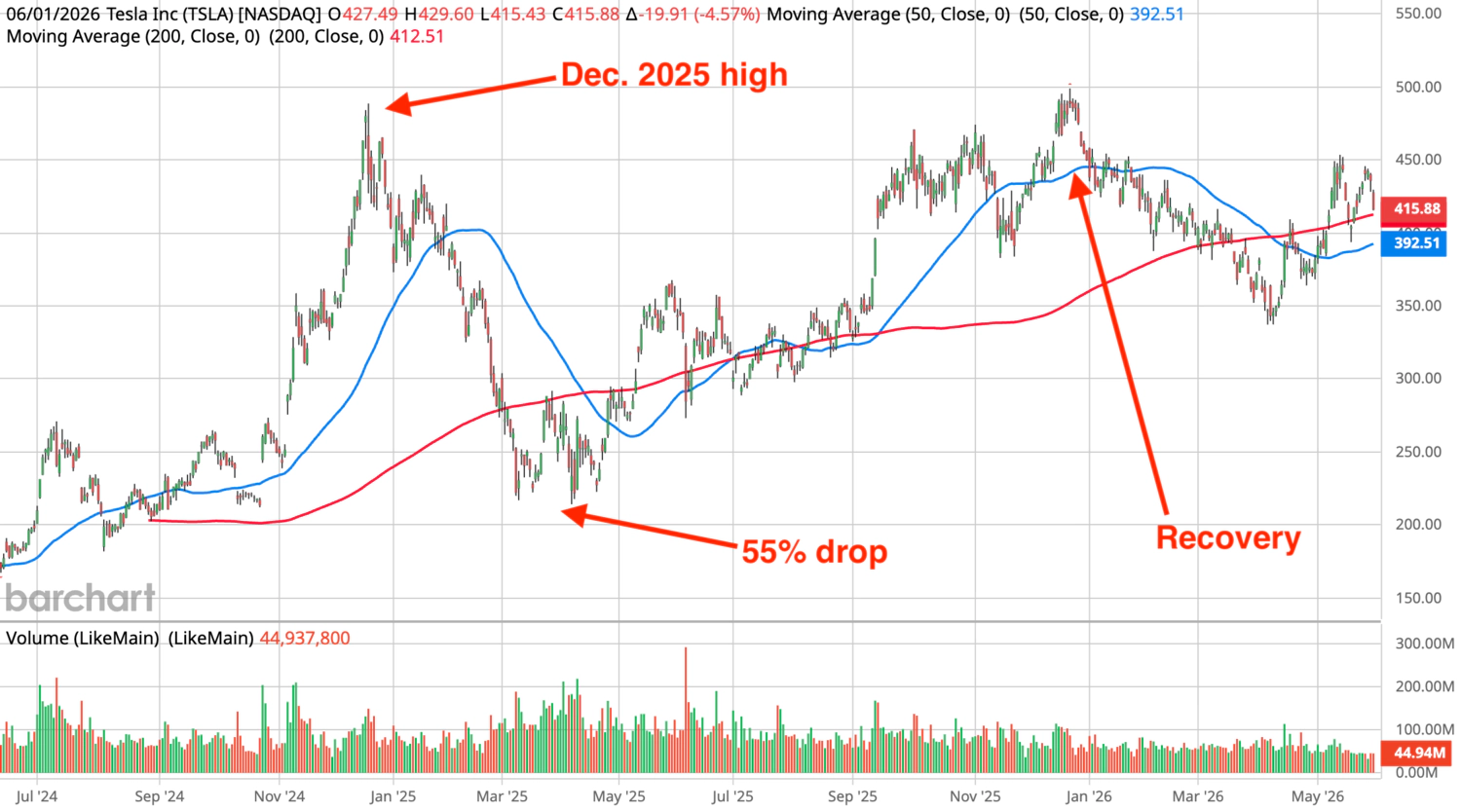
Tesla (TSLA) is the textbook case because it illustrates every failure mode at once.
Tesla is a real business (obviously). Q1 2026 revenue of $22.4 billion, up 16% year-over-year. Gross margins of 21.1%. A real product that people actually buy and drive.
While the underlying business is fundamentally sound, the extreme valuation is where the risk lies.
As of May 2026:
- Trailing P/E: ~389x
- Forward P/E: ~200-215x (versus a 5-year average of ~102x)
- Price-to-sales: 13.3x (versus a consumer auto industry average of ~3.6x)
- Fair value estimates: $150-$320 depending on the model
- 73% of revenue is still automotive, but the $1.6 trillion market cap is built on autonomy, robotics, and FSD that haven’t scaled yet
FinanceCharts flagged Tesla as the largest potentially overvalued company by market cap in their May 2026 screener.
CSP Side: The Downside Blowthrough
In December 2024, Tesla peaked near $480 after the post-election Musk/Trump rally. A Wheel trader selling CSPs at $420-$450 strikes near that peak looked smart — premiums were massive.
By March 11, 2025, Tesla hit an intraday low of $217.02. A 55% crash from the December peak.
Q1 2025 profits plunged 71%, deliveries fell 13% (the biggest quarterly decline ever), and Musk’s DOGE involvement sparked protests and boycotts across multiple countries.
Let’s work through the math on an assignment during this time period:
- Assigned at $450 strike
- Collected $15 in premium
- Cost basis: $435
- Stock at $217
- Loss: $218 per share ($21,800 on 100 shares)
The $1,500 premium collected offers virtually no protection against a $21,800 drawdown.
CC Side: The Upside Cap
After bottoming near $217 in March 2025, Tesla rallied back to an all-time high of ~$490-$499 by December 2025 on robotaxi testing news.
A Wheel trader holding shares at $250 and selling covered calls at the $280 strike would have had shares called away early in the rally — capturing roughly $30 in appreciation plus premium while the stock ran another $200+ without them.
That’s the structural mismatch in action.
The Elon Factor
Musk is the most public CEO in the world. His political involvement, tweets, and media presence create narrative-driven volatility that has nothing to do with Tesla’s auto business — exactly the kind of unpredictable, non-fundamental price action the Wheel can’t handle.
Note: “Overvalued” is a model-dependent judgment, not a fact. Valuation alone is a poor short-term timing signal. The point isn’t that Tesla will fall. The point is that its risk profile is structurally mismatched with what the Wheel is designed to do. The violent two-way swings, narrative-driven pricing, and extreme valuation all work against the Wheel’s core mechanics.
When Growth Stocks Can Work for the Wheel

Not all growth is disqualifying.
A company growing revenue and earnings at 15-25% annually, with real profitability and a reasonable valuation, can be an excellent Wheel candidate. The line sits at the four pillars: valuation, profitability, growth, and upward revisions.
If the stock passes all four and the 6-12+ month ownership test, its steady growth acts as a strong tailwind. The disqualifier is when growth comes at the expense of everything else: no earnings, extreme valuation, story-driven price, binary risk events that can move the stock 30% in either direction on a single headline.
Attempting to run the Wheel on a stock with that profile is not a sound investment strategy — it’s more of a speculative bet.
If you want a deeper look at exactly where the line sits between growth stocks that work for the Wheel and growth stocks that don’t, take a look at this article on value versus growth stocks for the Wheel Strategy.
The Right Tool for the Right Stock
High-growth stocks can be great investments. But the Wheel is the wrong strategy to participate in them.
The strategy’s structural upside cap and full downside exposure create a lose-lose dynamic on stocks whose entire appeal is explosive price movement. For a small premium, you sell away the upside that makes these stocks worth owning in the first place, while retaining the full downside risk.
If you want to own a high-growth stock, buy the stock. Don’t try to Wheel it.
The Wheel works on stocks with tight price distributions, solid fundamentals, and prices anchored to real earnings — the kind of stocks that pass the 6-12+ month ownership test and make you comfortable holding through whatever the market throws at you.
To learn why meme stocks are equally dangerous but for different reasons, see why you should avoid meme stocks for the Wheel Strategy.