 by
by 
You wake up Monday morning.
Your CSP got assigned. 100 shares are now sitting in your account where a cash balance used to be.
Now what?
First, don’t panic.
Keep in mind that assignment is not a mistake and it is not a failure. It is The Wheel Strategy transitioning from Phase 1 (the CSP leg) to Phase 2 (the CC leg).
Next, review the post-assignment playbook:
- Recalculate your true cost basis
- Wait 24-48 hours to assess
- Sell a CC at-or-above your cost basis
- Be patient, let theta decay work in your favor
If you haven’t read What Happens When Your Cash Secured Put Gets Assigned? yet, start there. This article picks up right after assignment happens.
Table Of Contents
What “Selling Covered Calls After Assignment” Actually Means
Selling a covered call is Step 3 of the Wheel Strategy.
For reference, here is where you are on the map:
- Sell a CSP
- Assignment (shares delivered to your account)
- Sell a CC (you are here)
- Called away (shares sold at your strike)
- Back to selling CSPs
If you’re new to the strategy, What is The Wheel Strategy? walks through the full cycle in detail.
A quick recap on CCs:
- A covered call sells someone the right to buy your 100 shares at a specific strike by a specific date, in exchange for premium to compensate you for the risk you’re taking on (i.e., your shares being called away)
- If the stock stays below the strike at expiration, the call expires worthless (you keep the premium and the shares)
- If the stock closes above the strike, the shares get called away at the strike price (you keep the premium plus any gain up to the strike)
The CC leg is cost basis grinding in action. Every premium you collect grinds your effective cost basis down a little further.
You’re no longer collecting premium on collateral cash. You’re collecting premium on shares that can also appreciate (or depreciate) in value.
You’re an owner now, not just a seller of puts.
Note: For a full primer on covered calls, see What are Covered Calls (CCs)?.
The First 24-48 Hours After Assignment (What to Do and What Not to Do)

The first 48 hours after assignment is where new Wheelers do the most damage, typically due to letting their emotions run the show.
What NOT to Do
Three rules for the first 48 hours:
- Do NOT panic-sell the shares. New Wheel traders see “assigned” in their broker and dump the shares at a loss. (Yes, I’ve seen this happen. Yes, I may have felt the urge myself once or twice.)
- Do NOT immediately sell a CC on assignment day. Let the dust settle. The chain isn’t going anywhere.
- Do NOT sell a CC below cost basis just to “collect premium fast.” This is how you lock in a guaranteed loss if called away.
What to Do
Once the urge to “do something” has passed, here’s your checklist:
- Confirm the assignment in your broker (share count, strike, cash debit)
- Write down your true cost basis on paper (strike price minus all premiums collected)
- Check the chart: where’s the stock relative to your strike? Any news driving the move?
- Check IV: is it elevated (good for CC selling) or collapsed (wait)?
- Scan upcoming catalysts in the next 30-45 days (earnings, ex-div, Fed, CPI)
- Do nothing (literally nothing, let the emotions settle)
That last one is the hardest. It’s also the most important.
You are under no obligation to immediately sell a CC.
Check in with yourself.
If you’re emotional, give it a few days… even a week. Let it settle.
If you’re calm and collected (as you will be, after you’ve done this a few times), you may be ready to start scanning for CCs.
The emotion is real. We all feel it, especially when we’re getting started.
But don’t let it run the show.
Your job in the first 48 hours is to observe, calculate, and wait. Not react.
How to Calculate Your True Cost Basis After Assignment
Your broker will show you a number after assignment, but that number likely does not factor in your true cost basis.
The formula to calculate your true cost basis is simple:
True Cost Basis = Strike - Premium Collected
As a quick example, assume we sold a $30 strike and collected $1.50 in premium:
- Strike: $30
- Premium collected: $1.50
- True cost basis: $28.50
Your brokerage will likely tell you that your cost basis on those shares is $30; however, your true cost basis is actually $28.50.
I call this cost basis grinding. Every premium you collect (on the CSP leg, and now on the CC leg) grinds your effective cost basis down a little further. The number you own the shares at gets smaller with every contract you sell.
That’s the compounding engine of The Wheel.
Every premium makes the position a little more profitable, a little more forgiving, and a little harder to lose money on.
Note: Most brokers charge $0 commission on equity and roughly $0.65 per contract on options. For most Wheel traders this is a rounding error. I include it for accuracy, but don’t let it muddy the primary formula.
Dividends also reduce your effective cost basis, but I’m saving that for a dedicated article
How to Pick Your First Covered Call Strike After Assignment

Before you touch delta tables or DTE ranges, answer one question first.
What is your long-term conviction on this stock?
This is the single most important filter for your first CC.
- If you’re long-term bullish and the stock is in the top 10% of your conviction, you likely want to keep the shares (since the longer you keep the shares, ideally, the more they appreciate in value). That means lower delta, shorter DTE.
- If it’s not in your top 10%, run standard Wheel mechanics, with higher delta, longer DTE.
The Wheel Strategy is built for both assignment and being called away. Neither one is failure.
Think about the overall cycle of The Wheel Strategy:
- Start with a CSP, run a few rounds
- Eventually get assigned shares
- Start selling CCs
- Eventually shares get called away
- Still bullish on the stock and valid setups? Back to CSPs
The Wheel keeps turning.
Delta Rules for Covered Calls
Your delta target depends on your goal:
| Goal | Delta Range | What It Means |
|---|---|---|
| Keep Shares | 0.00-0.15 | Very low risk of being called away. Lower premium, but you hold on to the stock you’re bullish on. |
| Sell Shares | 0.15-0.30 | Balanced premium income vs. risk of being called away. Near-identical delta to standard CSP selling. Targets your exit price while collecting premium along the way. |
| Max Income | > 0.30 | Maximize premium collection. High likelihood of being called away (you’re actively trying to exit). |
Note: Whatever delta you land on, I recommend keeping the strike above your true cost basis so every called-away outcome is a profit. I break down choosing a strike above your cost basis in its own article.
For a full guide on screening and filtering the options chain for covered call strikes, see How to Filter and Screen Covered Calls for The Wheel Strategy.
DTE Rules for Covered Calls
DTE mirrors the delta logic:
- Long-term bullish / Keep Shares: 7-14 DTE — short enough that you can watch price action and adjust your strike if the stock runs
- Standard Wheel mechanics (not top-10% conviction): 30-52 DTE — maximizes premium capture
What If the Stock Is Way Below Your Cost Basis?
Wheel stocks are chosen on fundamentals, not price action alone.
If your thesis is still valid after a big drop, stay in the stock. Sell CCs, grind the cost basis, be patient.
If the thesis is broken, exit. Emotionless and surgical. Accept that the market went against you, it happens.
Don’t make it a big deal. There will be other trades.
The longer you stay in a losing trade with a broken thesis, the more your account suffers and the more you suffer psychologically.
Take the loss. Move on. Don’t dwell on what you can’t control.
For a deeper look at selling CCs below your cost basis (and when it actually makes sense), see Selling Covered Calls Below Your Cost Basis.
A Real Example On Selling CCs
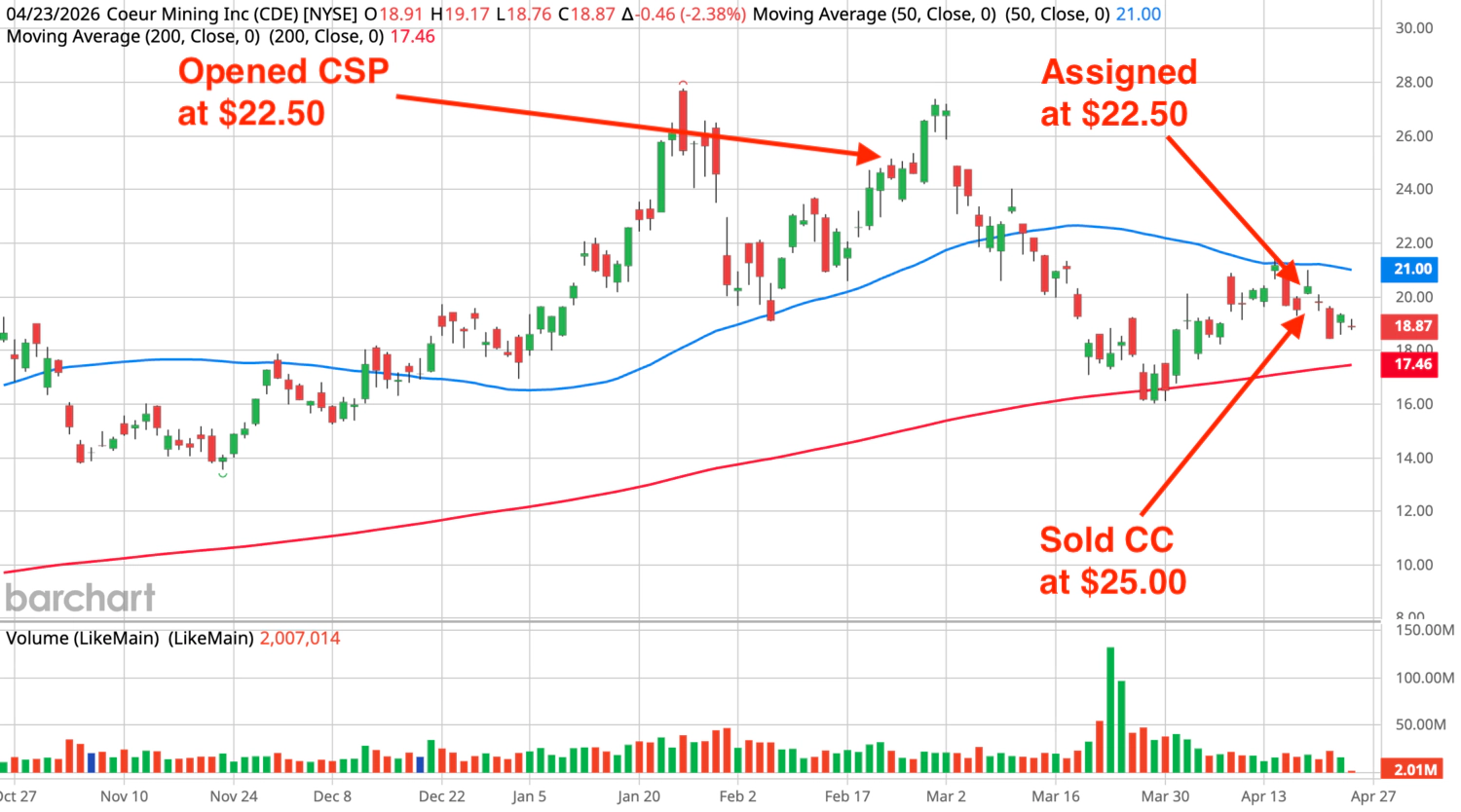
Here’s a trade I’m in right now. The numbers are real and the trade is still open (at the time of this writing), so I’ll stop the story at “first CC sold.”
The CSP Entry
- Entry: 2/26/26
- Ticker:
CDE - Strike: $22.50
- Expiry: 4/17/26
- Premium collected: $1.32 ($132 total)
The Assignment
CDE closed at $20.31 on expiration day (4/17/26).
- Assigned 100 shares at the $22.50 strike
- True cost basis after CSP premium: $22.50 - $1.32 = $21.18
The Conviction Check
After I was assigned, I ran my all-important conviction check:
- Q: What’s my long-term conviction on this stock?
- Verdict: top-10% conviction. Keep Shares play.
That means low delta, short DTE.
Here’s the thesis behind that verdict.
Gold is an excellent hedge against volatility and inflation. I’m expecting significantly more of both over the next 1-2 years.
CDE is a top gold miner and currently undervalued.
The Iran War has caused a temporary drawdown in gold, silver, and the precious-metal miners.
Why? Miners use a lot of oil, and the energy crisis has created a temporary dislocation in the sector.
My view is that once the Iran War subsides, gold will start climbing again to hedge the inevitable inflation ahead. This is exactly the kind of setup where I want to own the shares, not rush to get called away.
The First Covered Call
Three trading days after assignment I sold my first CC.
No panic, no rush. I let the dust settle, re-checked the thesis, then scanned the chain.
Here’s what I sold:
- Entry: 4/20/2026
- Strike: $25
- Expiry: 5/8/26 (18 DTE at entry)
- Premium collected: $0.20 ($20 total)
- Delta at entry: ~0.12 (comfortably in the 0.00-0.15 Keep Shares range)
Why did I go with the 18 DTE instead of my normal 7-14 DTE default?
Predominately chain availability.
The 7-14 DTE range didn’t offer the delta and ROC I wanted, so I took the next available expiry (5/8/26, 18 DTE) to stay in the right delta range.
A minor, intentional deviation from the default rule.
The rules are a framework, not a straitjacket.
The delta mattered more than hitting a perfect DTE window, so I adjusted.
That’s how it works in practice (and it’s exactly the kind of thing no textbook will tell you; trading is part art, part science).
Why the Strike Price?
I didn’t pick the $25 strike because it sounded like a round number, I picked it because it passed three filters in a specific sequence:
- Delta filter first: Scanned the chain, $25 sat at ~0.12 delta, which fit cleanly inside the “Keep Shares” range.
- Chart check: $25 looked clean given the current price action.
- Thesis check: if called away at $25, I’d be thrilled with the outcome.
All three aligned. I sold the call.
The P&L Math (Cost Basis Grinding in Action)
Here’s where cost basis grinding doing its magic:
- Effective cost basis if called away: $22.50 - ($1.32 + $0.20) = $20.98
- Profit if called away at $25: ($25 - $20.98) x 100 = $402
Cost basis keeps grinding with every premium collected, not just on the CSP leg, but on the CC leg too.
Common Mistakes When Starting the CC Leg

Here are the five mistakes I see most often in the first few weeks of the CC leg.
1. Not Re-Evaluating Conviction Level at Assignment
Ask yourself:
- Has anything changed since you sold the CSP?
- Would you own this stock at this price today?
- Is the broader market still bullish?
If the broad market is starting to turn against you or the stock has its thesis invalidated, you have a decision to make.
Don’t autopilot into the CC leg just because “the process says sell a CC.”
The process also says think first.
2. Rushing Into Selling CCs
It’s okay to take a few days. Even a couple of weeks. See how the market shakes out.
You are under no obligation to immediately start selling CCs.
The Wheel rewards patience, not speed.
Over the weeks following assignment, resist the low-grade urgency that tempts you to sell a mediocre CC on Day 4 or Day 9 just because you feel like you should be doing something.
You shouldn’t. Not until the setup is right.
3. Failing to Know Your True Cost Basis
Remember that your true cost basis is the strike minus the sum of all premiums received, including both the CSP and CC phases.
This is cost basis grinding, and if you’re not tracking it, you’re flying blind. (you won’t know whether a given CC strike locks in a profit or a loss.)
Write it down and update it after every filled premium.
4. Not Exiting a Position With a Broken Thesis
Don’t hold the bag on a stock that’s plummeting with no fundamental floor underneath it.
Live to fight another day, you can’t win them all.
Cut your losses and move on.
Remember, it’s hard to get rich if you keep going broke.
5. Not Letting the Stock Run During a Super Strong Bull Run
If both the broad market and the stock are super hot, consider pausing CC sales and letting the stock run.
You don’t have to sell a CC every single expiration cycle.
If you’re worried about protecting profits, run a trailing stop under the 21EMA (or use a flat percentage, 5-10% below current price).
Capping your upside during a ripping bull run is one of the most expensive mistakes a Wheeler can make.
The Wheel Keeps Turning
Assignment is not a mistake, it’s not a failure, it’s The Wheel transitioning from Phase 1 (CSPs) to Phase 2 (CCs).
You now own shares of a company you wanted to own, at a price you selected, with premium already collected. That’s not a loss. That’s the strategy working.
Your playbook for the next few days:
- Recalculate your true cost basis
- Wait 24-48 hours to assess
- Sell a CC at-or-above your cost basis
- Be patient and let theta decay work in your favor
Every premium you collect grinds the cost basis a little lower. Every contract you sell makes the position a little more forgiving.
The Wheel keeps turning.
- Next up, what happens when your covered call gets exercised and your shares get called away.
- For the full map of the covered call leg, see Covered Calls for The Wheel Strategy.