 by
by 
Screening covered calls is not the same as screening cash secured puts.
When you screen CSPs, you’re looking for new positions, that if assigned, you wouldn’t mind holding and owning in your portfolio.
When you screen CCs, you already own the shares. The stock selection is done.
The screener’s job shifts from “What do I want to buy?” to “At what price am I willing to sell, and how much premium do I collect while I wait?”
If you’ve read my guide on how to screen and filter CSPs, many of the criteria carry over, including annual yield, ROC, delta.
But the application of these criteria change, and one filter, the minimum strike price, has no CSP equivalent at all.
That one filter is the difference between locking in a real profit and walking away flat after weeks of grinding.
Note: This article details my process on how to screen for covered calls. To see how covered call screening fits into the larger picture of The Wheel Strategy, see my complete covered call playbook.
Table Of Contents
Why Screening Covered Calls Is Different From Screening CSPs
When you screen CSPs, the workflow has two stages:
- Screen for stocks first
- Then screen for options on those stocks
I walk through that workflow, from stock universe to pre-screened watchlist to filtered options candidates, is covered in the CSP screening guide.
When you screen CCs, you enter mid-funnel. The stock selection already happened — you own the shares.
The screener’s job changes from “What should I trade?” to “What strike and expiration match my goal on shares I already hold?”
There are two specific differences separate CC screening from CSP screening:
- The minimum strike price filter: This controls whether being called away results in a profit, break-even, or loss. CSPs have no equivalent because you’re entering a new position, not managing an existing one.
- The earnings filter is relaxed: When selling CSPs, I filter out options that expire after the next earnings date. For CCs, that filter goes away. You carry the downside risk whether or not a CC is open, so filtering around earnings adds little downside protection (only caps upside).
Everything else, annual yield, ROC, delta, carries over from the CSP screener with minor adjustments to the threshold values.
If you haven’t read the CSP screening guide yet, start there. This article assumes you’re familiar with those base concepts and focuses on what changes for covered calls.
The Conviction Check Comes Before the Screener
Before opening your options screen, answer one question:
What is your conviction level on this stock?
If you’ve read How to Sell Covered Calls After Assignment, you already know my suggested three conviction bands.
Here’s a quick recap, because they determine which screener configuration you’ll use:
- Keep Shares (top 10% conviction): Delta 0.00-0.15, DTE 7-14
- Balanced: Delta 0.15-0.30, DTE 30-52
- Max Income / Exit: Delta > 0.30, DTE 30-52
The conviction check is the filter before the filter.
It narrows which screener configuration to run before you look at a single candidate.
This is the opposite of CSP screening, where you run the screener and then check conviction on the results. For CCs, conviction sets the screener parameters.
That’s a subtle but important inversion. Don’t skip it.
What Each CC Filter Does (and How It Differs From CSPs)

Once you’ve established your conviction level, these are the filters you apply to the options chain.
Note: I not going to re-derive the formulas here, those are covered in the individual guides linked below. Instead, I’ll focus on what changes for CCs vs. CSPs and why.
Days to Earnings
For CSPs, my default is to avoid holding through earnings. The option should expire before the next earnings date.
For CCs, the filter is relaxed.
Why? You already own the shares.
The downside risk from a bad earnings report exists whether or not you have a CC open. A CC doesn’t add downside risk, it only caps upside.
The one scenario to be aware of:
A blowout earnings report could send the stock ripping past your strike, and your shares get called away well below the peak. That’s the “regret trade” — yes, you made money, but you left a lot more on the table.
But trying to time earnings by not selling CCs before them is a form of market timing. And market timing is hard.
I’d rather collect premium consistently than try to guess which earnings reports will surprise to the upside.
Annual Yield
Just like CSPs, I target an annual yield of at least 20% for CCs.
Below that, the risk-reward doesn’t justify tying up your shares vs. passive alternatives.
I covered the full annual yield formula and how to use it in How to Calculate Annual Yield on Wheel Strategy Options.
Return on Capital (ROC)
For CCs, the ROC floor drops to 1%, compared to 1.5% for short-dated CSPs.
Why lower?
CC premiums on above-cost-basis strikes can be thinner, especially low-delta, far-OTM strikes on high-conviction names where you’re deliberately selling far from the money to avoid being called away.
ROC still matters. It prevents you from selling a CC that technically passes the yield filter but generates almost nothing in absolute dollars.
A CC with a 25% annual yield but a 0.3% ROC per cycle isn’t worth the effort or the risk.
For the full ROC derivation, see How to Calculate Return on Capital (ROC) for Wheel Strategy Options.
Delta
The delta you choose should be based on your convinction in the underlying stock:
- If you want to keep the shares, target the low end (0.00-0.15)
- If you’re running standard Wheel mechanics, target the middle (0.15-0.30)
- If you’re ready to exit, go above 0.30
Delta on a short call approximates the probability of being called away, just as delta on a short put approximates the probability of assignment.
A 0.15 delta CC means roughly a 15% chance your shares get called away. A 0.30 delta CC means roughly 30%.
That probability framing is the simplest way to connect your conviction level to the screener output: how likely are you willing to let these shares go?
For more on how delta works, see Understanding Delta: The Most Important Greek for The Wheel Strategy.
Minimum Strike Price
This is the filter that has no equivalent in CSP screening, and in my opinion, it is the single most important CC-specific filter.
The minimum strike price is the floor below which you refuse to sell a call. It directly controls whether being called away results in a profit, break-even, or loss.
- Setting it to your cost basis: If called away, you break even. No profit, no loss. Your capital is returned, but you earned nothing for the time it was locked up.
- Setting it to your original CSP strike (or higher): If called away, you lock in a profit that includes all collected premiums.
Where you set this floor determines everything about the trades your screener surfaces.
I’ll walk through the exact math with a real position in the next two sections, as this is the conceptual centerpiece of CC screening and it’s worth getting right.
The CC Screener Profile
Unlike CSPs (where I run two profiles — standard and short-dated), the CC screener uses a single base profile:
| Criterion | Value | Rationale |
|---|---|---|
| Days to Earnings | Irrelevant | You already own the shares; earnings downside exists regardless |
| Annual Yield | > 20% | Same floor as CSPs |
| ROC | > 1% | Ensures meaningful absolute return per cycle |
| Delta | < 0.30 | Ceiling for “Keep Shares” and “Balanced” conviction levels |
Note: The Max Income / Exit tier overrides the delta ceiling to > 0.30, actively seeking to be called away.
Your conviction level adjusts the working parameters within this single profile:
| Conviction Level | Delta Target | DTE Target |
|---|---|---|
| Keep Shares | 0.00-0.15 | 7-14 |
| Balanced | 0.15-0.30 | 30-52 |
| Max Income / Exit | > 0.30 | 30-52 |
The base filters (earnings, yield, ROC) catch the obvious disqualifiers. Your conviction level then narrows the delta and DTE ranges to match your goal on that specific stock.
Setting the Minimum Strike Price
Understanding your minimum strike price has a massive impact on your potential profits.
I’ll use a real position I’m in right now with CDE (Coeur Mining):
- Assigned on my CSP on 4/2/26 at the $20.50 strike
- Cost basis: $18.65 (after premium collection from the CSP and prior CC rounds)
- CDE currently trading at $17.44
Recall that the cost basis is the zero line, not the target.
This is where most Wheel traders get confused.
Novice Wheel traders see their $18.65 cost basis and think, “If I sell a CC right at $18.65, I keep all the premium I collect.”
No. That’s wrong.
(For what it’s worth, this confused me too when I first started trading The Wheel.)
The premiums collected on prior CSP and CC rounds are what reduced the cost basis to $18.65 in the first place. They’re already baked into the true cost basis.
Let’s look at the math to make this more concrete:
- Original CSP strike: $20.50
- Total premium collected (CSP + prior CC rounds): $1.85/share
- True cost basis: $20.50 - $1.85 = $18.65
Being called away at $18.65 means every dollar of that $1.85 in premium went toward getting you back to zero — not toward profit.
You locked up capital for weeks, collected premium across multiple cycles, and walked away with nothing to show for it.
That’s not a win. That’s an opportunity cost.
To keep all accumulated premium as actual profit, you need to sell above your initial CSP strike ($20.50).
Here’s how the three minimum strike levels break down for this CDE position:
- $18.65 (cost basis): The zero line. Called away here means break-even (net profit $0.00). All premiums collected along the way went toward offsetting the gap between the $20.50 assignment price and the $18.65 cost basis. Going below this means locking in a loss.
- $18.66 – $20.49 (above cost basis, below initial strike): Profit begins here. Any strike above cost basis produces a positive return. But you’re only keeping part of the premiums you’ve collected. Some still went toward offsetting the original purchase price.
- $20.50+ (at or above initial CSP strike): This is where you keep all accumulated premiums as pure profit, plus any capital gains on the stock itself. Called away at $20.50 means every dollar of CSP and CC premium you ever collected on this position is yours. Called away above $20.50 means premiums plus stock appreciation.
I’ve covered when and why to sell above cost basis separately. And for the rare scenarios where selling below cost basis actually does make sense (and the many where it doesn’t), see Selling Covered Calls Below Your Cost Basis.
The minimum strike is a risk calculus tool. It prevents the screener from surfacing strikes that would lock in a loss or a paltry break-even.
For high-conviction names where I’m long-term bullish, my practical default is to set the minimum strike at or above the original CSP strike. I’d rather see fewer candidates than get tempted by fat premiums on strikes that cap my upside too early.
The Minimum Strike in Action
We’ll make this concept more concrete by looking at the output of ThetaScanner for my CDE position.
Here’s the CDE setup again:
- Assigned on my CSP on 4/2/26 at the $20.50 strike
- Cost basis: $18.65
- CDE currently trading at $17.44
Minimum Strike of $18.65 (Cost Basis)
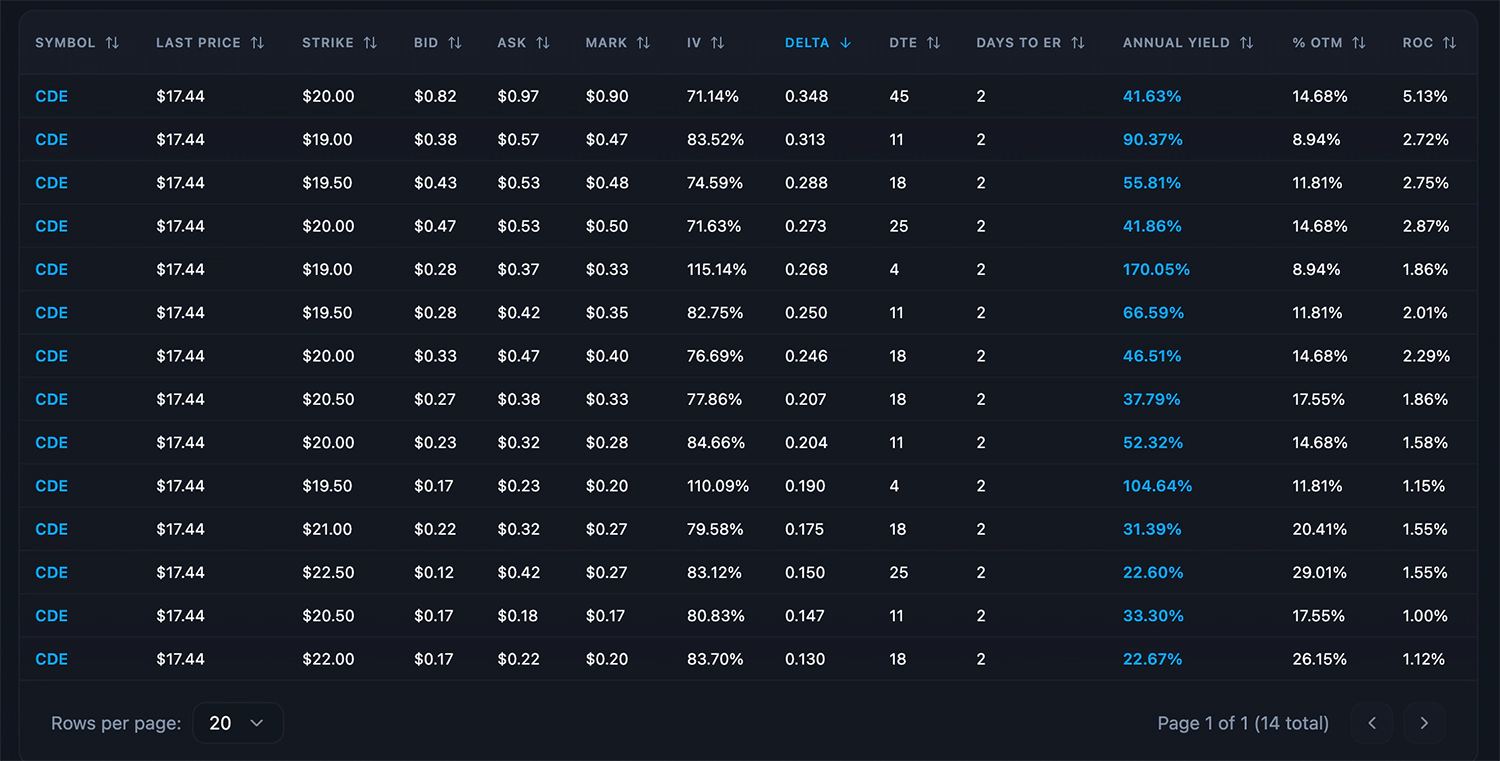
Here I set my minimum strike price to be $18.65 (my cost basis), resulting in 14 candidate setups.
The here range is wide:
- Strikes from $19 to $22.50
- Deltas from 0.13 to 0.35
- Annual yields from 22.6% to 170%
- ROC from 1.0% to 5.13%
- DTEs spanning 4 to 45 days
Lots of choices. The higher-delta, closer strikes look tempting.
Take the $19 strike at 4 DTE: 170% annual yield and 1.86% ROC. On paper, that’s outstanding.
But being called away at $19 when your cost basis is $18.65 means you net $0.35/share. That’s $35 total on 100 shares.
All that premium collection across multiple CSP and CC cycles — weeks of capital deployed, multiple contracts managed — and you walk away with $35 in profit on the stock itself.
The 170% annual yield looks incredible because the annualization factor on a 4-day trade inflates the number massively. The absolute return tells the real story.
Recall that CDE is trading at $17.44. The closer strikes ($19, $19.50) are less OTM, which is why their delta, annual yield, and ROC are all elevated, but the opportunity cost is enormous if you’re bullish on the stock.
Minimum Strike of $20.50 (Original CSP Strike)
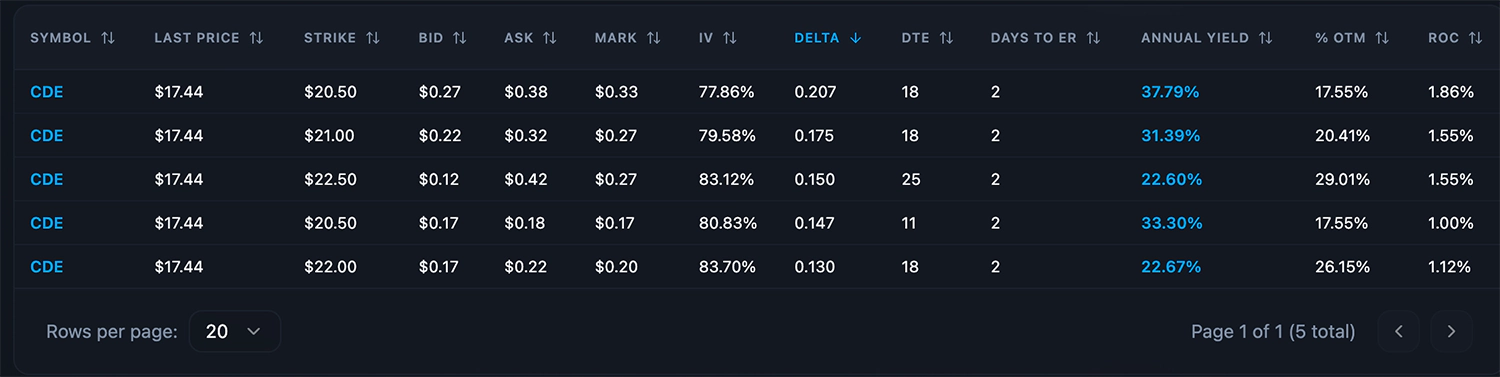
This time I adjusted my minimum strike price to be $20.50, resulting in only 5 candidates.
Effectively, the screener just eliminated 9 candidates with a single filter change:
- Strikes: $20.50, $21, $22, $22.50
- Deltas: 0.13 to 0.21
- Annual yields: 22.6% to 37.8%
- ROC: 1.0% to 1.86%
- DTEs: 11, 18, 25
Every remaining strike means that if called away, you keep all accumulated premiums as pure profit plus capital gains on the stock.
The $20.50 strike at 18 DTE is the richest candidate here: 0.207 delta, 37.8% annual yield, 1.86% ROC. Still a low probability of being called away.
And if it happens? You pocket ($20.50 - $18.65) x 100 = $185 in capital gain — with every dollar of CSP and CC premium collected across the entire position as pure profit on top.
What This Comparison Surfaces
With 14 candidates at $18.65 vs. 5 at $20.50, the screener is asking you a direct question:
How much do you believe in this stock?
If you’re a premium harvester (i.e., you want maximum theta decay and premium income, and you accept higher called-away risk), the wider candidate set makes sense. More candidates, fatter premiums, higher delta.
If the stock is range-bound or you’re neutral on the direction, this is a valid approach. Your profits come primarily from premium collection, not stock appreciation.
If you’re a stock appreciation player (i.e., you expect the stock to run, and you want to hold the shares as long as possible), the narrower set is right. Fewer candidates, thinner premiums, lower delta.
If you’re long-term bullish (as I am on CDE via the gold thesis), this is the filter I use. The majority of profits will come from capital appreciation, with premium as a bonus.
Neither answer is wrong.
The minimum strike price just forces you to be honest about which game you’re playing.
How CC Screening Fits Into the Weekly Workflow
CC screening is lighter than CSP screening because the stock watchlist step is already done. You own the shares.
Here’s the workflow I use:
- After assignment: Run the conviction check on the stock. Configure the options screener based on your conviction level and set the minimum strike price.
- Weekly (or more often for short DTE): Re-run the CC screener on all open share positions. Market conditions, IV, and chain availability change constantly.
- Before selling: Verify bid-ask spreads and confirm the strike still aligns with your conviction and cost basis.
If you’ve read the CSP screening workflow, you already know the full funnel: stock screen, options screen, conviction check, trade.
The CC workflow is a subset. You enter mid-funnel because you already own the stock.
The conviction check and minimum strike price are your primary levers. Everything else, the weekly cadence, the bid-ask verification, the discipline of waiting for the right setup, carries over directly from CSP screening.
The Screener Surfaces Candidates, Conviction Determines the Trade
The screener’s job is to filter. Your job is to decide.
Start by running the stock conviction check on every open share position. Then configure the CC screener to match — set the minimum strike, the delta range, and the DTE window based on your conviction level.
- For a broader view of how all of this fits into the full Wheel cycle, see The Wheel Strategy: The Complete Guide.
- Once you’ve sold a CC and it approaches expiration, the next question is: what happens if your shares get called away? I cover that full scenario in What Happens When Your Covered Call is Exercised and Called Away.