 by
by 
Delta is the single number you will use every time you open a Wheel position. It measures how much an option’s price changes per $1 move in the underlying stock.
But for Wheel traders, its real power is as an approximate probability of assignment.
For example, a -0.25 delta put has roughly a 25% chance of being assigned.
Delta is where strike selection starts, and it’s the reason I check delta first on every cash-secured put and covered call I sell. My personal sweet spot is the 0.20-0.30 range (your mileage may vary).
It’s also one of the four options Greeks, so if those still feel shaky, start with Options Fundamentals: The Complete Guide.
Table Of Contents
What Is Delta and Why Does It Matter for The Wheel?
Delta measures the rate of change in an option’s price relative to a $1 move in the underlying stock:
- Call deltas are positive, ranging from 0 to +1.0
- Put deltas are negative, ranging from 0 to -1.0
- A delta of 0.30 means the option price moves roughly $0.30 for every $1 the stock moves
- At-the-money (ATM) options have deltas near 0.50 (calls) or -0.50 (puts)
- Deep in-the-money options approach delta of 1.0 (or -1.0), behaving almost like stock
- Far out-of-the-money options have deltas near zero, barely moving with the stock
- Delta is not static — it changes as the stock price, time to expiration, and implied volatility shift
That’s the textbook version.
But for Wheel traders, delta’s most practical use isn’t price sensitivity. It’s probability.
Why Delta Is Really About Probability of Assignment

A -0.30 delta put means roughly a 30% chance of assignment.
That’s the number that matters when you’re deciding which strike to sell.
Not the “theoretical” price sensitivity.
Not the Greek letter on a chalkboard.
For Wheel traders, delta is less about price sensitivity and more about one question: what are the odds I get assigned?
When you sell a cash-secured put at the -0.25 delta strike, you’re saying: “I believe there’s roughly a 75% chance this put expires worthless and I keep the premium.”
When you sell at -0.40 delta, you’re saying: “I’ll take a coin-flip-minus-ten-percent chance of buying these shares, because the premium is worth it.”
This approximation is one of the most important components of Wheel options screening.
Note: The delta-as-probability relationship comes from the Black-Scholes model’s risk-neutral probability framework, which assumes a log-normal distribution of stock prices. In practice, real-world distributions have fatter tails, so actual assignment rates may differ slightly. But the approximation is close enough to be actionable for strike selection.
Again, I want to reiterate that this is an approximation, not a guarantee. But it’s close enough that every experienced Wheel trader I know uses it as their primary strike selection filter.
Delta Ranges for Conservative, Moderate, and Aggressive Wheel Traders
Not all Wheel traders are built the same, and delta is where you define your risk personality.
Here’s how the three tiers break down:
| Tier | Delta Range | Approx. Annualized Returns | Typical Stock Profile | Probability Put Expires Worthless |
|---|---|---|---|---|
| Conservative | 0.20-0.25 | 8-12% | Large/mega-cap value stocks | 75-80% |
| Moderate | 0.25-0.35 | 12-20% | Mix of large and mid-cap | 65-75% |
| Aggressive | 0.40+ | 20-35%+ | Smaller-cap, high-beta names | Below 60% |
The core tradeoff is simple: higher delta means more premium collected, but a greater probability of assignment.
My personal preference is the 0.20-0.30 delta range. I find it gives me enough premium to make the trade worthwhile while keeping assignment probability manageable.
For more detail on what drives returns at each tier, see What Returns Can The Wheel Strategy Generate?.
If you’re running the Wheel Strategy on quality value stocks, the moderate tier is where most disciplined practitioners land.
(And if you’re selling 0.50+ delta puts on meme stocks for the juicy premium…well, good luck. You’ll need it.)
How to Use Delta for Cash-Secured Put Strike Selection
If you have $1 to spend at the Wheel general store, $0.90 of it should go to stock selection.
- You ALWAYS start with a stock you want to own
- Then you determine your target buy price
- Then you check deltas.
Delta doesn’t tell you what to buy. It tells you where to sell the put on a stock you’ve already decided you want.
Worked Example: Barrick Mining Cash-Secured Puts
Let’s walk through a real example using B (Barrick Mining), looking at the April 17, 2026 expiration (35 DTE).
On March 13, 2026, B was trading at $43.41.
Three strikes to consider follow.
CSP $40 Strike
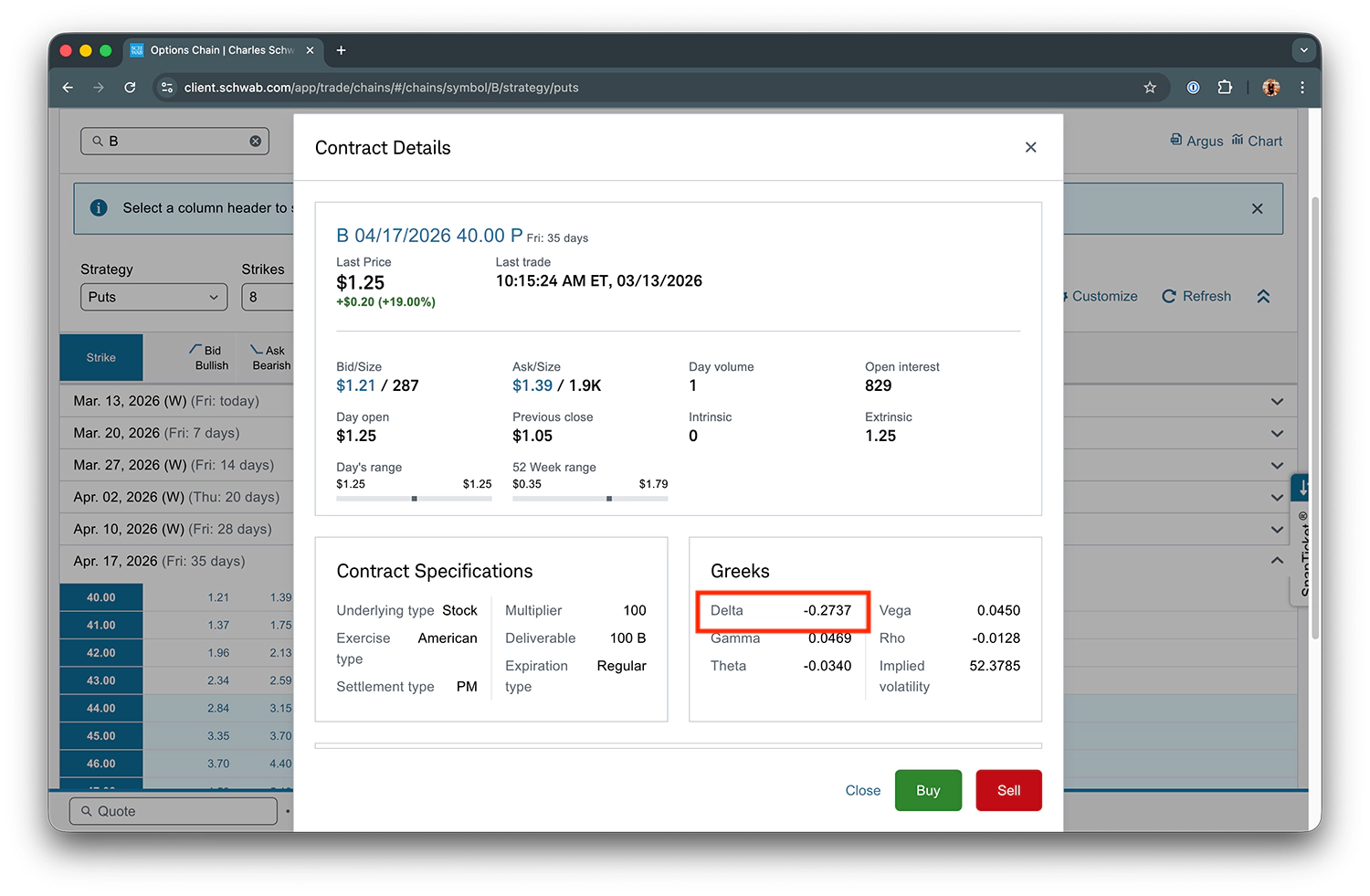
BApril 17, 2026 $40 put- Delta: -0.2737 (~27% chance of assignment)
- Premium: $1.25
Would I want to own B at $40? Yes.
Is a ~27% chance of assignment something I can live with? Absolutely.
CSP $41 Strike
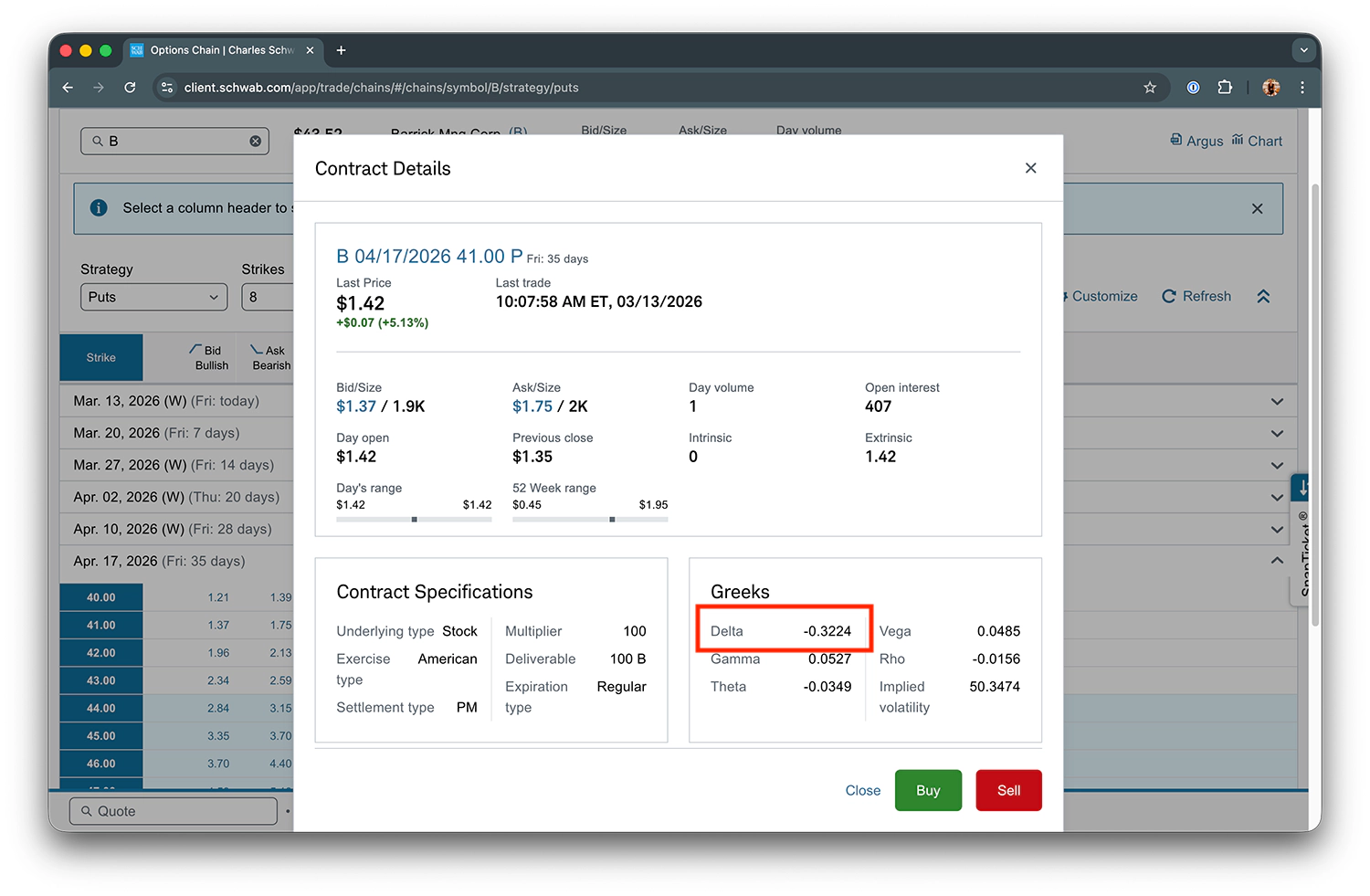
BApril 17, 2026 $41 put- Delta: -0.3224 (~32% chance of assignment)
- Premium: $1.42
Slightly more premium ($0.17 extra), but now assignment probability jumped to ~32%.
The question is whether that extra $17 per contract is worth the additional 5% assignment risk.
CSP $42 Strike
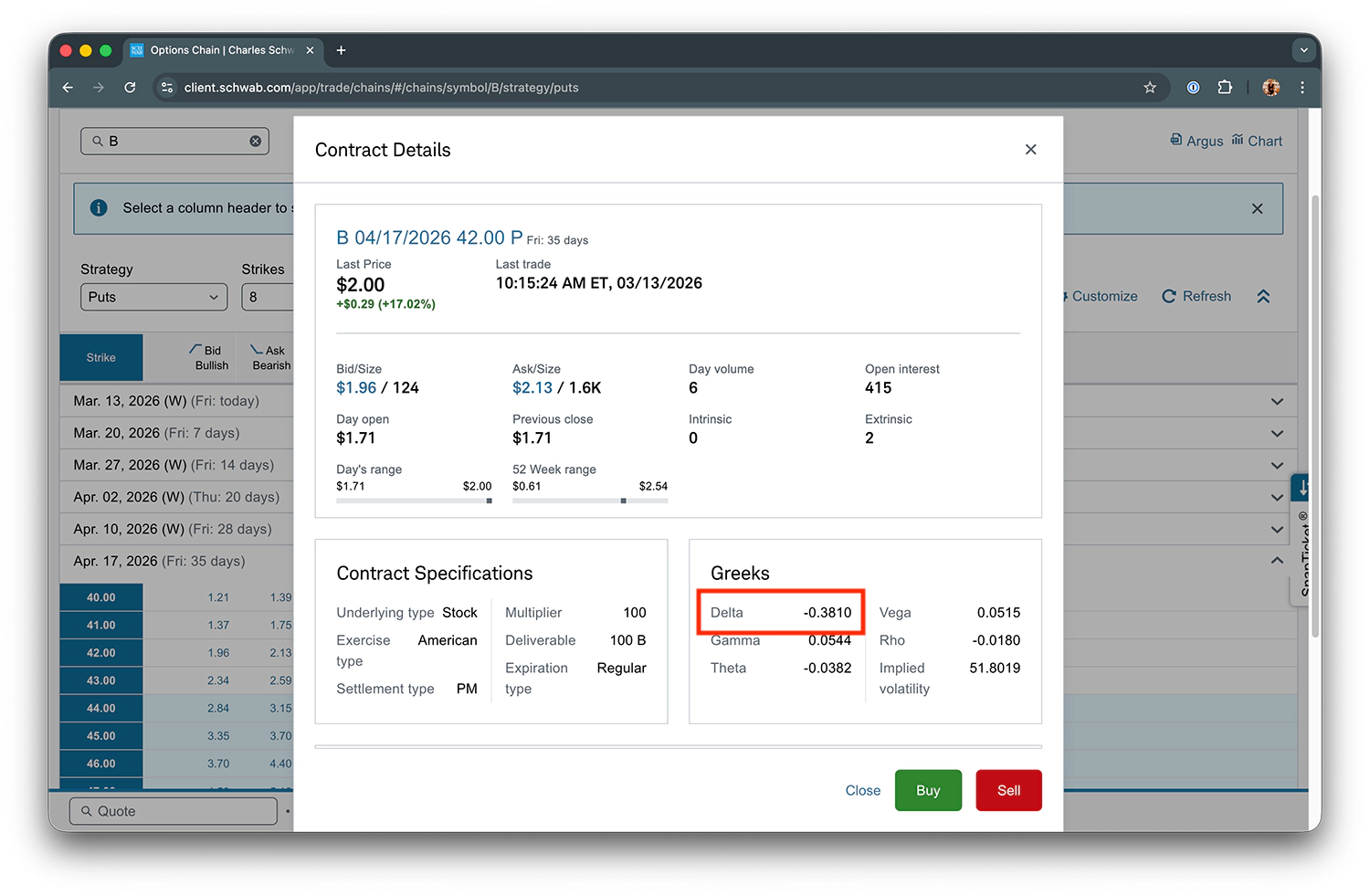
BApril 17, 2026 $42 put- Delta: -0.3810 (~38% chance of assignment)
- Premium: $2.00
Now we’re collecting $2.00 in premium, but there’s a ~38% chance we’re buying shares at $42.
That’s only $1.41 below the current price of $43.41. Not a lot of cushion.
My Decision Process
Here’s how I would walk-through the process:
- I like
Bas a company and I want to own shares - My target buy price based on fundamentals is around $40
- The $40 strike gives me a 0.2737 delta (~27% assignment probability), which sits right in my 0.20-0.30 sweet spot
- I collect $1.25 in premium, which would make my effective cost basis $38.75 if assigned
- That’s a price I’m genuinely happy to pay for this stock
The $41 and $42 strikes offer more premium, but they push me closer to the current price and raise assignment probability beyond my comfort zone.
Stock selection first. Target price second. Delta third.
In that order.
Always.
How to Use Delta for Covered Call Strike Selection
Now let’s say you sold the $40 put on B, collected $1.25 in premium, the stock went against you, and got assigned.
You now own 100 shares of B at a cost basis of $38.75:
- Strike price: $40
- Premium collected: $1.25
- Effective cost basis: $40 - $1.25 = $38.75
Now you’re in Phase 3 of the Wheel, selling covered calls.
The key difference between CSPs and covered calls is what delta represents:
- On CSPs, delta approximates the probability of buying shares
- On covered calls, delta approximates the probability of shares being called away
Worked Example: Barrick Mining Covered Calls
Using the same B stock, same April 17, 2026 expiration (35 DTE), here are two call strikes to consider:
CC $47 Strike
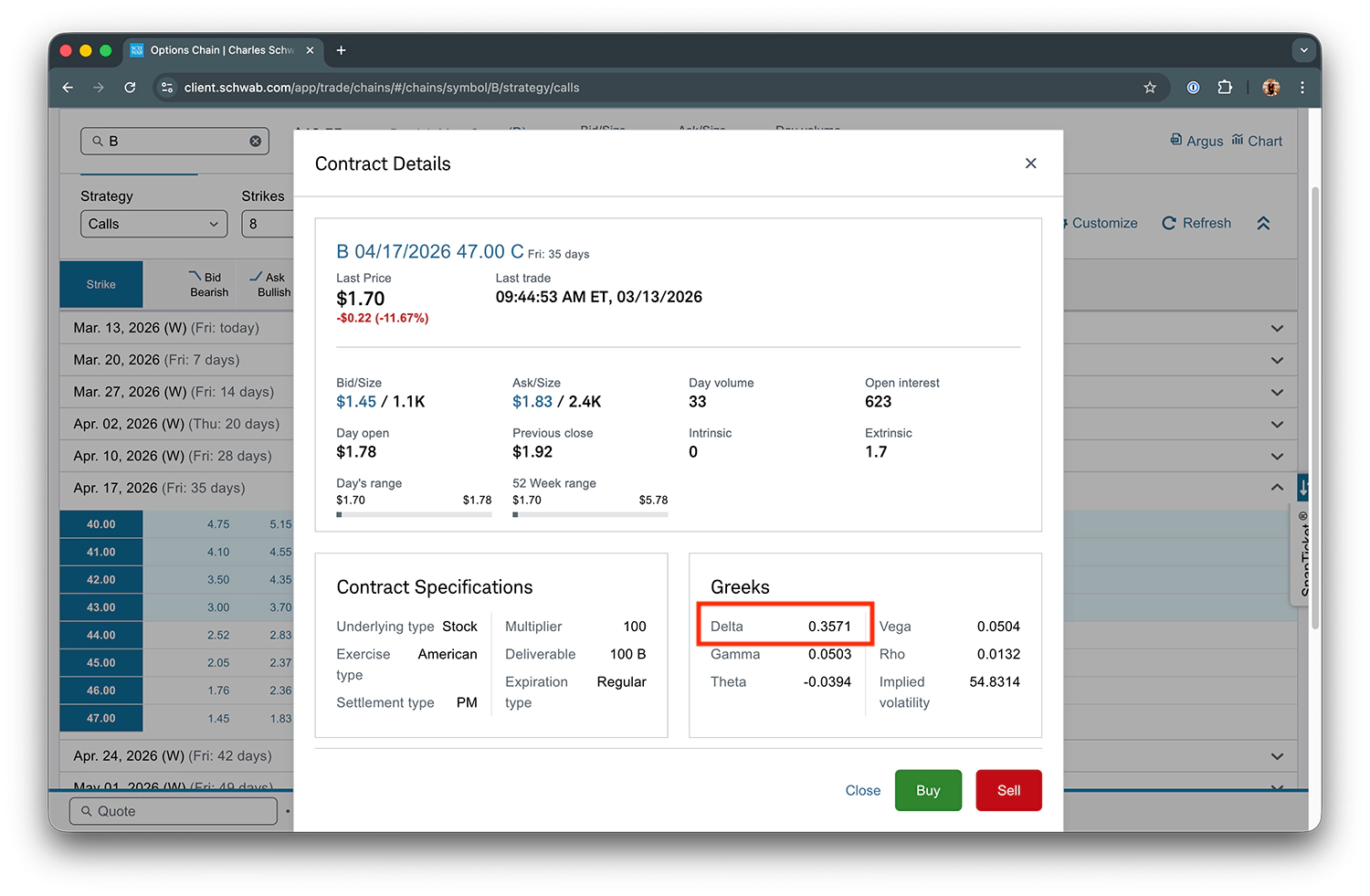
BApril 17, 2026 $47 call- Delta: 0.3571 (~36% chance of being called away)
- Premium: $1.70
CC $50 Strike
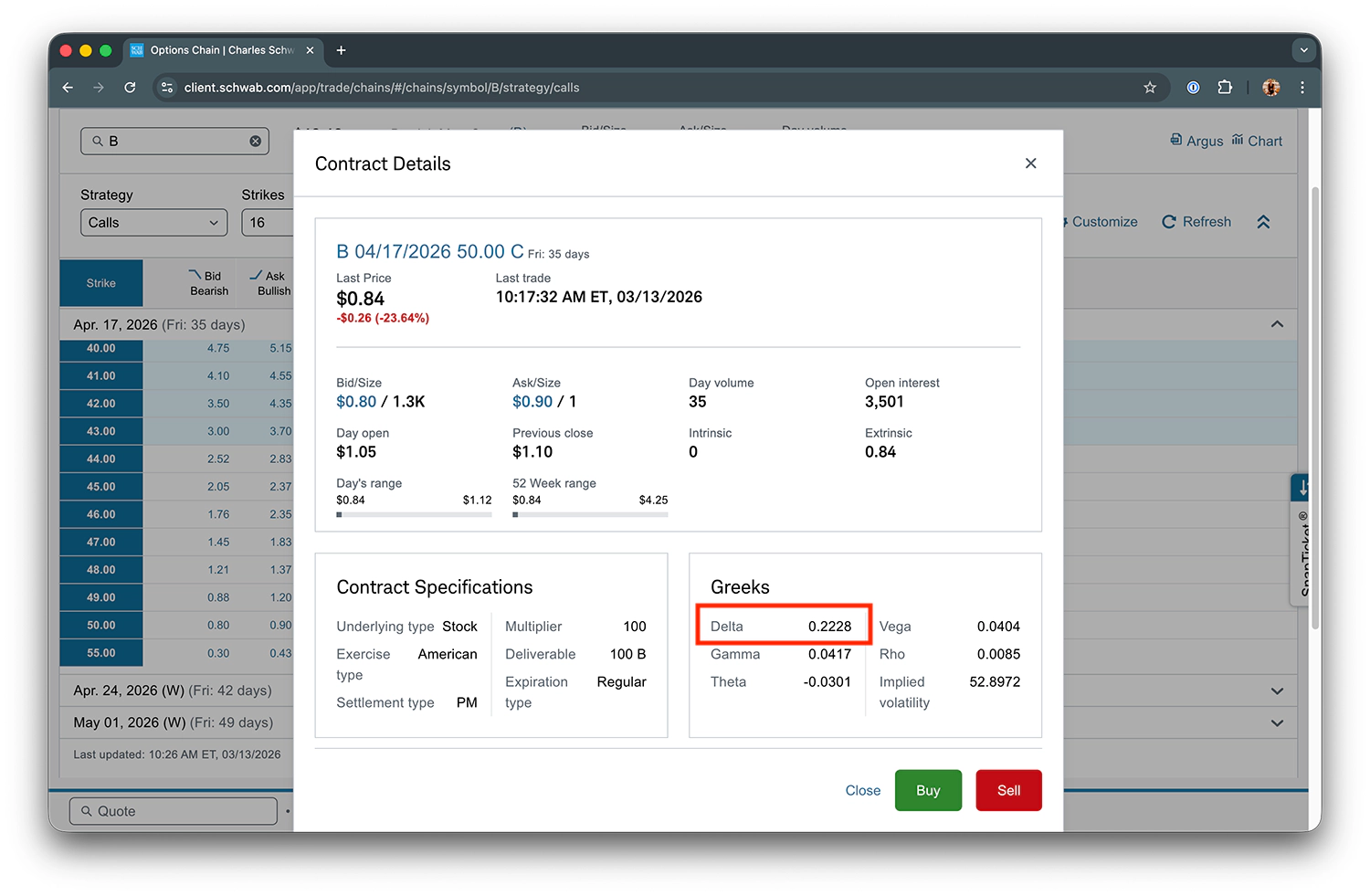
BApril 17, 2026 $50 call- Delta: 0.2228 (~22% chance of being called away)
- Premium: $0.84
Evaluating the Two Strikes
Both strikes are well above your $38.75 cost basis, so the question isn’t whether you profit — it’s how much premium you want to collect while you wait.
Here’s the tradeoff:
- The $47 strike collects $1.70 in premium but has a ~36% chance your shares get called away
- The $50 strike collects $0.84 in premium but only a ~22% chance of losing your shares
If B gets called away at $47, your total profit is:
- Capital gain: $47 - $38.75 = $8.25 per share
- Plus the $1.70 CC premium
- Total: $9.95 per share ($995 per contract)
If called away at $50:
- Capital gain: $50 - $38.75 = $11.25 per share
- Plus the $0.84 CC premium
- Total: $12.09 per share ($1,209 per contract)
The $50 strike gives you more upside if called away, but you collect less premium each cycle if the stock stays below the strike.
My personal approach?
If I think the stock has room to run, I go with the lower delta (0.20-0.25 range) to keep my shares longer. If I’m ready to exit the position, I’ll bump up to 0.30-0.35 delta and take the higher premium.
How Delta Changes as Expiration Approaches
Delta isn’t a fixed number. It shifts as expiration gets closer, and understanding this behavior helps you avoid surprises.
The important bits:
- ATM options see the most dramatic delta changes near expiration
- An ATM put can swing from -0.50 to -0.90 (or back to -0.10) in the final days
- Deep OTM options stay near zero and don’t move much
- Deep ITM options stay near -1.0 (puts) or +1.0 (calls) and don’t move much either
- The rate of delta change is called gamma, and gamma spikes as expiration approaches
- This is why Wheel traders typically sell 30-45 DTE options (it keeps gamma manageable)
Note: Gamma is what makes the final week before expiration so volatile for option prices. If you want to understand how all four Greeks interact, that’s covered in The Options Greeks Explained.
How Implied Volatility Affects Delta
Implied volatility (IV) changes the shape of the delta curve, which directly affects your strike selection.
The short version:
- Higher IV spreads out the delta curve, giving OTM options higher deltas than they’d have in a low-IV environment
- Lower IV compresses the curve, making OTM deltas drop off more steeply
- The same strike can have a meaningfully different delta depending on the current IV environment
- In the
Bexamples above, IV was running around 50-55%, which is elevated, meaning those OTM deltas were a bit higher than they’d be in a calmer market
When IV is high, you may need to go further OTM to hit your target delta. When IV is low, your usual OTM strikes may have lower deltas than expected, offering less premium.
Note: Don’t worry if this feels like a lot of moving parts. In practice, you check delta, glance at IV, and make a decision. It takes about 30 seconds once you’ve done it a few times (and know your fundamental research).
For a full breakdown of how IV affects your Wheel trades, see my guide on implied volatility.
Common Delta Mistakes Wheel Traders Make
Even traders who understand delta conceptually still make these mistakes in practice:
- Chasing high-delta strikes for premium without considering assignment risk. A 0.45 delta put pays well, but you’re nearly flipping a coin on whether you’re buying 100 shares. If you haven’t done the fundamental work on that stock, you’re gambling.
- Ignoring delta entirely and picking strikes by “feel.” Selling the $40 put because it’s a “round number” or because “it looks far enough away” is not a system. Delta gives you a quantifiable framework.
- Forgetting that delta changes. You sold a 0.25 delta put, but two weeks later the stock dropped and now it’s a 0.45 delta put. Keep in mind that the delta at entry is not the same delta at exit. Monitor your positions!
- Spending all their energy on delta when stock selection is the real game. Remember, if you’re at “The Wheel General Store” with $1 in your hand, spend $0.90 of that dollar on the right stock (i.e., stock selection). Delta is the last 10 cents. Don’t optimize the wrong variable.
These delta slip-ups are just a few of the mistakes I see Wheel traders make.
Get Your Reps In With Delta
You now have a practical framework for using delta in your Wheel trades:
- Delta approximates your probability of assignment; use it as your primary strike selection filter
- Conservative traders target 0.20-0.25, moderate traders 0.25-0.35, aggressive traders 0.40+ delta values
- Always start with stock selection, then target price, then delta (in that order, always)
- On covered calls, delta tells you the probability of your shares being called away
- Monitor delta throughout the trade, not just at entry
The next time you open your options chain, look at the delta column:
- Find the strike that matches your risk tolerance
- Sell it
- Manage it
- Repeat
That’s how the Wheel works, one delta-informed decision at a time.
Ready to learn about the other Greek that drives your Wheel income? Check out my guide on theta and time decay.