 by
by 
When I first stumbled into options trading, I was convinced the entire system was designed to confuse normal people.
- Strike prices
- Expiration dates
- Puts
- Calls
- Greeks named after a fraternity roster
It felt like financial jargon had been weaponized specifically to keep me out.
Then I actually learned what a stock option is, and I realized the core concept is embarrassingly simple.
A stock option is a contract that gives you the right, but not the obligation, to buy or sell shares of a stock at a specific price by a specific date.
That single sentence is the entire foundation.
Everything else is detail and nuance.
I came to options through The Wheel Strategy, which uses options to generate income on stocks you want to own. Before I could run that system with any discipline, I needed to understand options from the ground up.
This is the starting point I wish I’d had.
Table Of Contents
What Are Stock Options?
A stock option is a contract that gives you the right, but not the obligation, to buy or sell shares of a stock at a specific price by a specific date.
So what does “the right but not the obligation” actually mean?
“Right” means you can do something. You have permission, but you don’t have to.
“Obligation” means you must do something. No choice.
As a kid, you likely had the option to go outside and play after doing your homework.
But, at the end of the night, you had the obligation to brush your teeth before bed.
- When you buy an option, you’re paying for the right. You choose whether to use it or let it expire.
- When you sell an option, you’re taking on the obligation. If the buyer exercises their right, you must fulfill your end of the deal.
This asymmetry is what makes options work.
One side has flexibility.
The other has responsibility.
The price you pay (or receive) for this right is called the premium (think of it like an entry fee).
The Ice Cream Analogy
Here’s a non-financial way to think about it.
Imagine it’s winter and your favorite ice cream shop sells scoops for $3.
You pay the shop $0.50 now for the right to buy a scoop at $3 anytime before August.
Summer comes. Demand spikes. The price goes to $6.
But you still have the right to buy at $3. You exercise your right and get $6 ice cream for $3 (minus the $0.50 you paid for the right).
Or maybe it’s a cool summer and ice cream stays at $3. Your right isn’t worth exercising, and you’re out the $0.50 premium.
The shop? They collected $0.50 from you upfront and took on the obligation to honor that $3 price no matter what.
Stock options work the same way, but instead of ice cream you’re dealing with 100 shares of a stock, a strike price, and an expiration date.
What Is the Difference Between Calls and Puts?
| Concept | Call Option | Put Option |
|---|---|---|
| Gives you the right to… | Buy shares at the strike price | Sell shares at the strike price |
| You profit when… | Stock goes up | Stock goes down |
| You lose when… | Stock goes down or stays flat | Stock goes up or stays flat |
| Think of it as… | A bullish bet | A bearish bet (or insurance) |
There are two types of stock options:
- Calls
- Puts
Let’s break them down.
Call Options
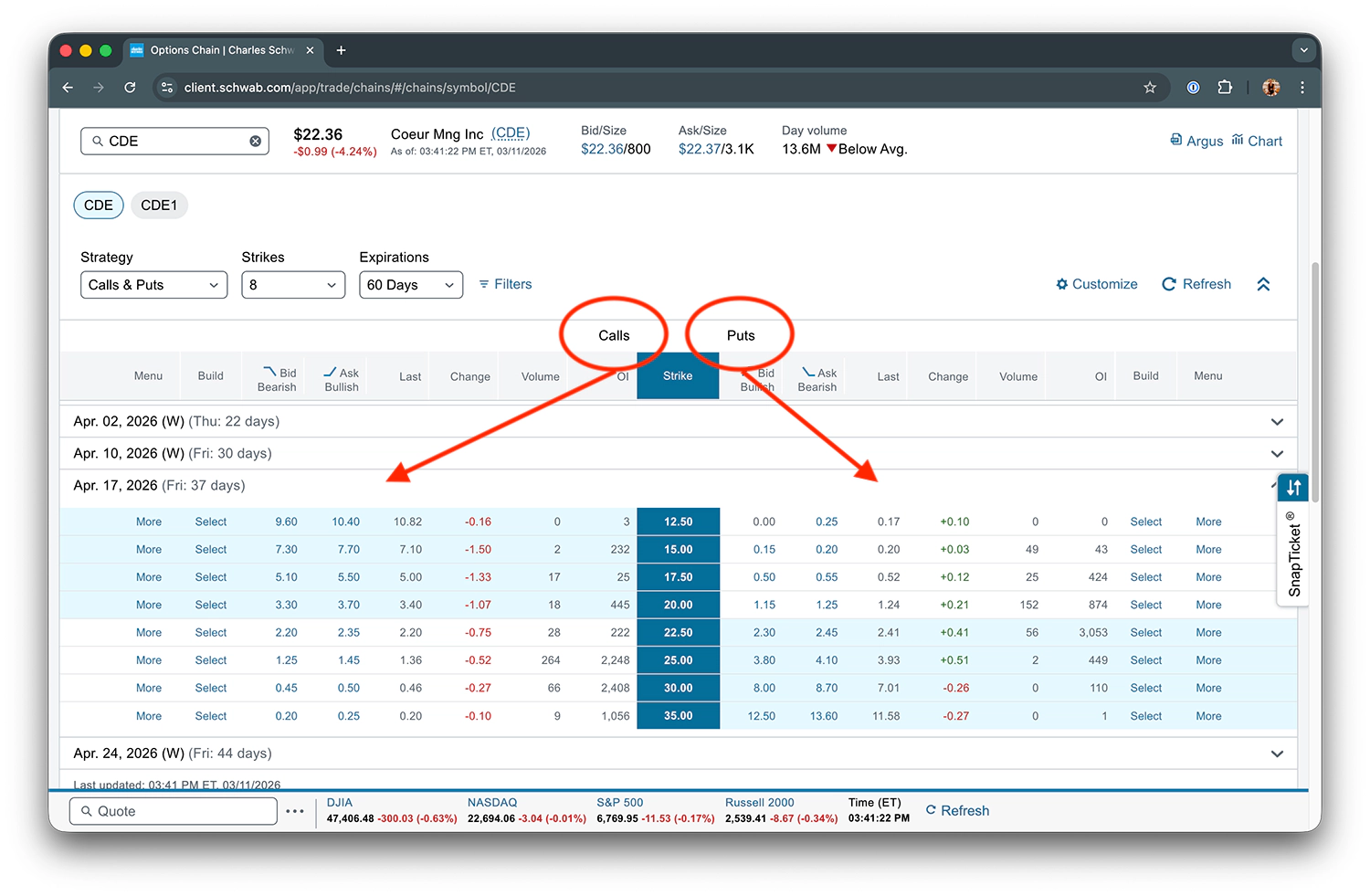
A call gives you the right to buy 100 shares at the strike price before expiration.
Here’s a simple example using CDE (Coeur Mining), which is trading around $22:
- You buy a
CDE$22.50 call for $2.20 - The stock goes to $27
- Your call is now worth significantly more than the $2.20 you paid
- You profit
If the stock stays flat or drops? The call expires worthless, and you lose the $220 premium (that’s $2.20 x 100 shares).
Put Options
A put gives you the right to sell 100 shares at the strike price before expiration.
Same stock, opposite direction:
- You buy a
CDE$22.50 put for $2.41 - The stock drops to $17
- Your put is now worth significantly more than the $2.41 you paid
- You profit
If the stock stays flat or goes up? The put expires worthless, and you lose the $241 premium.
Buying vs. Selling Options (and Why It Matters)

So far we’ve talked about buying options.
But options can also be sold, just like how we can short a stock.
This is where things get interesting (and where the Wheel Strategy lives).
| Scenario | Right or Obligation? | You Profit When… | Max Risk |
|---|---|---|---|
| Buy a Call | Right to buy shares | Stock goes up above strike + premium paid | Premium paid (limited) |
| Buy a Put | Right to sell shares | Stock goes down below strike - premium paid | Premium paid (limited) |
| Sell a Call | Obligation to sell shares if exercised | Stock stays below strike (keep premium) | Unlimited (at least in theory) |
| Sell a Put | Obligation to buy shares if exercised | Stock stays above strike (keep premium) | Strike price x 100 - premium received |
Let’s walk through each scenario using the CDE example.
Buy a Call
You pay a premium for the right to buy 100 shares at the strike price.
You’re bullish. You think the stock is going up.
- You buy a
CDE$22.50 call for $2.20 - You profit if
CDEgoes above $24.70 (strike + premium) before expiration - Max risk: the $240 premium you paid
Buy a Put
You pay a premium for the right to sell 100 shares at the strike price.
You’re bearish, or you’re buying insurance on shares you already own.
- You buy a
CDE$22.50 put for $2.41 - You profit if
CDEdrops below $20.09 (strike - premium) before expiration - Max risk: the $241 premium you paid
Sell a Call
You collect a premium and take on the obligation to sell 100 shares at the strike price if the buyer exercises.
You’re neutral-to-slightly-bearish. You think the stock will stay flat or go down.
- You sell a
CDE$25 call for $1.36 - You keep the $136 premium if
CDEstays below $25 by expiration - Max risk: unlimited (the stock can rise indefinitely), which is why most traders sell calls only when they already own the shares (a “covered” call)
Sell a Put
You collect a premium and take on the obligation to buy 100 shares at the strike price if the buyer exercises.
You’re neutral-to-slightly-bullish. You think the stock will stay flat or go up.
- You sell a
CDE$20 put for $1.24 - You keep the $124 premium if
CDEstays above $20 by expiration - Max risk: $20 x 100 - $124 = $1,876 (if the stock goes to $0, which is…unlikely, but that’s the math)
The Distinction You Need
Buyers pay premium for flexibility (rights). Sellers collect premium for taking on responsibility (obligations).
That distinction is the single most important concept in all of options trading.
How the Wheel Strategy Uses Buying and Selling
If you’re learning about options because of the Wheel Strategy, here’s the thing: you’ll primarily be on the selling side.
The Wheel uses two of the four scenarios above:
- Selling puts (cash-secured puts) to collect premium on stocks you’re willing to own
- Selling calls (covered calls) against shares you already hold to collect more premium
You sell puts to get paid while waiting for a stock you want. If assigned, you sell calls against those shares for additional income.
This is why the buyer vs. seller distinction matters. As a Wheel trader, you need to understand the obligations you’re taking on.
For a deeper dive into how the Wheel works, see the Wheel Strategy complete guide.
Key Options Terms You Need to Know
These are the terms you’ll see every time you open an options chain. We’ll keep the definitions practical, with real examples from a brokerage account.
For a deeper look at how options contracts work, we go through strike, expiration, and premium one at a time.
What Is a Strike Price?
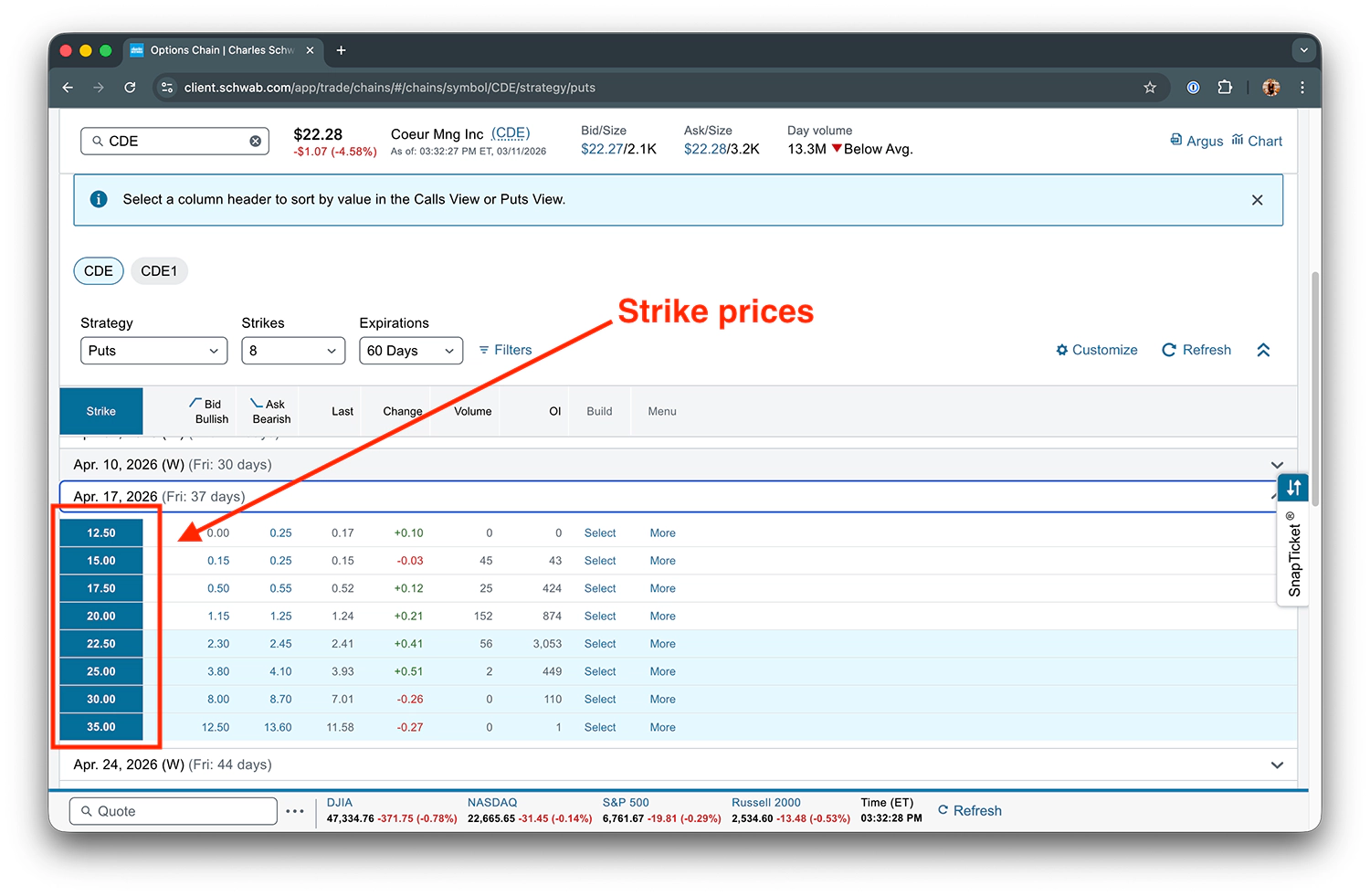
The strike price is the price at which you can buy (call) or sell (put) the underlying stock.
In the screenshot above, you can see strike prices ranging from $12.50 all the way up to $35.00 for CDE puts.
With CDE trading around $22, the $22.50 strike is close to the current stock price. The $20 strike is below it. The $25 strike is above it.
Each strike has a different premium because each carries a different probability of ending up in the money (we’ll get to what “in the money” means shortly).
What Is an Expiration Date?
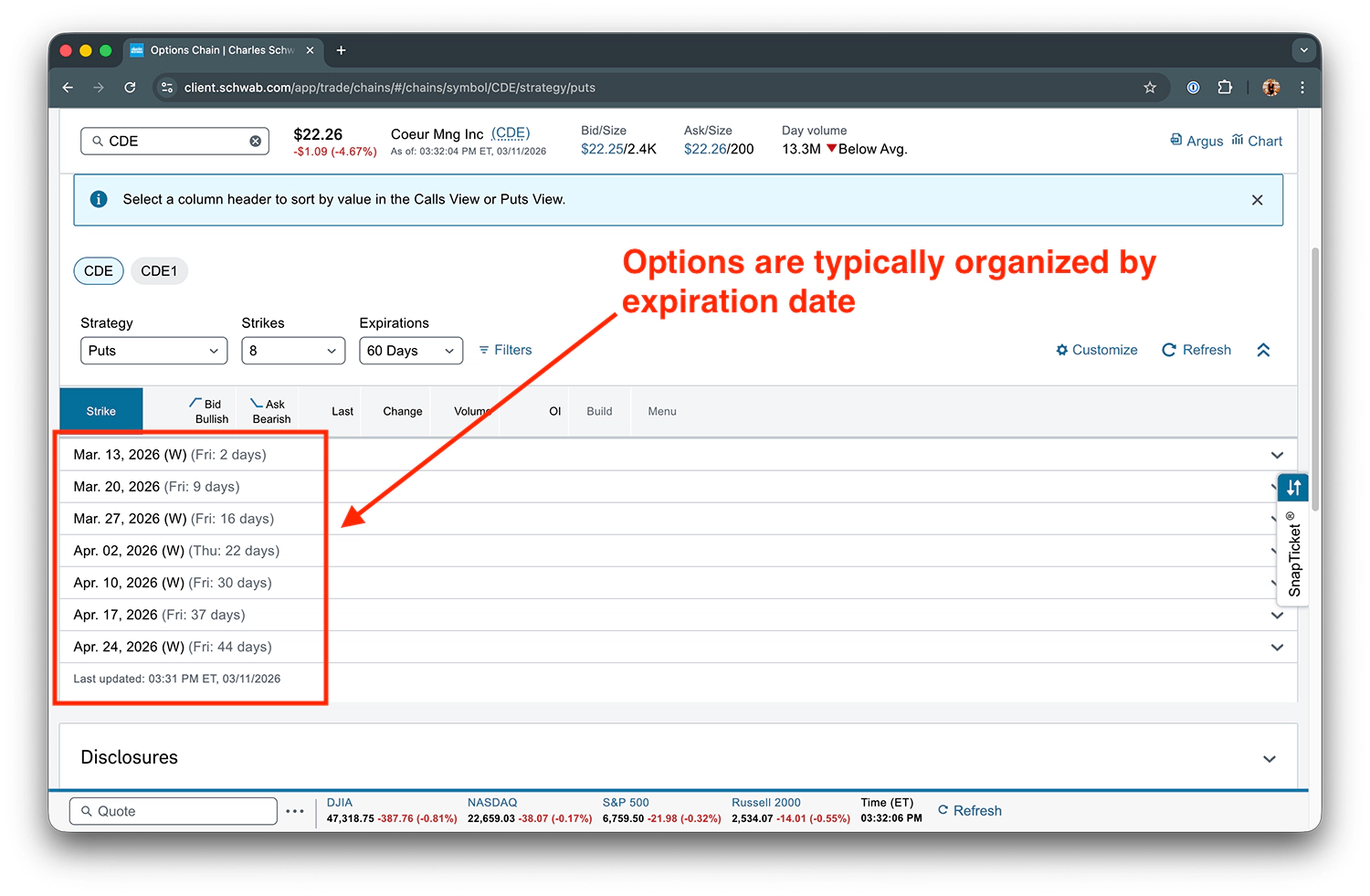
The expiration date is the date by which the option must be exercised, or it expires worthless.
Think of it as a countdown timer. Once it hits zero, the option ceases to exist.
The screenshot above shows several available expirations for CDE:
- Mar 13, 2026 (2 days)
- Mar 20, 2026 (9 days)
- Mar 27, 2026 (16 days)
- Apr 02, 2026 (22 days)
- Apr 10, 2026 (30 days)
- Apr 17, 2026 (37 days)
- Apr 24, 2026 (44 days)
“Fri: 30 days” means the option expires on a Friday, 30 days from now.
Most options expire on Fridays (with occasional exceptions for holidays).
What Is an Options Premium?
The premium is the price you pay (as a buyer) or collect (as a seller) for the option contract.
Remember the CDE strike price screenshot from a moment ago? The bid and ask columns are the premium.
Here’s how to read them using the $20 strike put:
- The ask is $1.25 — that’s what you’d pay to buy one contract: $1.25 x 100 = $125
- The bid is $1.15 — that’s what you’d receive if selling one contract: $1.15 x 100 = $115
The bid is always lower than the ask.
The difference between them is called the spread, and it’s the cost of doing business.
What Is Contract Size?
One options contract represents 100 shares of the underlying stock.
This is why options are leveraged. A small move in the stock price gets multiplied by 100.
If a premium is quoted at $1.50 per share, one contract actually costs $150 (not $1.50).
This trips up beginners constantly. The prices displayed in the options chain are per-share, but you always trade in 100-share blocks.
Forget this, and your position will be 100x larger (or smaller) than you intended.
What Do ITM, OTM, and ATM Mean?
These three abbreviations describe the relationship between the stock price and the strike price.
- ITM (In the Money): the option has intrinsic value right now
- Call: stock price is above the strike price
- Put: stock price is below the strike price
- OTM (Out of the Money): the option has no intrinsic value right now.
- Call: stock price is below the strike price
- Put: stock price is above the strike price
- ATM (At the Money): the stock price is at or very near the strike price.
Let’s make this concrete with CDE at around $22:
- The $20 put is OTM — the stock is above the $20 strike, so the put has no intrinsic value. The $20 put bid of $1.15? That’s all time/optionality value
- The $25 put is ITM — the stock is below the $25 strike, so the put has roughly $3 of intrinsic value. The $25 put bid of $3.80 confirms this ($3 intrinsic + $0.80 time value)
- The $22.50 strike is roughly ATM — closest to where the stock is currently trading
The deeper an option is in the money, the more expensive it is (because it already has built-in value).
The deeper it’s out of the money, the cheaper it is (because it needs a bigger move to become profitable).
If that feels like a lot of terminology, you’re right. But you just covered the vocabulary you’ll use for literally every options trade you’ll ever place.
Why Do Stock Options Exist?

Options are a flexible financial tool used for very different purposes.
Here are the four main reasons options exist:
- Hedging / Insurance: Protect a stock position from downside risk (buy a put as insurance in case the stock drops)
- Speculation: Bet on a stock’s direction with less capital upfront than buying shares outright
- Income generation: Sell options to collect premium as recurring income (this is where the Wheel Strategy lives)
- Leverage: Control 100 shares for a fraction of the cost of buying them, amplifying both gains and losses
Beyond these purposes, there are literally hundreds (if not thousands) of strategies that use options in different combinations:
- Buying calls: Bullish bet; limited risk, unlimited upside
- Buying puts: Bearish bet or insurance; limited risk
- Covered calls: Sell calls against shares you own to generate income
- Cash-secured puts: Sell puts on stocks you’re willing to buy, collect premium while you wait (i.e., get paid to “wait” for a limit order to be filled)
- Spreads: Combine buying and selling to define your risk and reward more precisely
- Iron condors: Profit when a stock stays in a range; defined risk on both sides
You don’t need to learn all of these.
The point is that options are a broad toolkit, and different strategies serve different goals.
If you’re here because of the Wheel Strategy, you really only need two of them: cash-secured puts and covered calls.
The rest is good to know, but not essential for getting started.
Common Misconceptions About Stock Options

We cover more misconceptions (and the mistakes that flow from them) in our guide on the common options trading mistakes to avoid.
I’ve heard all three of these. I believed at least two of them before I knew better.
“Options Are Gambling”
Are options gambling?
It depends entirely on the strategy.
Buying super far out-of-the-money options?
Working with 0 DTE options?
In my opinion, that is the equivalent to gambling. Most expire worthless, and you’re betting on a specific short-term move with the odds stacked against you.
Selling cash-secured puts on quality stocks you genuinely want to own? That’s closer to selling insurance. You collect premium upfront and only buy shares at a price you chose in advance.
The instrument isn’t the problem. How you use it determines whether it’s “speculation” or a “disciplined strategy.”
“Options Are Too Risky for Normal People”
Options can be risky.
So can buying individual stocks.
So can crossing the street without looking.
The risk comes from leverage: one contract controls 100 shares, so a $1 move in the stock equals a $100 swing in the option’s value.
That leverage amplifies both gains and losses, which is why options feel volatile.
But risk is manageable when you understand what you’re doing and choose strategies that match your risk tolerance.
“You Can Lose Everything with Options”
If you’re buying options, the most you can lose is the premium you paid. That’s it. Defined risk.
If you’re selling options, the risk profile depends on the strategy:
- Selling naked calls has theoretically unlimited risk
- Selling cash-secured puts has the same risk as buying the stock at the strike price (the stock can go to zero, but you chose the strike, so you should have picked a price you were comfortable with)
Know your max risk before you enter a trade. If you can’t articulate your worst-case scenario in one sentence, you shouldn’t be in the position.
Options aren’t inherently dangerous or safe.
The strategy you choose and the discipline you bring determine the outcome.
Where to Go from Here
Quick recap of what you just learned:
- Stock options give you the right (not the obligation) to buy or sell shares at a set price by a set date
- Calls = right to buy, puts = right to sell
- You can remember the difference between calls and puts by using the phrase: “I want to ‘call up’ an option” (meaning you want the price to go up), and “I want to ‘put down’ an option” (meaning you want the price to go down)
- Buyers pay premium for rights, sellers collect premium for obligations
This article is one piece of the larger Options Fundamentals: The Complete Guide, which ties the whole learning path together.
Your next steps in the learning path:
- Understanding Options Contracts: Strike, Expiration, Premium: Go deeper on the mechanics of how contracts work
- How to Read an Options Chain: Learn to navigate the screen you’ll use for every trade
- The Options Greeks Explained: Delta, Theta, Gamma, Vega: Understand the forces that move option prices
These are all part of the Options Fundamentals learning path. Start with options contracts, then work your way through the chain and the Greeks.
The hardest part of learning options is getting started.
You just did.