 by
by 
I used to stare at an options chain and just…pick one.
No real logic.
No framework.
Just vibes and a vague sense that “this one looks good.”
Could I have been more systematic?
Absolutely.
But I didn’t know what to be systematic about.
Every options contract is defined by three components:
- Strike price (the price level)
- Expiration date (the time horizon)
- Premium (the cost or income)
These three interact with each other, and understanding those interactions is what separates guessing from intentional trading.
In What Are Stock Options? A Beginner’s Guide, we introduced these terms. Now let’s unpack each one so you actually understand what you’re looking at when you open an options chain.
We’ll walk through strike, expiration, and premium individually, then show how they interact, then connect everything to The Wheel Strategy.
Table Of Contents
What Makes Up an Options Contract?
Every options contract is defined by three core components:
- Strike price: The price at which you can buy or sell the underlying stock
- Expiration date: The deadline by which the contract must be exercised or it expires worthless
- Premium: The price you pay (as a buyer) or collect (as a seller) for the contract
One contract always represents 100 shares. Multiply the per-share premium in the chain by 100 to get the actual dollar cost.
Think of an options contract like a ticket with three fields printed on it: the price level (strike), the expiration date, and the cost of the ticket (premium).
Change any one field and you’re holding a different ticket with a different risk/reward profile.
These three components don’t exist in isolation.
They push and pull on each other (there’s a reason physicists make good options traders), and understanding those interactions is what separates beginners from confident traders.
What Is a Strike Price and How Does It Affect Your Trade?

Think of the strike price as a “price tag”.
How Strike Price Works
The strike price is the price at which you agree to buy (for calls) or sell (for puts) the underlying stock if the option is exercised.
It’s fixed when the contract is created. It never changes over the life of the option.
The options chain lists multiple strikes for any given expiration, and you choose the one that matches your outlook and risk tolerance.
ITM, ATM, and OTM (How Moneyness Changes the Risk/Reward Profile)
If you read What Are Stock Options?, you’ve already seen these terms. Now let’s go deeper on the tradeoffs.
- ITM (In the Money) means the option has intrinsic value right now
- Calls: stock price is above the strike
- Puts: stock price is below the strike
- Higher premium, higher probability of profit, but more capital at risk
- ATM (At the Money) means the stock price is at or near the strike
- Roughly 50/50 probability of finishing ITM
- Moderate premium
- OTM (Out of the Money) means the option has no intrinsic value
- Calls: stock price is below the strike
- Puts: stock price is above the strike
- Cheaper premium, lower probability of profit, but less capital at risk
Let’s make this concrete with CDE (Coeur Mining) at $22.28 using the Apr 17, 2026 expiration:
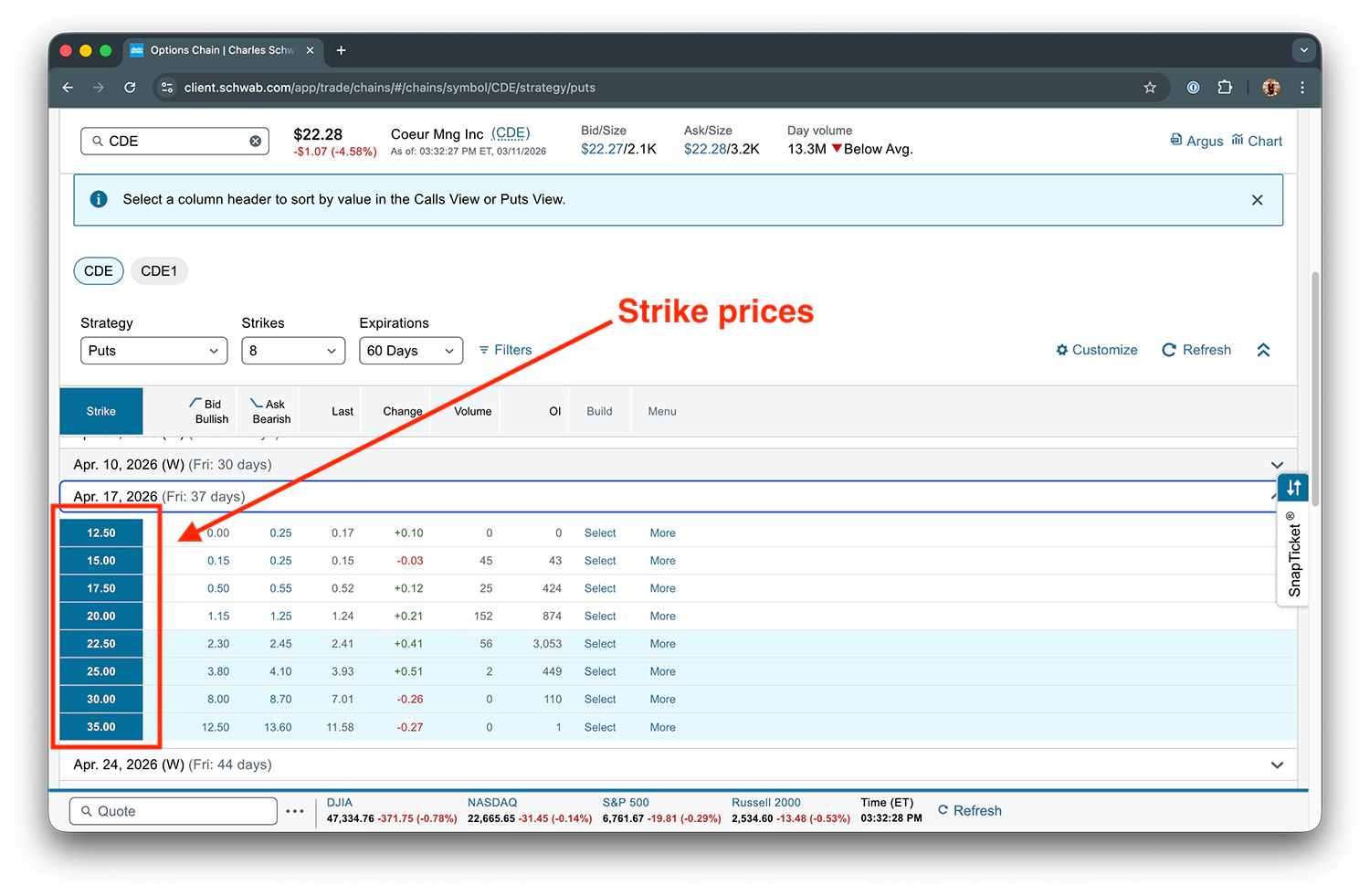
Looking at the image above:
- $20 put = OTM (stock is above the strike), ask premium $1.25
- $22.50 put = roughly ATM, ask premium $2.45
- $25 put = ITM (stock is below the strike), ask premium $4.10
Every premium reflects a different probability:
- The $25 ITM put costs $4.10 because it’s very likely to stay in the money
- The $20 OTM put costs $1.25 because the stock would need to drop significantly before that option has any intrinsic value
How Strike Selection Differs for Buyers and Sellers
These are two sides of the same coin.
Buyers want the stock to move past their strike.
They’re picking a target price:
- Buying OTM = cheaper bet, needs a bigger move to profit
- Buying ITM = more expensive, but the stock doesn’t need to move as far
Sellers want the stock to stay away from their strike.
They’re picking a buffer zone:
- Selling OTM = lower premium collected, but higher probability the option expires worthless (seller keeps premium)
- Selling ITM = higher premium collected, but higher chance of assignment
How Wheel Traders Think About Strike Selection
For Wheel traders selling cash-secured puts, strike selection equates to choosing the price you’re willing to buy the stock at.
Selling OTM puts gives you a margin of safety.
You’re getting paid to wait for a discount.
But strike selection alone isn’t enough.
You also need to factor in delta (probability of assignment) and implied volatility (whether the premium is rich enough to justify the risk).
Here’s how delta, probability, and premium shift across strikes:
| Strike | Moneyness | Approx. Delta | Approx. Probability of Profit (Sellers) | Ask Premium |
|---|---|---|---|---|
| $20.00 | OTM | -0.20 | ~80% | $1.25 |
| $22.50 | ATM | -0.50 | ~50% | $2.45 |
| $25.00 | ITM | -0.80 | ~20% | $4.10 |
Note: These delta values are general educational ranges, not CDE-specific. A later article in this series covers delta in depth.
The pattern is clear:
As you move further OTM, delta drops, probability of profit increases (for sellers).
But…the downside is that as your probability of profit increases, your premium decreases (meaning you’ll make less money).
It’s always a tradeoff. No free lunches at the options buffet.
How Expiration Dates Control Time and Risk

What Expiration Means Mechanically
The expiration date is the deadline. After this date, the contract ceases to exist.
If the option is ITM at expiration, it’s typically auto-exercised.
If OTM, it expires worthless.
Once expired, the rights (for buyers) and obligations (for sellers) are gone.
Weekly vs. Monthly vs. LEAPS Expirations
| Type | Typical DTE | Premium Level | Theta Decay Speed | Liquidity | Wheel Relevance |
|---|---|---|---|---|---|
| Weeklies | <7 days | Low | Fastest | Varies | Some Wheelers use 7-15 DTE for quick turnover |
| Monthlies | 30-45 days | Moderate | Accelerating | Generally strong | Most common Wheel timeframe |
| LEAPS | 365+ days | Highest | Slowest | Lower | Rarely used for the Wheel |
Not all expirations are created equal.
- Weeklies expire every Friday (typically <7 DTE). Rapid theta decay, quick turnover, but less premium collected per trade.
- Monthlies follow the standard cycle (third Friday of each month). Solid premium, well-established liquidity, good balance of time and decay.
- LEAPS (Long-Term Equity Anticipation Securities) go out 1+ year. Maximum premium, but capital is tied up longer and theta decay is slowest. Rarely used for Wheel traders.
What Is DTE (Days to Expiration) and Why Does It Matter?
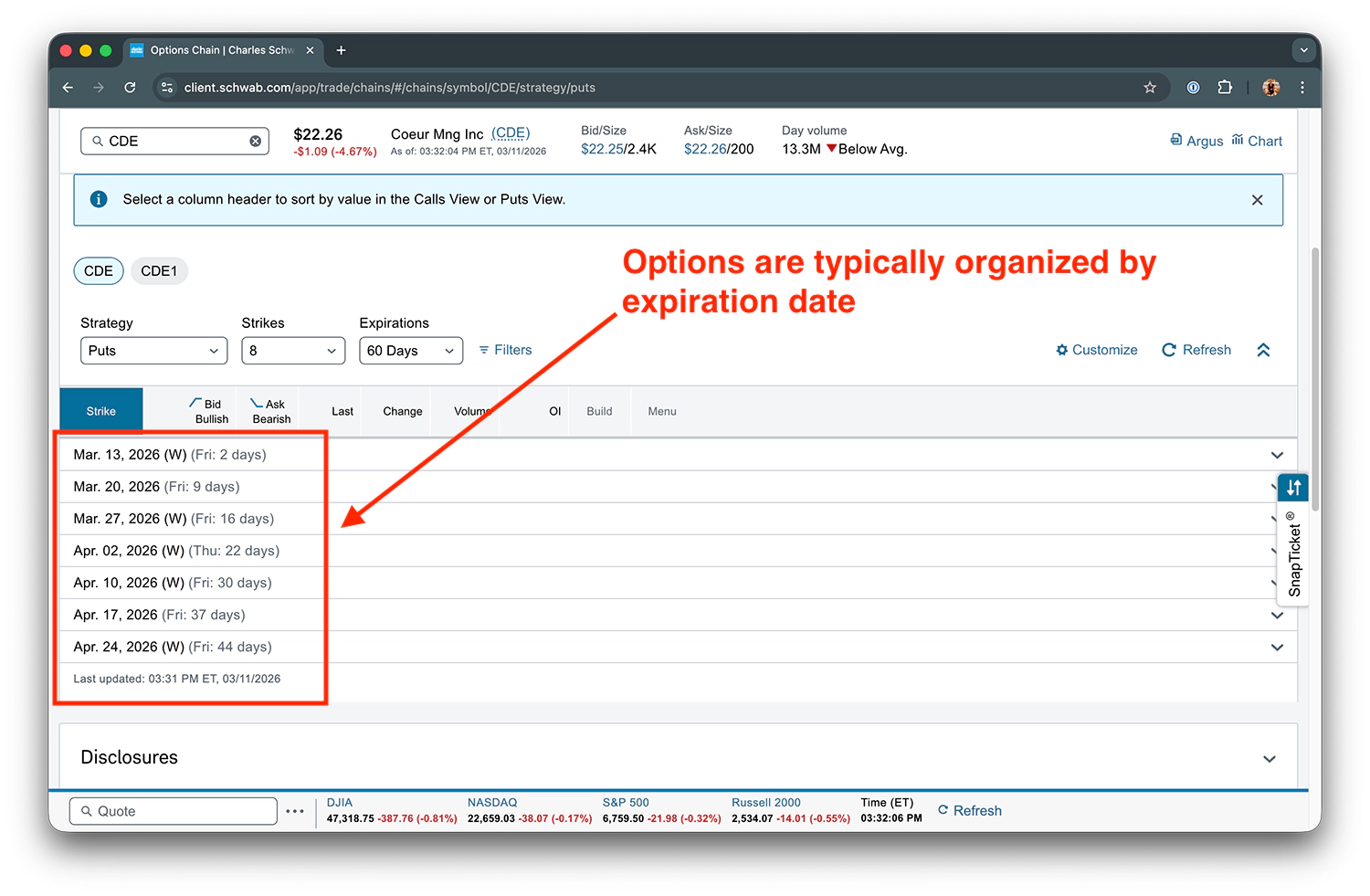
DTE is simply how many calendar days remain until expiration.
It’s the primary driver of time value in the premium. More DTE means more time value.
Theta decay accelerates as DTE decreases, especially inside 45 DTE. This is where time starts working hardest in your favor as a seller.
Here’s what real expirations look like for CDE:
- Mar 13 (2 DTE)
- Mar 20 (9 DTE)
- Mar 27 (16 DTE)
- Apr 02 (22 DTE)
- Apr 10 (30 DTE)
- Apr 17 (37 DTE)
- Apr 24 (44 DTE)
That range from 2 days to 44 days gives you a spectrum of time horizons, each with different premium and decay characteristics.
How Expiration Choice Affects the Wheel Strategy
30-45 DTE is where theta decay starts accelerating. This is a common approach (and my personal preference) because you get a good balance of premium collected vs. time exposed.
But some Wheelers prefer shorter DTEs (7-15 days), and that’s a legitimate alternative.
The tradeoff:
- Longer DTEs (30-45) = more premium to harvest, but more time for the trade to go against you (earnings, news, market events)
- Shorter DTEs (7-15) = less premium per trade, but you only have to be “right” (or “less wrong”) for a shorter window
Both approaches have advantages. Your mileage may vary.
What Is an Options Premium (and What Drives It)?
How Premium Is Quoted and What It Represents
The premium is the price of the options contract. What you pay as a buyer, or what you collect as a seller.
It’s quoted per-share in the options chain. Each option contract consists of a bundle of 100 shares.
A premium of $1.50 means the contract costs $150 ($1.50 x 100 shares).
Intrinsic Value vs. Extrinsic (Time) Value
Every premium is made up of two components: intrinsic value and extrinsic value.
- Intrinsic value: How much the option is worth if exercised right now. Only ITM options have intrinsic value.
- Extrinsic value: Everything else. Time remaining, volatility, uncertainty.
Let’s break this down with two CDE examples using the screenshot at the top of this section.
OTM Example (All Extrinsic)
CDEat $22.28, the $20 put (OTM)- Intrinsic value = $0 (it’s OTM, no value if exercised now)
- Ask premium = $1.25
- The entire $1.25 is extrinsic value (time + volatility)
ITM Example (Intrinsic + Extrinsic)
CDEat $22.28, the $25 put (ITM)- Intrinsic value = $25.00 - $22.28 = $2.72 (what it’s worth if exercised right now)
- Ask premium = $4.10
- Extrinsic value = $4.10 - $2.72 = $1.38 (the time and uncertainty portion)
Even ITM options have extrinsic value. You’re paying $2.72 for the intrinsic value plus $1.38 for remaining time and volatility.
That $1.38 will erode as expiration approaches. The $2.72 won’t (unless the stock moves).
Once you see this breakdown, you can’t unsee it. Every premium in the chain becomes a puzzle you can take apart.
What Drives Premium Higher or Lower?
Three primary forces drive premium:
- More time to expiration = higher premium (more uncertainty about where the stock ends up)
- Closer to the money (or ITM) = higher premium (higher probability of being exercised)
- Higher implied volatility (IV) = higher premium (market expects bigger moves, so options cost more)
IV is a big topic on its own and gets full treatment in What Is Implied Volatility (IV)?.
Why Premium Is Your Paycheck in the Wheel Strategy
Premium is your paycheck.
When you sell a CSP and collect $1.50 in premium, that $150 is yours to keep no matter what happens next.
Assigned? You keep it.
Option expires worthless? Again, you keep it.
But it’s not free money.
You’re collecting that premium in exchange for the obligation to buy 100 shares at the strike price if assigned. The premium is compensation for that risk.
The goal of the Wheel is to collect premium repeatedly.
- Sell a put
- Collect premium,
- Get assigned or let it expire
- Repeat
Just don’t confuse “repeatable income” with “risk-free income.” Those are very different things.
How to Apply Strike, Expiration, and Premium to the Wheel Strategy

Let’s pull the threads together.
When you sell a cash-secured put in the Wheel Strategy, you’re making three choices at once:
- Strike selection: Choosing the price you’re willing to buy the stock at. Selling OTM puts gives you a margin of safety, getting paid to wait for a discount.
- Expiration selection: Choosing your time horizon. 30-45 DTE is a common starting point (where theta decay accelerates), but 7-15 DTE is a legitimate alternative for quicker turnover.
- Premium evaluation: Is the income worth the risk? The premium is your paycheck, but is it worth to take on the obligation to buy 100 shares if assigned? That premium needs to justify the risk.
Covered Calls (Same Framework, Other Side of the Wheel)
Once assigned on a CSP, you sell covered calls against your shares.
Here, the strike is the price you’re willing to sell your shares at (ideally above your cost basis).
Expiration and premium follow the same tradeoffs as CSPs.
The component that changes character is the strike, because it’s now an exit price instead of an entry price.
Sell a strike below your cost basis, and a rally forces you to sell your shares at a realized loss.
- How covered calls actually work details using your shares as collateral, how delta maps to your conviction level, and what happens when your shares get called away.
- And if you’ve already been assigned and you’re staring at 100 shares wondering what comes next, picking your first covered call strike walks through cost basis, delta, and DTE.
Necessary but Not Sufficient
Strike, expiration, and premium are the foundation. But Wheel traders also need to factor in delta (probability of assignment) and implied volatility (whether the premium is rich enough relative to expected movement).
This article gives you the vocabulary and mechanics. The next articles in the series add the analytical tools.
Think of it this way:
- You now understand what each component does
- Delta and IV help you decide which specific values to choose
That’s where the real fun starts.
Where to Go from Here
Every options contract is defined by three components:
- Strike price (your price level)
- Expiration date (your time horizon)
- Premium (the cost or income)
These three interact. Change one, the others shift. Every contract is a set of tradeoffs.
For Wheel traders, these components are the foundation of every trade.
You choose…
- A strike you’re comfortable owning at
- An expiration that balances premium vs. time exposure
- And evaluate whether the premium justifies the risk
Make sense?
If you want to start reading real options data, check out our guide on how to read an options chain – learn to navigate the screen you’ll use to place every trade.
If you want to go deeper on the forces that move option prices, see the options Greeks explained – the analytical tools that help you choose specific strikes and expirations.
It all ties back to the options fundamentals hub, which maps the full learning path.
Next comes the decision-making framework. And that’s where options trading starts to feel less like guessing and more like a system.