 by
by 
The Greeks are four numbers on your options screen that explain why your option gained or lost value today.
They measure the different forces acting on your option’s price:
- Delta: How much it moves when the stock moves
- Theta: How much value it loses each day
- Gamma: How fast your exposure is changing
- Vega: How volatility shifts affect the price
Think of them like weather gauges.
Temperature alone doesn’t tell you if you need an umbrella.
You need humidity, wind speed, barometric pressure.
No single gauge tells the whole story.
The Greeks work the same way.
Each one measures a different force, and you need all of them together to understand what’s happening to your position.
You will use the Greeks daily for Wheel Strategy position management, namely delta for strike selection and theta for timing.
If you’re still building your options foundation, start with
- What Are Stock Options? A Beginner’s Guide,
- Understanding Options Contracts: Strike, Expiration, Premium
- How to Read an Options Chain
Those three articles give you the vocabulary you need for what follows.
Table Of Contents
What Are the Options Greeks?
The Greeks measure how sensitive an option’s price is to different factors.
- Stock price movement
- Time passing
- The rate of change of your exposure
- Volatility shifts.
Each Greek isolates one of these forces and tells you exactly how much it’s affecting your position right now.
Do you need to understand multi-variable calculus to trade options? No.
Could it help? Sure.
Hedge funds employ PhDs in math, physics, and computer science to analyze the Greeks. The Greeks are literally partial derivatives from stochastic calculus and the Black-Scholes model.
But here’s the thing: you don’t need a PhD in mathematics to be successful here.
You don’t need calculus to use the Greeks. They’re just four numbers on your screen that tell you what’s happening to your position.
Your brokerage (automatically) calculates them for you.
Your job is to understand what they mean and how to use them.
Here’s a summary of the four primary Greeks (plus one bonus):
| Greek | What It Measures | Plain English | Why It Matters | Wheel Relevance |
|---|---|---|---|---|
| Delta | Price sensitivity to stock movement | “How much does my option move when the stock moves $1?” | Tells you directional exposure and approximate probability of finishing ITM | Guides strike selection (probability of assignment) |
| Theta | Time decay per day | “How much value does my option lose each day just from time passing?” | Options are wasting assets (time is always ticking) | Theta is the Wheel trader’s best friend (you collect premium that decays in your favor) |
| Gamma | Rate of change of delta | “How fast does my delta shift as the stock moves?” | Delta isn’t static, and gamma tells you how quickly your exposure changes | Gamma risk near expiration is why some Wheelers close or roll early |
| Vega | Sensitivity to implied volatility | “How much does my option’s price change when IV moves 1%?” | IV spikes inflate premiums; IV drops deflate them | Elevated IV means richer premiums when selling CSPs and covered calls |
| Rho | Sensitivity to interest rates | “How do rate changes affect my option?” | Minor for short-dated, meaningful for LEAPs | Safely ignore for short-dated Wheel trades |
Let’s walk through each one.
How Does Delta Measure Direction and Probability?

Delta measures the rate of change of an option’s price relative to a $1 move in the underlying stock.
A delta of 0.35 means the option’s price moves approximately $0.35 for every $1 the stock moves.
- Call deltas are positive (0 to +1.0) because calls gain value when the stock goes up
- Put deltas are negative (0 to -1.0) because puts gain value when the stock goes down
Here’s how delta behaves across the options chain:
- ATM options have deltas around 0.50 (moves roughly $0.50 per $1 stock move)
- Deep ITM options approach 1.0 (or -1.0 for puts), moving almost dollar-for-dollar with the stock
- Deep OTM options approach 0, meaning stock movement barely affects them
But here’s how Wheel traders actually use delta.
Wheel traders look at delta as the probability of being assigned the stock (given the current spot price and baked-in IV).
A -0.35 delta put means roughly a 35% probability the put finishes ITM and you get assigned.
Note: This isn’t mathematically exact. Delta-as-probability is an approximation, but it’s how practitioners think about it, and it’s close enough to be actionable.
When you sell a CSP, delta tells you the likelihood you’ll end up buying those shares. That makes it the single most important number for strike selection.
Common Delta Ranges for Wheel Traders
Your delta target depends on how aggressive you are and your conviction on the underlying stock:
- Conservative (0.15-0.25 delta): Lower probability of assignment, less premium collected
- Moderate (0.25-0.35 delta): Balanced probability and premium
- Aggressive (0.35+ delta): Higher probability of assignment, more premium collected
Your mileage may vary.
Where you set that target shapes what returns the Wheel Strategy can generate over time.
For the full treatment of delta-based strike selection (probability targeting, position sizing, and how to calibrate delta to your risk tolerance), see my dedicated article on delta for the Wheel Strategy.
Delta Greek Example
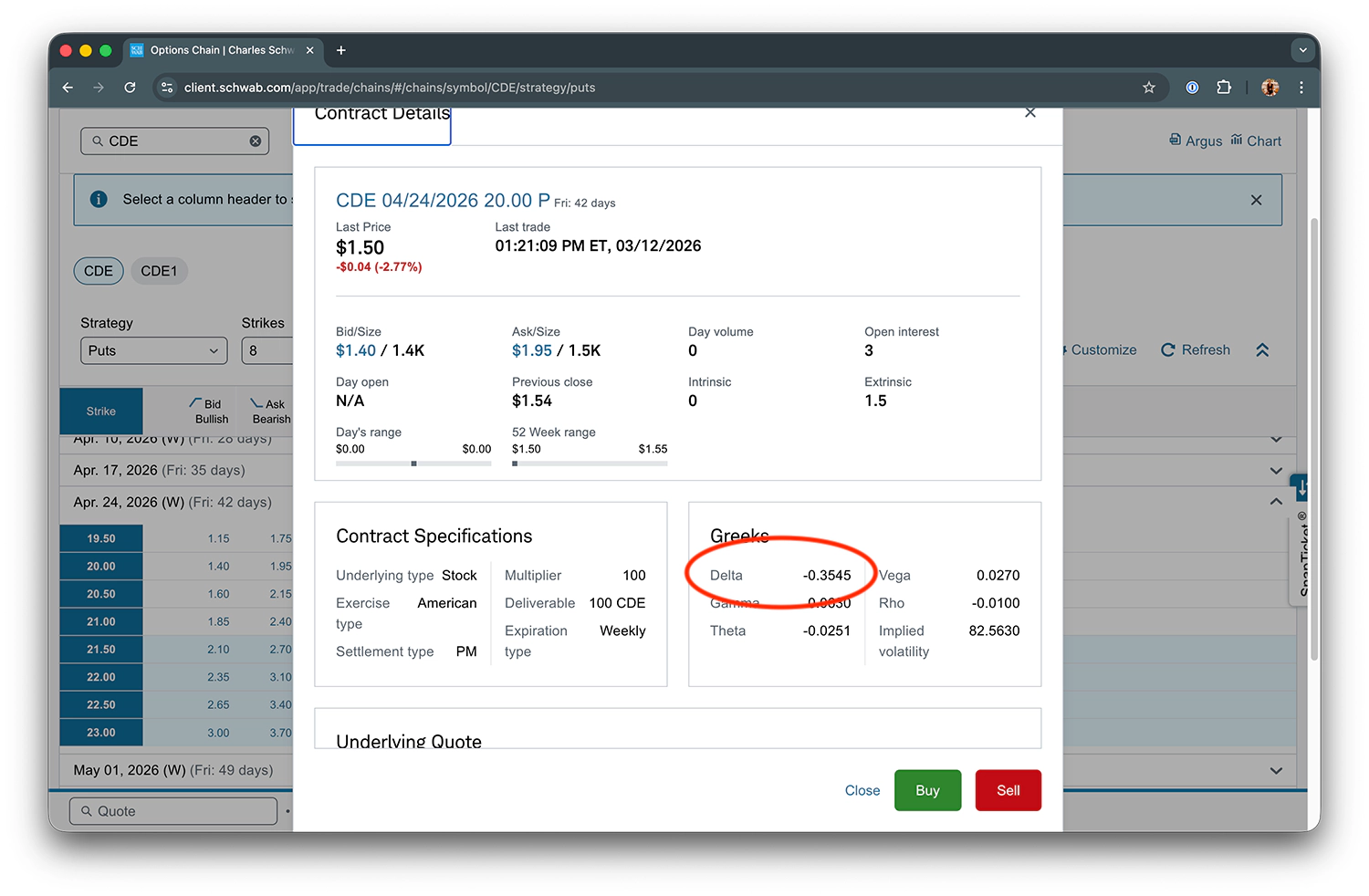
Let’s look at a real contract:
- Here we have a put contracted pulled up for
CDE - The stock is currently trading at $21.23
- The contract has 42 DTE
- And the put is priced at $1.50
This particular put has a delta of -0.3545, which means two things:
- For every $1
CDEdrops, this put gains approximately $0.35 in value - There’s roughly a 35% probability this put finishes ITM and you get assigned the shares at $20.00
If you sold this put:
- You’d collect $150 in premium ($1.50 x 100 shares)
- You’d have about a 35% chance of being assigned
- That means a ~65% chance the option expires worthless and you keep the full premium
We’ll reference this same contract throughout the article, adding a new Greek lens each time.
Why Does Theta Decay Your Option’s Value Every Day?

Theta measures how much value an option loses per day just from time passing, all else being equal.
It’s always negative for option buyers (time works against you) and effectively positive for option sellers (time works in your favor).
A theta of -0.0251 means the option loses approximately $0.0251 per share per day, or $2.51 per contract per day.
Why Theta Is the Wheel Trader’s Best Friend
When you sell a CSP or covered call, you collect premium upfront.
Every day that passes, theta erodes the value of the option you sold. Your obligation becomes cheaper to buy back (or more likely to expire worthless).
You’re literally getting paid for time passing.
That’s the entire business model of premium selling. Theta is the income engine.
The Theta Decay Curve
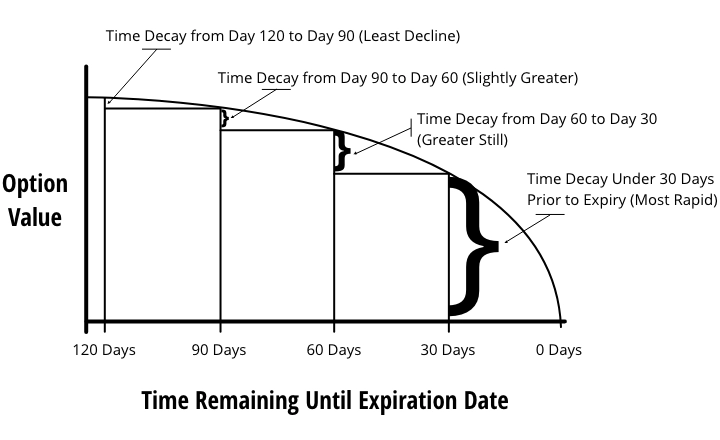
Theta decay is not linear. It accelerates as expiration approaches.
Here’s a rough sketch of the curve (using generic values to illustrate the principle):
- At 60 DTE: Theta is gentle, maybe ~$1/day per contract
- At 30 DTE: Theta accelerates, maybe ~$2.50/day per contract (the sweet spot where decay becomes meaningful)
- At 7 DTE: Theta is aggressive, maybe ~$5+/day per contract (value is melting fast)
This is why many Wheel traders target 30-45 DTE when selling options. You’re entering right as theta decay starts accelerating, capturing the steepest part of the curve.
For the full treatment of theta-based timing (including when to enter, when to close, and how to maximize decay), see my dedicated article on Understanding Theta: Time Decay and The Wheel Strategy.
Theta Greek Example
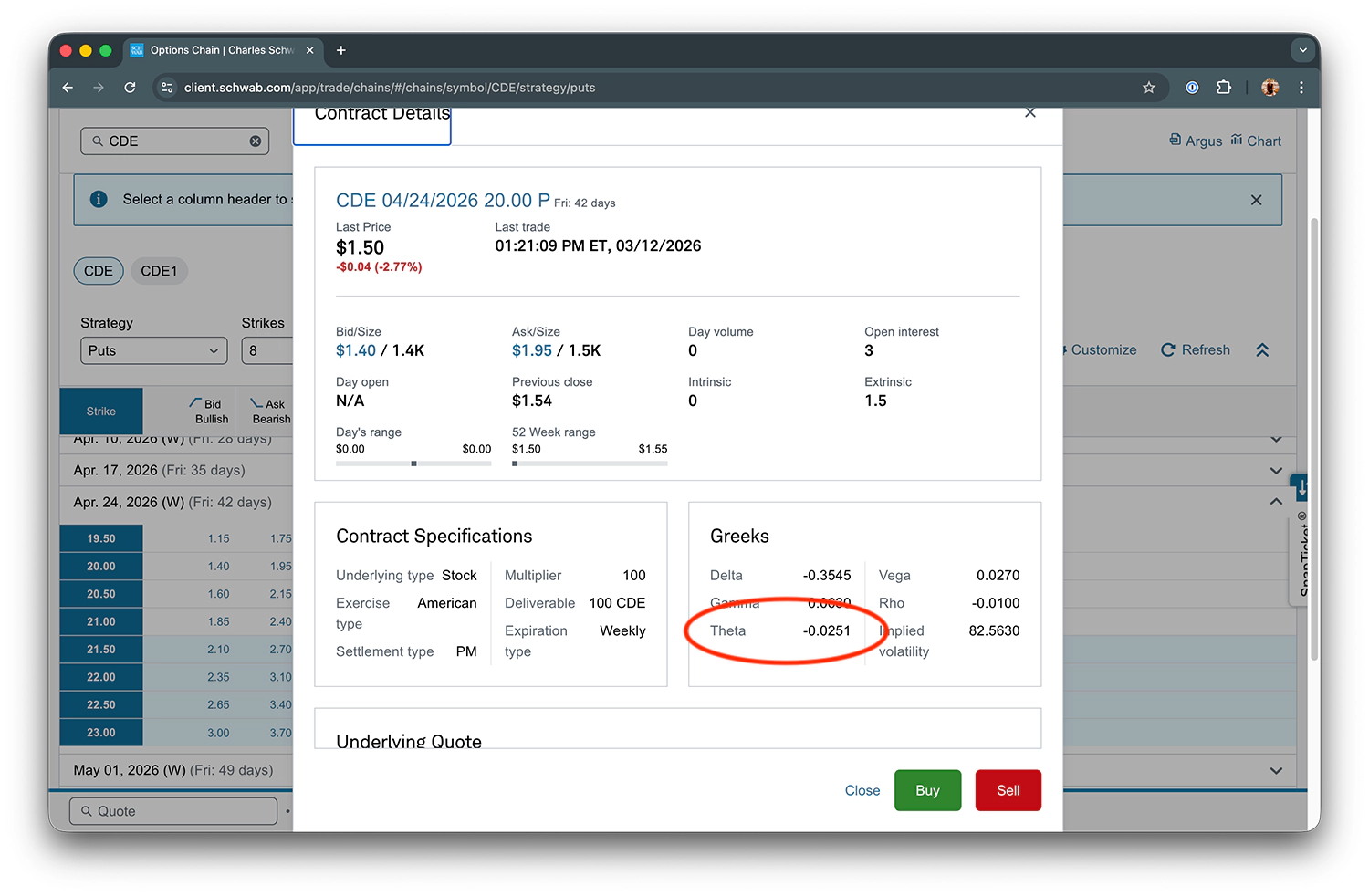
Looking back at our CDE contract details from above, the $20.00 Put has a theta of -0.0251.
This option is losing about $2.51 per contract per day to time decay.
If you sold this put, that daily decay is working in your favor. The option gets cheaper every day you hold it (assuming the stock doesn’t move against you).
Theta Scenarios and Lessons
When Theta Works in the Seller’s Favor
Here is an ideal scenario in which theta decay works for you:
- You sell a CSP at 35 DTE
- The stock barely moves over three weeks
- By 14 DTE, theta has eroded so much value that you can buy the option back for a fraction of what you sold it for
- Or just let it expire worthless
- You collected premium for doing nothing
The Beginner Mistake (Buying Options and Fighting Theta)
A beginner buys a call option expecting the stock to go up. The stock does go up, but slowly.
The call barely moves or even loses value. Why?
Because theta is eating away at the premium faster than the stock movement is adding value. The stock went in the right direction, but time decay won the race.
(Hint: This is the moment that turns most option buyers into option sellers.)
A Note on LEAPs
If you buy LEAPs (long-dated options, 1+ year out), always check theta before placing your order.
LEAPs are still wasting assets, just more slowly.
If you’re a buy-and-hold options investor, don’t forget:
Your position is bleeding value every single day, even when the stock isn’t moving.
If you invest in LEAPs, I suggest screening your stock universe for:
- Strikes you’re happy with
- Premiums you can afford
- LEAPs with theta values as low as possible
Don’t let theta decay eat your profits if you’re going long on a stock!
What Is Gamma and Why Does It Make Delta Unstable?

If delta is your speed, gamma is your acceleration.
- When you’re driving, speed tells you how fast you’re going right now
- Acceleration tells you whether you’re speeding up or slowing down
Effectively, gamma is the accelerator pedal for delta.
What Gamma Measures
Gamma measures how much delta changes for each $1 move in the underlying stock.
If your put has a delta of -0.35 and a gamma of 0.063:
- If the stock drops $1, your new delta is approximately -0.35 - 0.063 = -0.413
- If the stock rises $1, your new delta is approximately -0.35 + 0.063 = -0.287
Delta isn’t a fixed number. It’s constantly shifting as the stock moves, and gamma tells you how fast.
Where Is Gamma Highest?
Gamma behaves differently depending on where the option sits relative to the stock price:
- ATM options have the highest gamma (delta is most sensitive near the money)
- Deep ITM and deep OTM options have low gamma (their deltas are already near the extremes and don’t shift much)
- Gamma increases as expiration approaches (ATM options near expiration have the highest gamma of all)
Gamma Greek Example
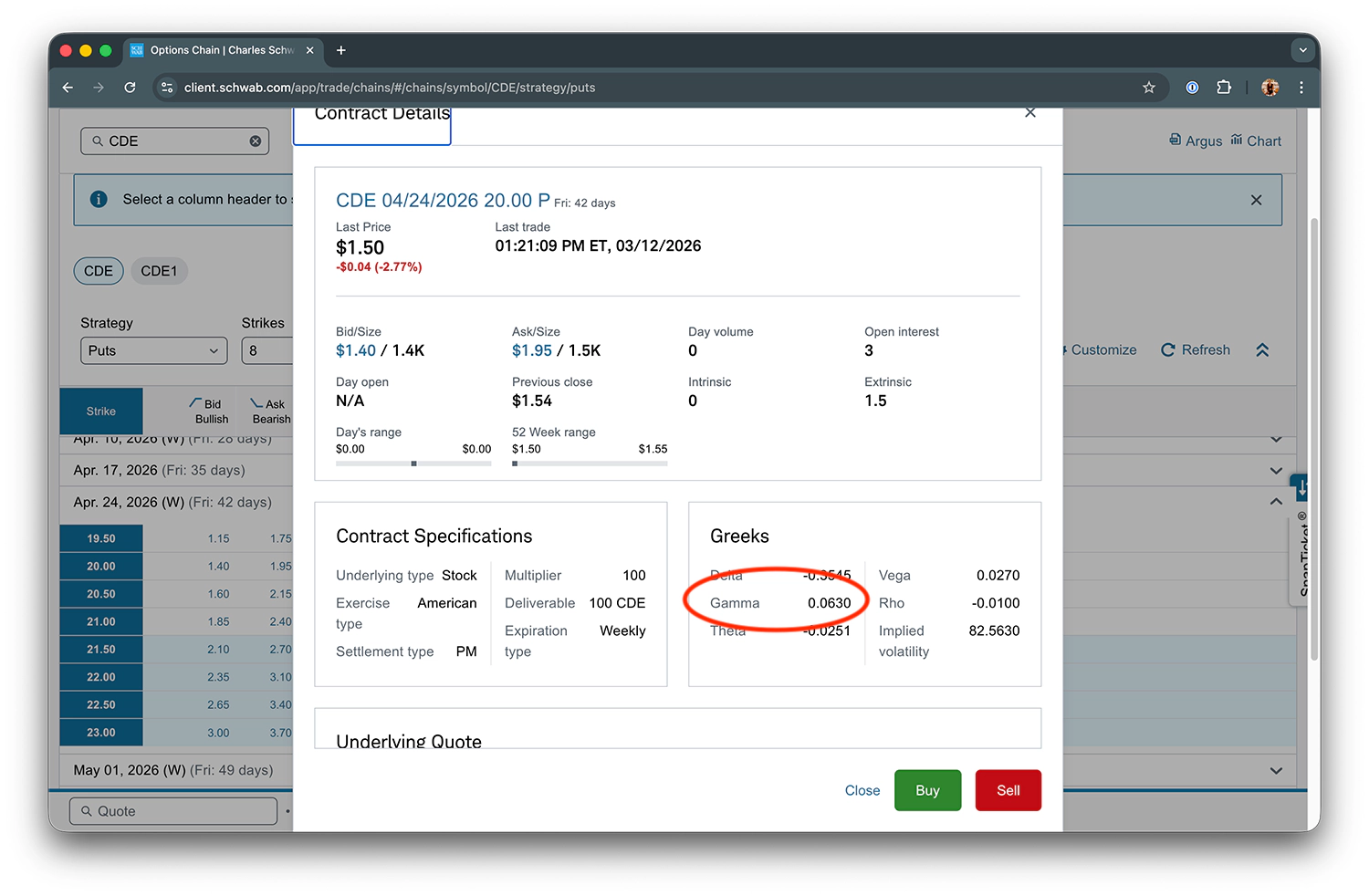
Looking back at our CDE contract details, the $20.00 Put has a delta of -0.3545 and a gamma of 0.0630.
- If
CDEdrops $1 from $21.23 to $20.23, delta shifts from -0.35 to approximately -0.41 - The option is now more sensitive to further stock movement
- If
CDEdrops another dollar, delta shifts again, and gamma is compounding the effect
Each dollar of movement makes the next dollar of movement matter more.
Why Gamma Creates Risk for Option Sellers Near Expiration
Gamma spikes near expiration for ATM options.
Delta can swing wildly with small stock movements.
A stock hovering near your strike in the final days turns your assignment probability volatile.
This is one reason Wheel traders close or roll positions before expiration rather than letting them ride to the last day.
Gamma near expiration turns a predictable position into a coin flip.
Most experienced sellers don’t stick around for that (your blood pressure will thank you).
How Does Vega Connect Volatility to Option Prices?

When IV spikes (like before earnings), option premiums inflate.
Vega tells you exactly how much.
Vega measures how much an option’s price changes for each 1 percentage point change in implied volatility.
Higher IV means higher premiums (the more uncertainty, the more the options cost). Lower IV means lower premiums.
Vega quantifies this relationship: the dollar amount the option’s price changes per 1% IV move.
Vega Greek Example
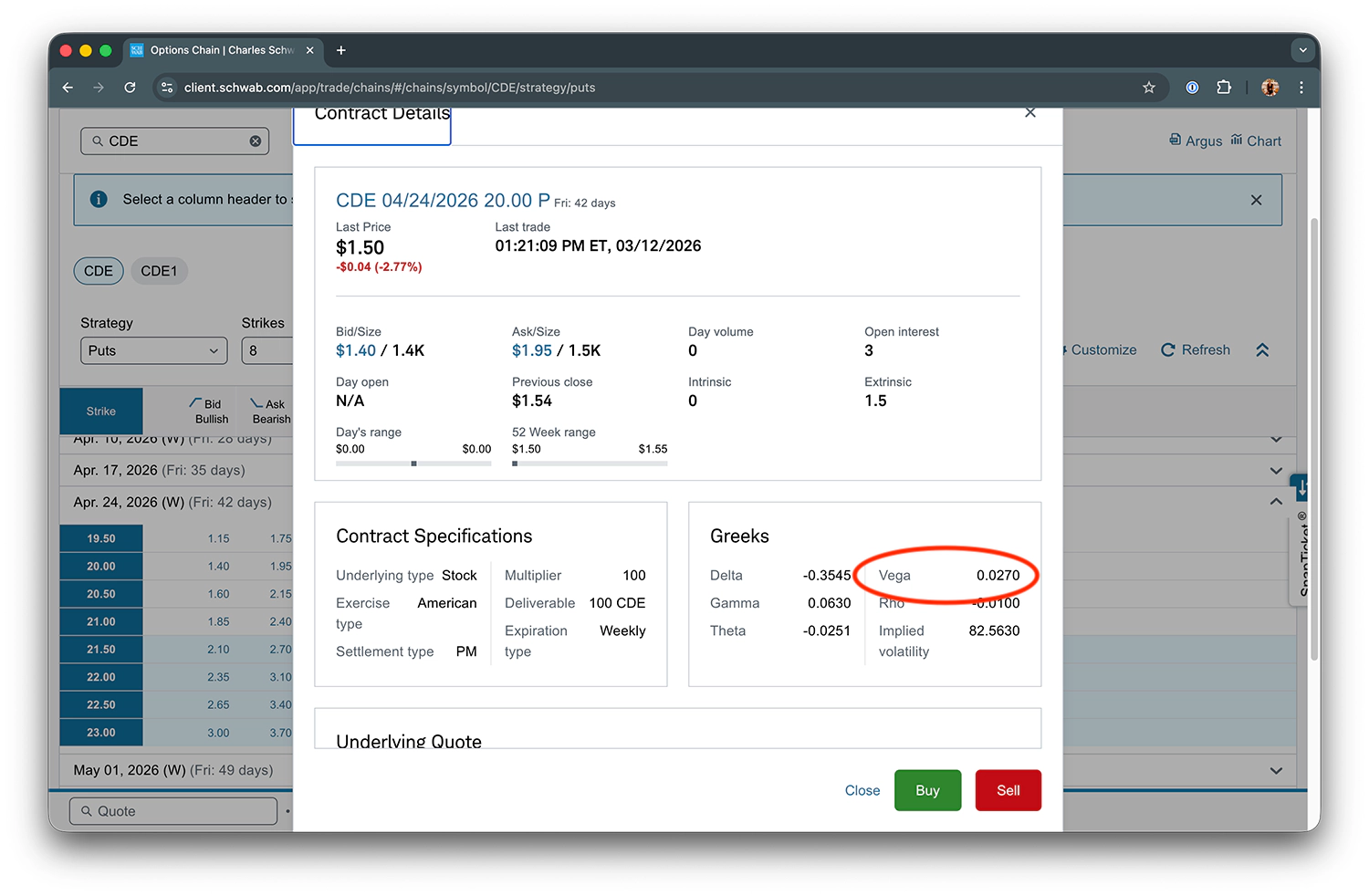
Looking back at our CDE contract details, the $20.00 Put has a vega of 0.027 and an IV of 82.56%.
- If IV drops by 1 percentage point (from 82.56% to 81.56%), the option price decreases by approximately $0.027 per share, or $2.70 per contract
- If IV rises by 1 percentage point, the option price increases by the same amount
CDE’s IV of 82.56% is quite high. This is a volatile stock, which is why the premium is relatively rich for an OTM put.
High IV equates to fat premiums for sellers.
Why Vega Matters for Timing Wheel Strategy Entries
Selling options when IV is elevated means collecting richer premiums for the same obligation.
If IV subsequently drops after you sell (IV crush), the option you sold becomes cheaper. Good for you as the seller.
This is why Wheel traders pay attention to IV rank and IV percentile. They want to sell when IV is high relative to its own history, not just high in absolute terms.
The classic example is earnings announcements.
IV spikes before earnings (uncertainty about the announcement) and often crashes after (uncertainty resolved).
If you sold an option before earnings, vega was working against you as IV rose. After the announcement, IV crush works in your favor.
This is a nuanced topic, and the dedicated IV articles go much deeper on timing and IV analysis.
For how implied volatility affects premium pricing and how to time entries, start there, then learn to compare IV and HV to find better Wheel trades.
How Do the Greeks Work Together on a Real Position?
The Greeks don’t operate in isolation. They push and pull simultaneously on your option’s price.
Here’s what that looks like for a short put position (i.e., selling a CSP in The Wheel Strategy):
| What Changed | Greek Involved | Effect on Your Short Put | Good/Bad for You? |
|---|---|---|---|
| Stock drops $1 | Delta | Put gains ~$0.35 in value (costs more to buy back) | Bad |
| One day passes (stock flat) | Theta | Put loses ~$0.025 in value (cheaper to buy back) | Good |
| Stock hovers near strike at expiration | Gamma | Delta swings wildly (assignment probability becomes unstable) | Bad |
| IV spikes (e.g., earnings approaching) | Vega | Put gains value (costs more to buy back) | Bad |
| IV drops (e.g., after earnings) | Vega | Put loses value (cheaper to buy back) | Good |
All four Greeks in action on a single position.
Here’s a hypothetical example using our CDE $20 put from earlier:
- Week 1: You sell the
CDE$20 put at 42 DTE. Delta says ~35% chance of assignment. Theta starts working in your favor with small daily decay. - Weeks 2-3:
CDEdrifts sideways. Theta is your best friend here. Every day the stock doesn’t move meaningfully, your option loses value. You’re winning by doing nothing. - Weeks 3-4:
CDEdrops toward $20.50. Delta increases (your put is getting closer to the money). Gamma accelerates the delta shift. Your assignment probability climbs. Meanwhile, IV might spike on the move, and vega makes the option more expensive to buy back. - Decision point: Do you hold and let theta continue working? Or close because gamma risk is rising near your strike?
The Greeks don’t make the decision for you, but they tell you exactly what forces are at play
My point is this:
At any given moment, multiple Greeks are acting on your position simultaneously, some in your favor, some against.
Understanding the balance is what separates reactive trading from intentional position management.
If you’re mathematically inclined and already comfortable with options, you can visualize these forces interacting rather than reading them off a table. GammaWins built a free options calculator that plots the Greeks on a P/L curve, with price and time sliders so you can see delta, theta, and the rest shift as the position moves.
You don’t need it to trade the Wheel, but it’s a nice way to build intuition if visualizing the dynamics is how your brain works.
Options Greeks Cheat Sheet
Tear this out and tape it next to your monitor. (Or bookmark this page. Less tape residue.)
| Greek | What It Measures | Typical Range | One-Liner Takeaway | Wheel Trader Tip |
|---|---|---|---|---|
| Delta | Price sensitivity to $1 stock move | 0 to 1.0 (calls) / 0 to -1.0 (puts) | “How much does my option move when the stock moves?” | Use delta as your probability-of-assignment gauge — target the range that matches your risk tolerance |
| Theta | Daily time decay | Always negative for buyers | “How much am I losing (or gaining) per day to time?” | Theta is your income engine — sell at 30-45 DTE to capture the steepest decay |
| Gamma | Rate of delta change | Highest ATM, near expiration | “How fast is my delta shifting?” | Watch gamma near expiration — it’s why closing or rolling early can save you from whipsaw |
| Vega | IV sensitivity per 1% move | Varies by DTE and strike | “How much do IV changes affect my option’s price?” | Sell when IV is elevated to collect richer premiums — then benefit from IV crush |
| Rho | Interest rate sensitivity | Small for short-dated options | “How do interest rate changes affect my option?” | Safely ignore for short-dated Wheel trades; matters more for LEAPs |
What Is Rho (and Can You Safely Ignore It)?

Rho measures how much an option’s price changes for a 1% change in interest rates.
For short-dated options (the kind Wheel traders typically sell at 30-45 DTE), rho’s impact is negligible.
Rates don’t move enough in a month to matter (and if they do move significantly in a month period, you likely have way more problems than your Wheel Strategy account).
Essentially, you can safely ignore rho for the Wheel Strategy.
For LEAPs holders (1+ year out), a 1% rate change can meaningfully shift the option’s value. Rising rates generally increase call values and decrease put values for long-dated options.
If you’re holding LEAPs, rho is worth monitoring alongside theta. Both are slow-burn forces that compound over long holding periods.
Where to Go After Learning the Greeks
You now understand the four primary Greeks and what each one measures.
You can look at the Greeks on your screen and understand the forces acting on your position. You know which ones help you as a Wheel seller (theta, and vega when IV is elevated) and which ones create risk (gamma near expiration).
That’s a meaningful upgrade to your options toolkit.
In summary:
- Delta tells you directional exposure and assignment probability
- Theta tells you how much value is decaying in your favor each day
- Gamma tells you how fast your exposure is changing
- Vega connects implied volatility to the premiums you collect
Each Greek gets its own dedicated deep dive in the Options Fundamentals series, where we apply them directly to the Wheel Strategy.
The Greeks don’t tell you what to do. They tell you what forces are acting on your position so you can decide for yourself.
And that’s the difference between guessing and trading with intention.