 by
by 
Annual yield is calculated as (Premium / Capital) x (365 / DTE). It annualizes your return so you can compare options trades across different strikes, DTEs, and stocks on an apples-to-apples basis.
For example, suppose you see a $3.50 premium put on a stock you like and think, “That looks solid.”
But is it?
How do you know?
Annual yield helps you address this question.
I run this formula on every single trade before I enter it. If the annual yield doesn’t clear 20%, the trade doesn’t happen.
No exceptions (well, almost no exceptions, but we’ll get to that).
Annual yield is one filter inside a bigger CSP process. If you’re learning more about CSPs, I suggest reading the complete CSP playbook.
Table Of Contents
Why You Need to Annualize Your Options Premiums
A 2% return sounds like a 2% return.
But it’s not.
What’s missing is the period over which that 2% is accrued:
- 2% in 7 days = 104.3% annualized
- 2% in 90 days = 8.1% annualized
Same percentage. Wildly different annual yields.
This is the trap that catches traders who compare premiums by raw dollar amount. You look at a 45 DTE trade paying $5.00 and a 30 DTE trade paying $3.50, and the $5.00 looks better because it’s more money.
Is it?
Well, that depends on how long your capital is tied up.
Without annualizing, you’re flying blind. You have no way to compare trades across different expirations, different strikes, or different stocks. You’re just grabbing the fattest premium and hoping for the best.
Annual yield isn’t the only number that matters, though.
Return on Capital (ROC) tells you how efficiently your capital is working per cycle (which we’ll cover in the next article).
But annual yield is where the comparison starts.
The Annual Yield Formula
Here’s the formula for annual yield:
Annual Yield = (Mark / Strike) x (365 / DTE)
Three components, each doing a specific job:
- Mark (midpoint of bid and ask): The most realistic estimate of the fill price you’ll actually get.
- Strike: Your capital at risk per share. For cash-secured puts, this is the price you’re committing to buy at (strike x 100 for one contract).
- 365 / DTE: The annualization factor. This normalizes everything to a yearly rate so you can compare trades with different time horizons.
Screening for Annual Yields
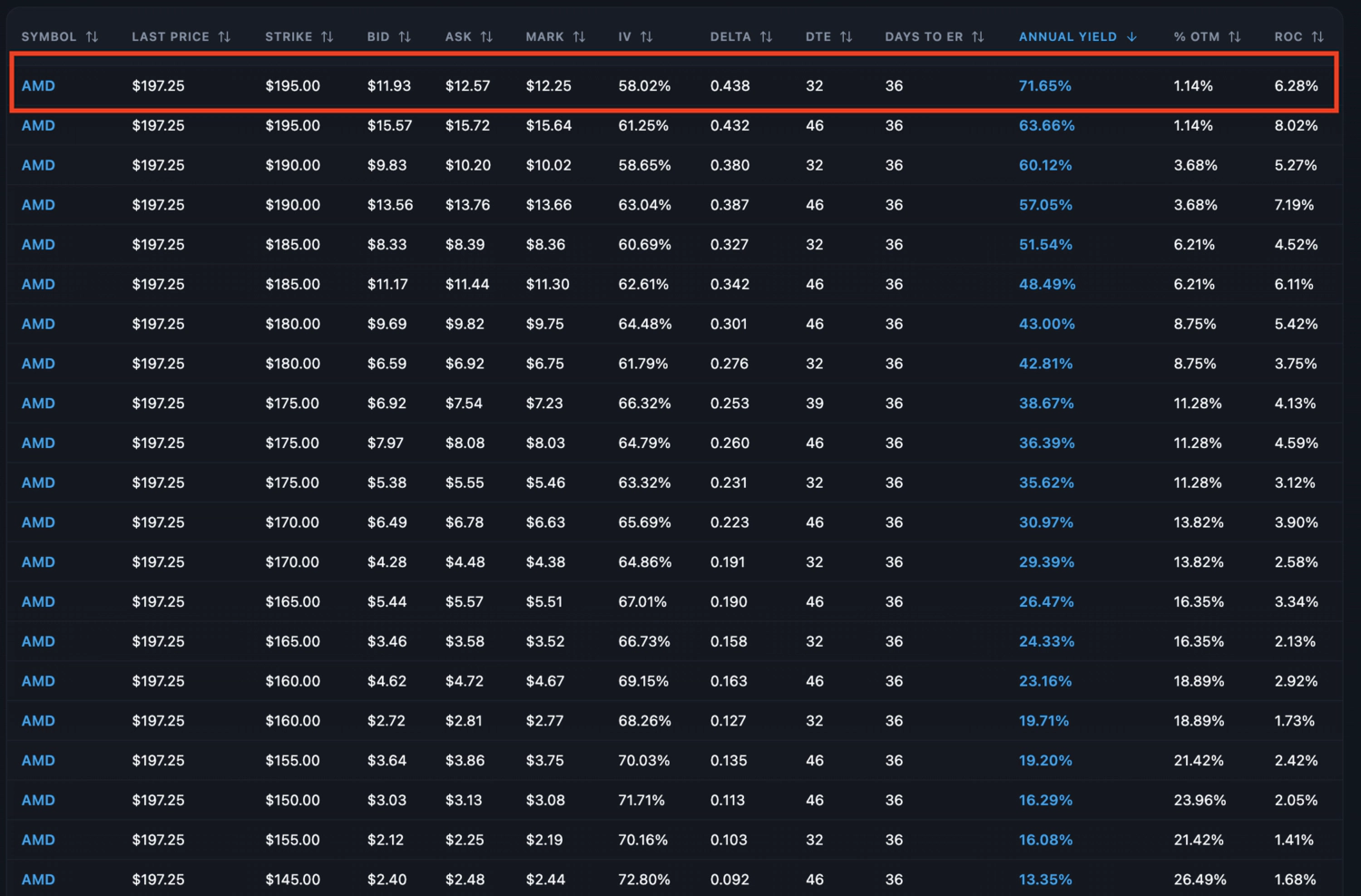
The above image shows puts for AMD with a 30-53 DTE, sorted by annual yield.
As you can see, the annual yield varies between 71.65% on the high end, all the way down to 13.36% on the low end.
Now let’s plug in real numbers.
AMD is currently trading at $197.25. We’re looking at the $195 strike put with 32 DTE (highlighted in the image above):
- Mark = $12.25
- Strike = $195.00
- DTE = 32
- Annual Yield = ($12.25 / $195.00) x (365 / 32)
- Annual Yield = 0.0628 x 11.41
- Annual Yield = 71.65%
71.65%.
Sounds incredible, right?
Before you start mentally spending that yield, look at the delta: 0.438.
That’s nearly a coin flip on assignment.
You’re getting paid handsomely because you’re taking on serious risk that AMD drops below $195, resulting in you buying 100 shares at a price just $2.25 below where it’s currently trading.
High yield is not the same as good yield.
The premium compensates for the risk. Always check what you’re being paid for.
Now let’s take a look at annual yield across varying strikes.
Annual Yield Across Different Strikes
Let’s pull out three rows from the screener above to better understand how annual yield changes across strikes.
These three examples are for AMD at $197.25 with 32 DTE:
| Strike | % OTM | Mark | Delta | ROC | Annual Yield | Risk Reality |
|---|---|---|---|---|---|---|
| $195 (Near-ATM) | 1.14% | $12.25 | 0.438 | 6.28% | 71.65% | Nearly a coin flip on assignment |
| $185 (Mid-Range) | 6.21% | $8.36 | 0.327 | 4.52% | 51.54% | Moderate cushion, moderate yield |
| $160 (Deep OTM) | 19.71% | $2.77 | 0.127 | 1.73% | 19.75% | Safe, but borderline for our 20% threshold |
The pattern here is clear.
As you move further OTM, yield drops. Premium falls faster than capital decreases, so the ratio compresses.
Would I sell the $195 strike? Not a chance. That delta is too close to a coin flip for my taste.
The $185 strike at 51.54%? Now we’re talking. A 6% OTM cushion with a 0.327 delta gives breathing room while still delivering a strong yield…but the delta is still a bit high for me.
And then there’s the $160 strike at 19.75%.
While the trade is relatively safe, the annual yield just isn’t large enough to justify the risk.
Honestly, if I was presented with these three trades, I’d likely skip on each of them.
Not because 19.75% is terrible. It beats the S&P’s long-term average. It beats treasuries. It beats money markets.
But tying up $16,000 in capital over 30 days for a $277 return likely isn’t the best use of capital for me.
One more thing worth noting:
In a low-IV environment, these yields compress across the board. The near-ATM trade might drop from 71% to 40%, and the deep OTM trade might fall to single digits. The relative pattern stays the same, but the absolute numbers shift with volatility.
What Counts as “Capital” in the Annual Yield Calculation

For cash-secured puts, capital is defined as:
Capital = Strike Price x 100
If you sell the $185 strike, your broker locks up $18,500 in collateral for the duration of the contract. That $18,500 is the denominator in your yield calculation.
This article focuses on cash-secured puts. If you’re using margin, your yield numbers are inflated and misleading.
Margin reduces your capital requirement on paper, which makes the yield look better.
But it doesn’t reduce your risk…instead, it increases it.
For the full breakdown on why risk increases with margin, see my guide on Cash Secured Puts vs. Naked Puts for The Wheel Strategy.
What’s a “Good” Annual Yield? (Benchmarks and Thresholds)
My floor is 20% annual yield.
That’s not a guess. It’s a line I drew after running enough trades to know what’s worth my capital and what isn’t.
The exception:
I’ll go down to 15% for a stock I have strong conviction in, on a setup I genuinely like, and if I don’t believe there will be better opportunities in the next 30 days.
But 15% is the exception. 20% is the rule.
Why 20%? Because your capital has alternatives:
| Benchmark | Annual Return | Your Capital Does… |
|---|---|---|
| Money market (top accounts) | ~4% APY | Nothing — sits in cash, FDIC insured |
| 10-year Treasury | ~4.25% | Locked for 10 years, guaranteed by Uncle Sam |
| SPY buy-and-hold | ~10% long-term avg | Rides every drawdown, no active management |
| CSP floor (mine) | 20%+ | Active management, 30-52 DTE cycles |
If your annual yield doesn’t beat these, why bother tying up the capital?
You’re doing real work here. Selecting stocks, analyzing options chains, managing positions, locking up capital that can’t be deployed elsewhere. That effort and that risk should be compensated well above what a money market or index fund delivers passively. (For a full walkthrough of how CSPs fit into the broader strategy, see The Wheel Strategy: The Complete Guide.)
The Yield Trap
Here’s the thing about those sky-high yields. Beginners see 70%, 80%, 90% annual yields and think they’ve found the cheat code.
They haven’t.
Look back at our screener data. The $195 strike on AMD shows 71.65% annual yield. Incredible on paper. But the delta is 0.438, meaning you’re nearly a coin flip from assignment on a strike that’s only 1.14% below the current price.
A 25% annual yield on a stock you’d happily own at that strike beats a 70% yield on a trade that keeps you up at night.
The yield trap is chasing the number while ignoring what the number is telling you.
High yield is the market’s way of saying, “This trade has a high probability of going against you.”
The premium isn’t a gift. It’s compensation for risk.
For a deeper look at the risk-reward tradeoffs of selling CSPs, check out The Pros and Cons of Selling Cash Secured Puts.
How to Use Annual Yield to Filter and Compare Trades
Annual yield is a screening tool, not a decision-maker.
Here’s how it fits into the workflow:
- Start with stocks you’d own if assigned. Maintain a watchlist of fewer than 50 (ideally fewer than 25) quality stocks you’ve researched and have genuine conviction in.
- Check delta. Does the assignment probability match your risk tolerance? A 0.15-0.20 delta is a reasonable starting point for most Wheel traders.
- Check IV. Is implied volatility elevated, compressed, or normal? This tells you whether the premium is rich or thin relative to history.
- Apply your annual yield threshold. Filter for 20%+ (or whatever floor you’ve set). Anything below gets cut immediately.
- Compare remaining candidates. Annual yield is the tiebreaker, not the only criterion. Delta, IV, and your conviction in the underlying all matter.
Note: This five-step filter is the condensed version of my full screening and filtering process for cash secured puts. And because the annualization math hinges on your expiration date, it pairs naturally with picking the right DTE.
If AMD at the $185 strike shows 51.54% annual yield and AAPL at a comparable strike shows 22%, annual yield helps you rank them.
But if you have higher conviction in AAPL and its delta fits your risk profile better, the lower yield might still be the better trade.
Before every Wheel trade, run this number. If it doesn’t clear your threshold, move on.
No negotiating. No “just this once.” The whole point of a system is that you follow it.
I’ll wrap up by saying annual yield tells you the rate of return.
But there’s another metric that tells you how efficiently your capital is working per cycle.
That’s Return on Capital (ROC), and it’s what we’ll cover next.