 by
by 
Screening cash secured puts is a two-step process. First, you filter for stocks you’d actually like to own for 6-12+ months. Second, you filter the options on those stocks by DTE, annual yield, delta, ROC, and earnings date.
Most traders invert this process, which I don’t recommend.
They open a screener, sort by highest premium, and work backward to convince themselves the underlying stock is “fine.”
Sound familiar?
That’s how you end up assigned on a stock you never wanted to hold, wondering where it all went wrong.
The fix isn’t a better screener. It’s a better process.
I built and refined these screener profiles through trial and error. The system exists because winging it led to bad assignments on stocks I had no business owning.
If you’ve already read my guide on choosing the right DTE, the criteria below will look familiar. What follows is how to turn those concepts into actual screener filters.
Note: Screening is one stage of the Wheel, and if you want the bigger CSP picture, I put it all in one guide.
Table Of Contents
Why Most Traders Screen for Cash Secured Puts the Wrong Way
The most common approach to screening CSPs goes something like this:
- Open a screener
- Sort by premium (highest first)
- Find a fat premium on a stock you’ve vaguely heard of
- Talk yourself into owning it, “Well, this stock doesn’t seem that bad…”
- Get assigned
- Stock gaps down 20%+
- Regret everything
That’s backwards. And it’s the single most common mistake new Wheel traders make.
The correct order of operations is stock screen first, options screen second.
You start with a curated list of stocks you’d buy outright at the strike price, and then you screen the options on those stocks for the criteria that matter.
This isn’t complicated. But it requires discipline, and discipline is the part most people skip.
How to Build a Pre-Screened Stock Watchlist

You should never sell a put on a stock you wouldn’t buy outright at that price.
If you wouldn’t happily hold 100 shares of that company for 6-12+ months after assignment, it has no business being on your watchlist. Period.
The stock screen comes first because it establishes the universe of names you’re willing to trade. The options screen narrows that universe to specific contracts worth selling.
For the stock screen itself, I look at a handful of fundamental criteria:
- Revenue growth
- EPS growth
- ROIC (return on invested capital)
- Debt levels
- Forward PEG ratio
I’m not going to deep-dive into stock selection methodology here (that deserves its own guide). The point is that these filters produce a watchlist of quality companies, and only then do you move to the options screen.
But if you do want to see what that watchlist looks like when I run it, every Monday I publish the best stocks for The Wheel Strategy, along with the cash-secured put setups on them.
What Each Screening Criterion Does (and Why It Matters)

Once you have a pre-screened stock watchlist, these are the filters you apply to the options chain.
DTE (Days to Expiration)
DTE determines how long your capital is locked up and how theta decay behaves over the life of the contract.
I covered this in depth in my guide on how to choose the right DTE when selling cash secured puts, so I won’t restate the full analysis here.
The short version:
30-52 DTE is my default range. It balances premium collection, theta efficiency, and manageable gamma exposure.
I also run a short-dated screener at 7-14 DTE for faster capital turnover when the setup is right.
But the majority of my Wheel positions come from 30-52 DTE.
Annual Yield
Annual yield normalizes premium across different DTEs so you can compare apples to apples.
Without it, you’re comparing raw dollar premiums on contracts with completely different time horizons, which tells you almost nothing.
I wrote a full breakdown of the annual yield formula and how to use it in How to Calculate Annual Yield on Wheel Strategy Options.
The key takeaway is that annual yield is how you compare trades, but it is not the deciding factor (it’s just one of the factors).
Delta
Delta serves as a probability proxy.
Lower delta means a higher probability of the option expiring worthless (which is what you want as a put seller), but it also means lower premium.
Higher delta means more premium but a greater chance of assignment.
For a deep dive into how delta works and why it matters for the Wheel, see Understanding Delta: The Most Important Greek for The Wheel Strategy.
ROC (Return on Capital)
ROC measures how much cash you collect per contract per cycle, without annualizing.
While annual yield tells you the rate of return, ROC tells you the absolute return per cycle.
This distinction matters most for short-dated trades where the annualization factor (365 / DTE) can inflate annual yield numbers, making a small absolute return look impressive on paper.
Don’t get sucked into selling a CSP just because the annual yield is high. You also need to check the ROC to making sure your account is getting enough of a lift to justify the risk.
I break down the full ROC formula in How to Calculate Return on Capital (ROC) for Wheel Strategy Options.
Earnings Date
Earnings announcements introduce binary event risk that no amount of strike selection or delta filtering can hedge.
A stock can gap 10-20% on an earnings miss or guidance revised downwards, and your carefully chosen OTM strike is suddenly deep ITM overnight.
My personal preference is to not hold a CSP through an earnings announcement. I filter for options that expire before the next earnings date.
That said, this is a preference, not a hard rule. Some traders are comfortable with the risk, especially on high-conviction names.
At minimum, be aware of the earnings calendar and reduce position size if earnings fall within your contract window.
Liquidity and Bid-Ask Spreads
Tight bid-ask spreads mean better fills and less slippage on entry and exit.
I’m not going to belabor this one here. If you want the full picture on how liquidity affects your Wheel trades, check out Understanding Bid-Ask Spreads and Options Liquidity, as well as Options Fundamentals: The Complete Guide.
The Standard Screener (30-52 DTE)
Here are my filter criteria for the standard screener I use:
| Criterion | Value | Rationale |
|---|---|---|
| DTE | 30-52 | Sweet spot for theta efficiency and manageable gamma |
| Annual Yield | > 20% | Floor to justify the capital lockup vs. passive alternatives |
| Delta | 0.2-0.3 | Balances probability of profit with meaningful premium |
| Earnings | Expires before next earnings date | Avoids binary event risk |
It’s worth noting that these four criteria work together, not independently.
- The DTE range captures the steepest part of the theta decay curve
- The delta range keeps assignment probability reasonable
- The annual yield floor ensures you’re being compensated well above what a money market or index fund delivers passively
- And the earnings filter removes surprise risk (well, as much as we reasonably can)
Remove any one of them and the system has a hole.
After the screener runs, you’ll see a list of candidates.
If you use ThetaScanner, the tool I use, your output would look something like this:
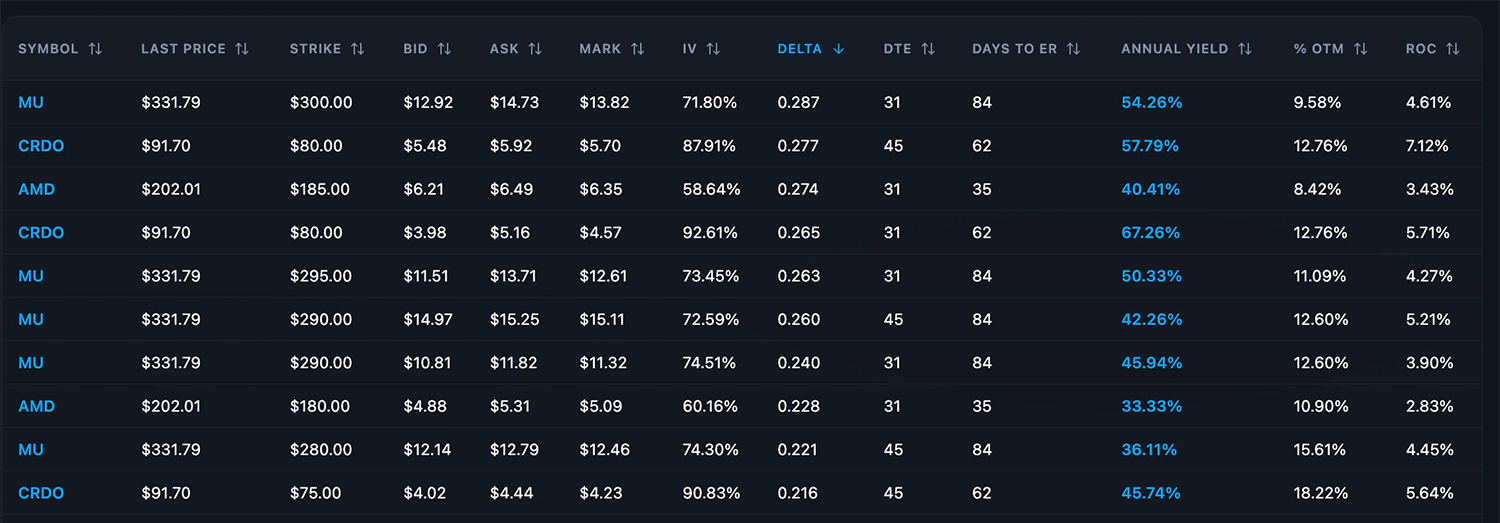
Note that this table includes only stocks that passed my pre-screener (~30 stocks out of the entire stock market). These are stocks I wouldn’t mind owning for 6-12+ months.
Of the 30 stocks that pass my pre-screener, only three stocks pass my options filter.
The table shows 10 candidates (across 3 tickers) with columns for symbol, price, strike, DTE, delta, annual yield, and ROC.
Don’t fixate on which specific stocks appear here as screener results shift daily with price movement, IV changes, and the earnings calendar.
What matters is the structure of the output: a filtered list of contracts that all meet your minimum criteria.
From here, you evaluate the top candidates based on conviction.
Ask yourself:
“Which stocks on this list do you have the highest confidence in?”
That’s where you start.
One more thing: always check bid-ask spreads before entering a position. A candidate can pass every filter and still be a poor trade if the spread is too wide.
For more on this, see Understanding Bid-Ask Spreads and Options Liquidity.
The Short-Dated Screener (7-14 DTE)
Below are the filter criteria for my short-dated screener:
| Criterion | Value | Rationale |
|---|---|---|
| DTE | 7-14 | Fastest theta decay, rapid capital turnover |
| Annual Yield | > 20% | Same floor as the standard screener |
| Delta | 0.0-0.35 | Wider range (explained below) |
| ROC | > 1.5% | Ensures meaningful absolute return per cycle |
| Earnings | Expires before next earnings date | Same filter as standard |
There are key differences from the standard screener are worth calling out:
- Why the delta range is wider
- Why ROC matters more
Why the Delta Range Is Wider
The standard screener uses 0.2-0.3 delta. The short-dated screener widens this to 0.0-0.35.
Now, don’t get me wrong — a wider delta range doesn’t mean reckless risk-taking.
Instead, it’s a practical concession. At 7-14 DTE, the options chain is thinner, and tighter delta filtering would eliminate too many candidates (leaving you with very few, or zero, viable trades).
The wider range keeps the funnel usable without meaningfully changing the risk profile.
Why ROC Matters More Here
ROC > 1.5% is a filter only for the short-dated screener. The standard screener does not use ROC as a filter threshold.
This is intentional.
At short DTE, the annualization factor (365 / DTE) inflates annual yield. A $0.30 premium on a 7-day trade can show a 30%+ annual yield, but the absolute return per cycle is tiny.
The ROC floor of 1.5% ensures each cycle generates enough cash to be worth the effort and the risk.
For the standard screener at 30-52 DTE, annual yield alone is sufficient because the annualization factor is less distortive.
What the Output Looks Like
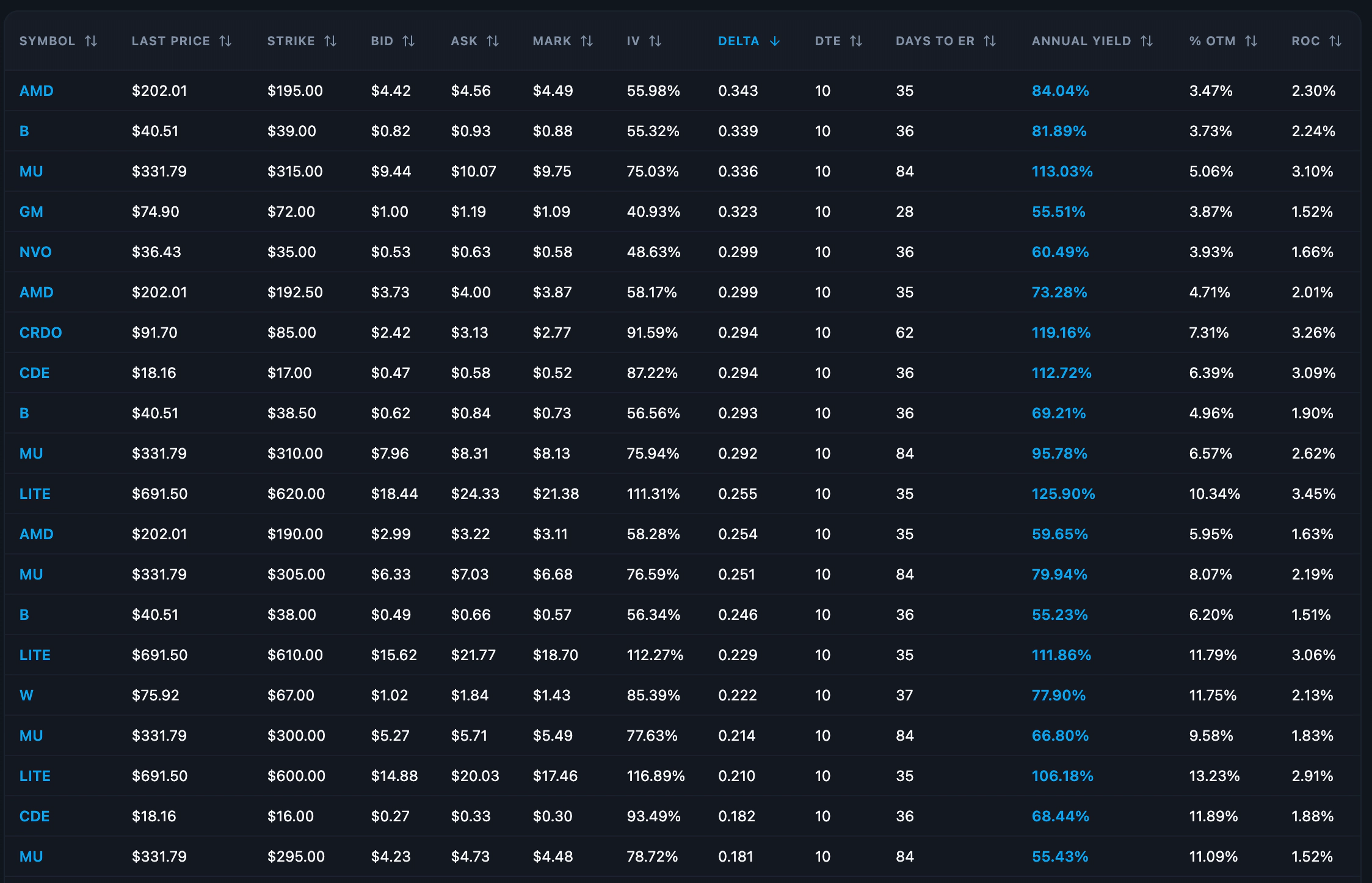
Take a second to study the table above.
Notice something?
The short-dated screener surfaces more candidates per ticker than the standard screener. The table displays just over 20 results across more tickers, with multiple viable strikes per name.
This is counterintuitive. You’d expect fewer options at shorter DTE. But the nature of how screeners work at short DTE (with wider delta range and more strike granularity near expiration) means you’ll often see more rows per ticker, not fewer.
Longer-dated options, by contrast, often return very few or even zero viable candidates per ticker. Most tickers simply won’t have a contract in the 30-52 DTE window that clears all four filters simultaneously.
As with the standard screener, always verify bid-ask spreads before entering. Short-dated options can have wider spreads, especially on lower-volume names.
Which Screening Tool to Use
Any options screener will work for this workflow, as long as it lets you filter by:
- DTE
- Delta
- Annual yield
- ROC
- Earnings date
For what it’s worth, the tool I use is ThetaScanner. I’ve found it straightforward to set up these exact filter profiles, and I know other retail Wheel traders who use it as well.
But I’m not here to pitch a tool. Use whatever works for you. The filters matter more than the interface.
How to Put It All Together (The Weekly Screening Workflow)
Screening isn’t a one-time event. It’s a weekly routine.
Here’s the workflow I follow:
- Monday morning: Run the stock screener to refresh the stock watchlist
- 2-3 times per week: Run the options screener(s) against the watchlist
- Before each trade: Verify bid-ask spreads and confirm earnings dates
The number of candidates you see depends entirely on market regime, volatility, and the earnings calendar:
- In bullish, elevated-IV environments, the standard screener might surface 30+ setups
- In bearish or low-volatility regimes, you might see only 5-10
- During earnings season, the earnings filter alone can cut your candidate pool in half
Fewer candidates isn’t a failure. It means the filters are working.
Here’s a simplified view of the entire funnel:
- Full Stock Universe → Stock screen (fundamentals, quality)
- Pre-Screened Watchlist (~30-50 stocks) → Options screen (DTE, yield, delta, ROC, earnings, liquidity)
- Filtered Candidates (varies by market regime) → Conviction check (highest confidence names with best setups)
- Trade → Open the trade in your brokerage account
The final step is where judgment meets system.
Look at the stocks with the highest conviction on your watchlist. If those same names are also showing top candidates in the screener output, that’s your signal.
Conviction plus criteria is the trade. Neither alone is sufficient.
Is it sexy? No.
Does it work? Consistently.
(You might want to laminate the flowchart and tape it to your monitor. Or don’t. I’m not your mother.)
How to Start Screening Your First Cash Secured Puts
The core idea is simple.
Screening is a two-step funnel: screen for quality stocks you’d own for 6-12+ months first, then screen for options that meet your criteria.
Start with the standard screener (30-52 DTE). Get comfortable with the workflow, learn how the filters interact, and build the habit of running it consistently.
Add the short-dated screener once you’ve got a few cycles under your belt and want faster capital turnover.
The system doesn’t guarantee winners. But it guarantees you’re never selling a put on a stock you don’t want to own, at a strike that doesn’t meet your criteria, on a timeline you haven’t thought through.
That alone puts you ahead of most Wheel traders.
- For a broader view of how screening fits into the overall Wheel Strategy, check out The Wheel Strategy: The Complete Guide.
- Once you’ve found your candidates, the next step is entering the position, which I walk through step by step.