 by
by 
The bid-ask spread is the difference between the highest price a buyer will pay (bid) and the lowest price a seller will accept (ask).
- A tight spread means efficient, low-cost execution
- A wide spread increases trading friction, often forcing you to give up edge when entering or exiting positions
Consider the following scenario:
You sell a cash-secured put, get filled near the ask, and collect a solid premium.
A week later the stock rallies and your position shows +80% profit. Time to book the win early.
You submit your buy-to-close as a market order…and only walk away with +30%.
The bid-ask spread just swallowed half your gain, and can be a major killer of Wheel Strategy returns. That spread is the topic of this article, and ignoring it is one of the most expensive mistakes Wheel Strategy traders make.
If you’re new to options chains and want a primer on the columns and layout, start with How to Read an Options Chain.
For the full picture of where bid-ask spreads fit within options fundamentals, check out my Options Fundamentals: The Complete Guide.
Table Of Contents
What Are Bid and Ask Prices?
Three numbers define every options transaction:
- Bid: The highest price a buyer is currently willing to pay for the option
- Ask: The lowest price a seller is currently willing to accept for the option
- Spread: The gap between them, and the hidden cost on every trade
Market makers are the firms posting these bid and ask prices. They profit from the spread itself (buying at the bid, selling at the ask, pocketing the difference). We’ll cover them in more detail in the next section.
Now let’s look at what these numbers look like in practice, on a contract you should probably never trade:
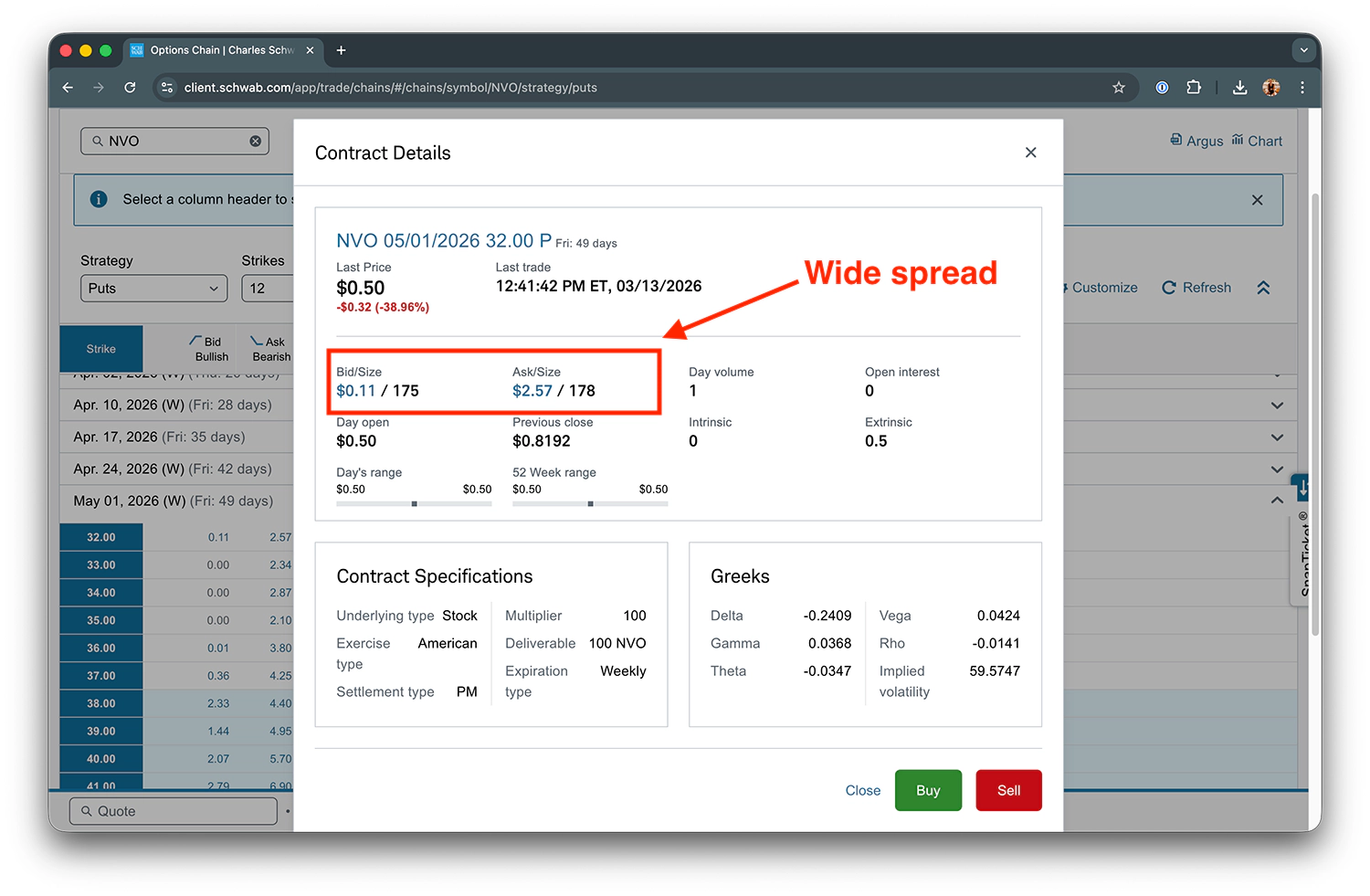
This is the contract detail for NVO (Novo Nordisk) 05/01/2026 $32 put on Schwab’s options chain.
Here’s what each number means:
- Bid: $0.11 — the most anyone is willing to pay for this put right now
- Ask: $2.57 — the least any seller will accept
- Spread: $2.46 — the gap between them
- Last: $0.50 — the price of the most recent trade
- Volume: 1 — exactly one contract has traded today
- Open Interest: 0 — zero outstanding contracts at this strike and expiration
What does that $2.46 spread actually mean?
If you sold this put at the bid ($0.11 per share) and immediately tried to buy it back at the ask ($2.57 per share), you’d lose $2.46 per share before the stock moves a penny.
The spread ($2.46) is wider than the option’s last traded price ($0.50). That’s what terrible liquidity looks like.
What Drives the Bid-Ask Spread on Options?
Six factors determine how wide or tight the spread will be on any given option:
- Volume and open interest: More participants trading means more competition, which tightens the spread. Low volume and OI means fewer participants, so market makers widen spreads to compensate for the risk of holding inventory.
- Liquidity of the underlying stock: Options on heavily traded stocks (
AAPL,AMD,SPY) have tighter spreads because the underlying is easy to hedge. Options on thinly traded stocks inherit that illiquidity. - Time to expiration: Options closer to expiration on popular strikes tend to have tighter spreads. Far-out expirations with low interest see wider spreads.
- Strike distance from current price: ATM and near-ATM strikes get the most trading activity and tightest spreads. Deep OTM and deep ITM strikes attract less interest and wider spreads.
- Overall market conditions: During volatility spikes, market panics, or after-hours trading, market makers widen spreads to protect themselves from rapid price changes.
- Market maker competition: More market makers quoting the same option means tighter spreads. They undercut each other to capture order flow.
How Market Makers Affect the Spread
Market makers deserve a brief explanation because they’re on the other side of most of your trades:
- They are the firms that continuously post bid and ask prices, providing liquidity so you always have someone to trade with
- They profit from the spread itself (buying at the bid, selling at the ask, pocketing the difference hundreds or thousands of times a day)
- More market makers competing on the same option drives spreads tighter, because they undercut each other to win your order flow
The takeaway: popular, high-volume options attract more market makers, which means tighter spreads, which means lower costs.
NVO vs. AMD (A Tale of Two Spreads)
Now let’s see all six factors in action by comparing two real contracts.
You’ve already seen the NVO $32 put earlier in this article. Here’s AMD:
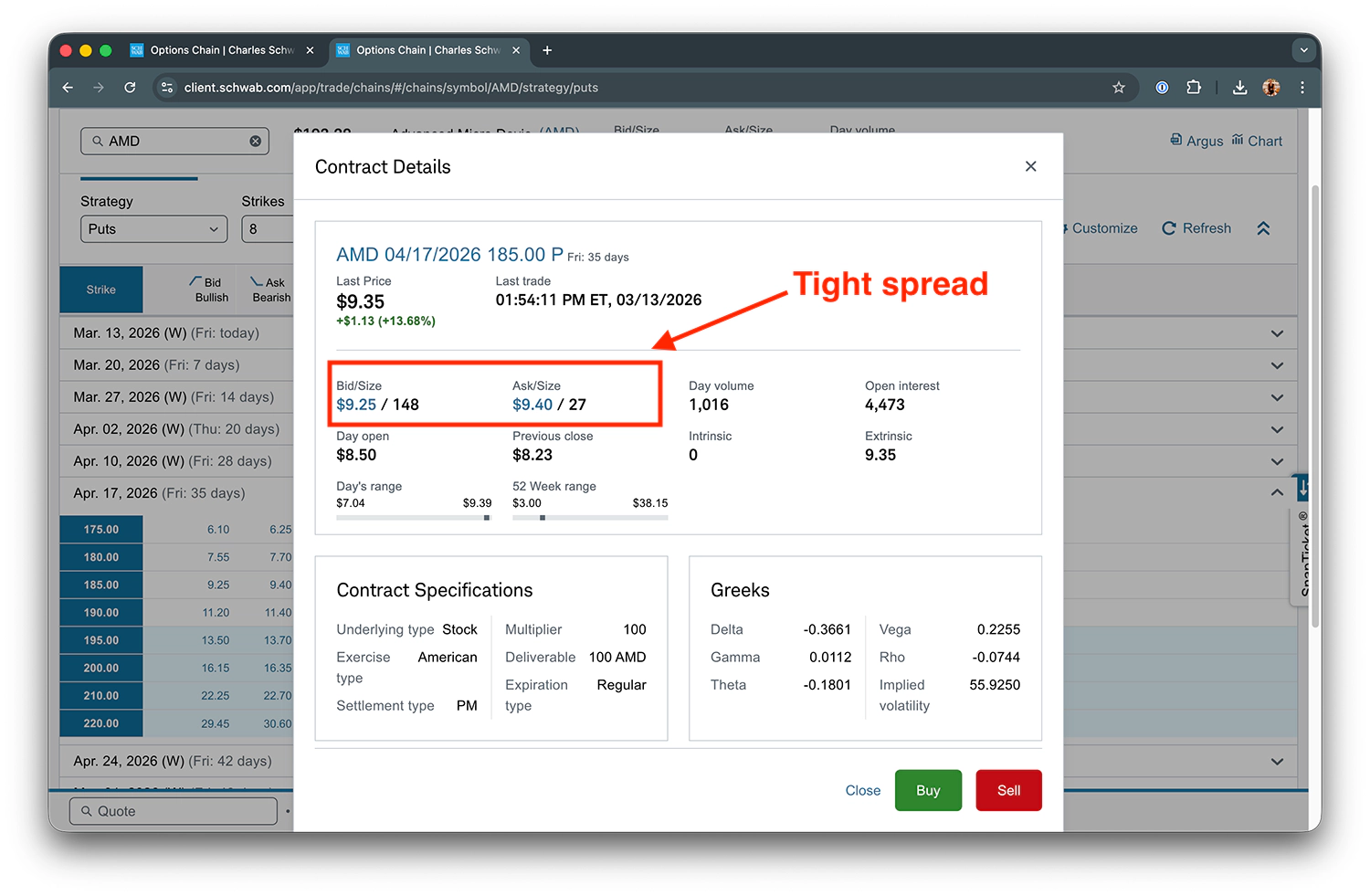
Same asset class. Same mechanics. But completely different spread:
| Metric | NVO $32 Put | AMD $185 Put |
|---|---|---|
| Bid | $0.11 | $9.25 |
| Ask | $2.57 | $9.40 |
| Spread | $2.46 | $0.15 |
| Mid | ~$1.34 | ~$9.30 |
| Volume | 1 | 1,016 |
| Open Interest | 0 | 4,473 |
| Spread as % of Mid | ~184% | ~1.6% |
Every single factor listed above is working in AMD’s favor and against NVO.
AMD has massive volume, deep open interest, a heavily traded underlying stock, and fierce market maker competition.
NVO has one lonely trade and zero open interest.
The spread tells you everything.
How Wide Spreads Erode Your Wheel Returns
The raw dollar spread doesn’t tell the full story.
The real measure of spread cost is the spread as a percentage of the premium you collect. That’s what determines how much of your edge the spread eats.
- On liquid options, the spread typically costs 1-3% of premium. Barely noticeable.
- On illiquid options, the spread can eat 20-50%+ of your collected premium. Sometimes more.
Let’s revisit our two contracts with the percentage-of-premium lens:
- AMD $185 put:
- Mid-price ~$9.30
- Spread $0.15
- Spread as % of premium: ~1.6%
- Cost per contract: ~$15
- You keep virtually all of the premium you collected
- NVO $32 put:
- Mid-price ~$1.34
- Spread $2.46
- Spread as % of premium: ~184%
- Cost per contract: ~$246
- The spread is wider than the premium itself
The NVO spread is wider than the premium. You literally cannot make money on this trade unless you sell the contract and it expires worthless.
Even if you somehow got filled somewhere near the middle, the spread cost overwhelms any premium you’d collect. Dead on arrival.
Could you technically trade the NVO put? Sure.
Should you? Not unless you enjoy donating money to market makers (they appreciate the generosity, I’m sure).
The Compounding Problem
The Wheel doesn’t involve one trade. It involves dozens.
- You sell CSPs
- You buy them back (or let them expire)
- You sell covered calls. You cycle back to CSPs
- Every single one of those transactions has a spread cost
Even a modest 5% spread cost per trade doesn’t sound bad in isolation, but over 30-40 trades per year it compounds into a meaningful drag on annual returns.
This is why liquidity isn’t a nice-to-have.
It’s a requirement for the strategy to work as intended.
What Are Volume and Open Interest in Options Trading?
Volume and open interest are the two numbers that predict spread quality before you even look at the bid and ask.
Volume
Volume is the number of contracts traded today. It resets to zero every morning.
High volume means lots of people are actively buying and selling this option right now.
Low volume means almost nobody is trading it, and you may struggle to get filled at a fair price.
Open Interest
Open interest is the total number of contracts that currently exist and haven’t been closed out.
Think of it as a running tally of how many contracts are still “alive” at a given strike and expiration.
Every options contract requires a buyer and a seller.
When both open new positions (one buys to open, one sells to open), that creates one new contract, and open interest goes up by one.
When someone closes their position (buys to close or sells to close against an existing contract), that contract ceases to exist, and open interest goes down.
High open interest means deep liquidity. Lots of traders have active positions at this strike and expiration, which typically means tighter spreads and easier fills.
Low or zero open interest means you’re essentially alone. No existing market. Wide spreads. Poor fills.
What Each Number Tells You
Here’s how to read volume and open interest together:
- High volume + high OI: Active trading, deep existing market, tight spreads (this is what you want)
- High volume + low OI: A one-day spike, not necessarily sustainable liquidity
- High OI + low volume: The market exists but nobody’s active today (spreads may be wider than usual)
- Low volume + low OI: No market, wide spreads, avoid
You want both volume and OI to be healthy.
Volume and OI in Action
Let’s revisit our two contracts one more time:
- AMD $185 put: Volume 1,016; Open Interest 4,473 — active trading, deep market, tight spread ($0.15, 1.6%)
- NVO $32 put: Volume 1; Open Interest 0 — one lonely trade, no existing market, wide spread ($2.46, 184%)
The volume and OI numbers predicted the spread quality perfectly. You didn’t even need to look at the bid and ask to know which contract was tradeable.
How to Trade Options with Tight Bid-Ask Spreads

Here is where the theory turns into something you can actually use on your next trade.
Check Liquidity Before You Trade
Before entering any position, look at the volume and open interest on your target strike and DTE:
- High volume and high OI at your target strike = green light
- Low or zero volume and low or zero OI = red flag
- If the options chain looks empty at your target strike and DTE, consider a different stock or a different expiration
An empty options chain is the market telling you nobody else wants to be here. Listen to it.
Always Use Limit Orders (Never Market Orders)
Never use market orders on options.
Market orders on options are how you donate money to market makers. You’ll get filled at whatever price they feel like giving you, and on wide spreads that can mean losing a significant chunk of premium instantly.
Always use limit orders.
Here’s how to think about pricing:
- When you’re selling to open (STO) a cash-secured put, try to fill near the ask. This might feel backwards at first. But remember, you’re the seller. The ask is the higher price. Filling near the ask maximizes the premium you collect.
- When you’re buying to close (BTC) a cash-secured put, try to fill near the bid. You’re the buyer now. Previously, you sold an option. Your job is to now buy back that same option at a lower price. The bid is the lower price. Filling near the bid minimizes the cost to close your position.
Same logic applies to covered calls. STO near the ask, BTC near the bid. You’re always trying to get filled on the favorable end of the spread.
Use the Mid-Price as Your Starting Reference
The mid-price is the halfway point between the bid and ask:
Mid = (Bid + Ask) / 2
If you’re selling to open, start at the ask price and work your way back to the mid-price.
On liquid options, the mid-price is usually close to fair value. On illiquid options, the mid-price is less reliable because the spread is so wide (the “middle” doesn’t mean much when the gap is enormous).
When It’s Acceptable to Trade Wider Spreads
Sometimes you’ll find a contract where the spread is wider than you’d like, but the premium is attractive on a stock you’d like to own anyway.
You can trade wider spreads, but only when both of these conditions are true:
- You can get filled near the ask (i.e., you’re collecting the annualized return and ROC you want)
- You don’t mind holding until expiration!
The reason is simple. With a wide spread, closing early (taking profits or cutting losses) becomes expensive or impossible. The spread eats you alive on the exit.
If there’s any chance you’ll want to close the position before expiration, a tight spread is non-negotiable.
Where to Go from Here
In summary:
- Bid and ask define the price range you trade within
- A tight spread means efficient, low-cost execution
- A wide spread increases trading friction, often forcing you to give up edge when entering or exiting positions
- Volume and open interest determine how tight or wide that spread will be
- And liquidity is the gatekeeper that decides whether your Wheel edge survives execution
Check the spread before every trade. It takes 2 seconds.
Liquidity isn’t glamorous, but it’s the difference between keeping your edge and giving it away.
If you want to learn more about the mistakes that silently erode Wheel returns (spread costs being one of many), check out my guide on common options trading mistakes.