 by
by 
Theta measures how much value an option loses per day just from time passing, all else being equal.
For Wheel traders who sell cash-secured puts and covered calls, theta is how you get paid. The option you sold gets cheaper every single day, and that daily erosion is your income.
In our previous article you learned about delta, which can be used to tell you the probability of assignment. Theta tells you how much you’re getting paid to wait.
If you haven’t read the Options Greeks overview, start there for the full picture.
For the complete picture of how all the Greeks work together in the Wheel Strategy, check out Options Fundamentals: The Complete Guide.
Table Of Contents
What Is Theta?
Here’s a quick overview of theta:
- Theta measures how much value an option loses per day just from time passing, all else being equal
- It’s displayed as a negative number on your brokerage screen (e.g., -0.0349)
- For options buyers, the negative theta decay is a negative, because it means your option is losing value every day
- For option sellers, that negative is actually positive (that daily decay is money in your pocket)
- For Wheel Strategy practitioners, the option you sold is getting cheaper every day, and you keep the difference
For example, let’s say you sold a $41 put on B (Barrick Mining) has a theta of -0.0349.
That option loses approximately $0.035 per share, or $3.49 per contract, per day.
That $3.49 isn’t disappearing into the void. It’s transferring from the option buyer to you.
Now let’s talk about how theta behaves (and how to exploit it).
Why Theta Decay Is Non-Linear (The Decay Curve)
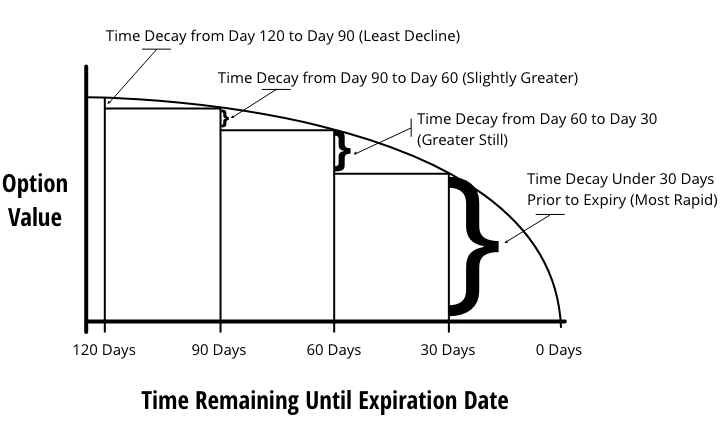
Think of an ice cube on a countertop on a hot day.
The ice cube melts slowly at first, then faster and faster as it gets smaller.
Theta works the same way.
- Far from expiration, time decay is a slow drip
- As expiration approaches, the melt accelerates
The intuition is straightforward. With 60 days left, the stock has plenty of time to move in any direction, so time value erodes slowly (there’s still real uncertainty in both the general market and the stock itself).
With 7 days left, there’s almost no time for the stock to make a meaningful move, so whatever time value remains evaporates rapidly.
Less time remaining means less chance for the stock to move which means time value disappears faster.
Key landmarks on the curve:
- 60+ DTE: Gentle decay, theta is small. Time is passing but barely denting the premium.
- 30-45 DTE: Decay starts accelerating. This is the inflection zone where daily theta becomes meaningful.
- 14 DTE: Steep decay. Premium is melting noticeably day by day.
- 7 DTE and under: Aggressive decay. Whatever time value is left evaporates quickly.
This curve shape is exactly why most Wheel traders sell at 30-45 DTE. You’re entering right as the decay curve steepens, capturing the most efficient part of the erosion.
You’re not paying for the slow first half. You’re stepping in right when theta shifts into a higher gear.
How DTE Affects Theta (Choosing When to Sell)

Choosing your DTE is choosing which part of the decay curve you want to ride. There are two core tradeoffs to understand.
Tradeoff #1: Premium vs. Decay Rate
- Longer DTE (45-52 days) means more total premium collected, but daily theta is smaller (decay is slower)
- Shorter DTE (7-15 days) means less total premium, but daily theta is larger (you’re on the steep part of the curve)
- Shorter DTE also means more gamma risk (delta swings more violently near expiration)
- But a positive of shorter DTE is that you have less time for the trade to move against you (i.e., getting assigned or called away)
Tradeoff #2: Time in Trade vs. Capital Efficiency
- Longer DTE ties up your capital for more days per trade (your cash is locked up longer for that premium)
- Shorter DTE frees capital faster (you can cycle into a new position sooner)
- Different priorities: capital turnover vs. total premium per trade
In practice, you need to balance between your annual yield and your Return on Capital (ROC).
When you start screening options chains you’ll find there are plenty of opportunities to grab 70%+ annual yield on a trade…
…only to then notice the premiums are so small and the ROC so low that even if your trade is successful, you’ll only add a couple dollars maximum to your total account value.
Like I’ve said before, there’s no free lunch in the stock market.
Two Common DTE Camps
Neither camp is wrong. They reflect different priorities.
The 30-52 DTE camp enters right as the decay curve steepens, collects meaningful premium, and avoids the gamma risk of final-week expiration.
The 7-15 DTE camp maximizes capital efficiency, rides the steepest part of the decay curve, and accepts higher gamma risk along with more frequent trade management.
I’d say most of my Wheel trades end up in the 30-53 DTE range; however, I do occasionally enter 7-15 DTEs as well.
You’ll have to feel out for yourself what DTEs are best for your trading style, personality, and psychological attunement.
Worked Example: $41 Put at Different DTEs
Let’s take a look at a hypothetical example. Suppose that we’re looking at B $41 put as expiration approaches:
- At 45 DTE: theta is -$0.025/day ($2.50/contract/day) — slow and steady
- At 30 DTE: theta is -$0.035/day ($3.50/contract/day) — accelerating
- At 14 DTE: theta is -$0.055/day ($5.50/contract/day) — steep, premium melting fast
- At 7 DTE: theta is -$0.08/day ($8.00/contract/day) — aggressive, but gamma risk is elevated
Daily decay nearly triples from 45 DTE to 7 DTE.
But the closer you get to expiration, the more gamma can whipsaw your position. A stock that was comfortably OTM at 30 DTE can suddenly become ATM in a single session at 7 DTE, and your delta (and assignment probability) spikes.
More decay per day, but less room for error. That’s the tradeoff.
How Strike Selection Affects Theta

Strike selection and theta are directly linked.
The core concept being ATM options have the highest theta.
But wait…don’t all options at the same DTE have the same amount of time left?
Yes. A $40 put and a $42 put expiring on the same date both have 35 days left. Same clock, same countdown.
The difference isn’t time. It’s uncertainty.
An ATM option sits right at the strike where nobody knows if it’ll expire ITM or OTM. That maximum uncertainty is exactly what extrinsic value (time value) prices in. The more uncertain the outcome, the more extrinsic value the option carries.
- ATM options: Maximum uncertainty about whether they’ll expire ITM or OTM — peak extrinsic value, peak theta
- Deep OTM options: Almost certainly expiring worthless — very little uncertainty left to price in, so extrinsic value (and theta) is minimal
- Deep ITM options: Almost certainly expiring with intrinsic value — most of the premium is intrinsic, not extrinsic, so theta is small here too
Theta can only decay extrinsic value. That’s why ATM options, sitting at the point of maximum uncertainty, have the most theta. There’s simply more extrinsic value for time to erode.
Worked Example: Puts at 35 DTE Across Three Strikes
Here’s a hypothetical example for B put strikes at $35 DTE:
- $40 strike (furthest OTM): theta -0.0340 ($3.40/contract/day)
- $41 strike (moderate OTM): theta -0.0349 ($3.49/contract/day)
- $42 strike (closest to ATM): theta -0.0382 ($3.82/contract/day)
The $42 put decays $0.42/contract/day faster than the $40 put.
Not a huge gap at this DTE, but it compounds over weeks. And the difference widens as expiration approaches.
The Delta-Theta Tradeoff
Here’s the thing:
You’re not choosing between delta and theta independently. They move together.
Higher delta strikes (closer to ATM) give you more theta, more daily decay working in your favor.
But higher delta also means higher probability of assignment. The same tradeoff from the delta article, just viewed through the theta lens.
The question is always the same: how much assignment risk are you comfortable with for the decay rate you’re collecting?
And for the call side of the Wheel, theta works the same way. The B $47 call may have theta of -0.0304 ($3.04/contract/day) and the $50 call may have theta of -0.0301 ($3.01/contract/day).
Same mechanics, same tradeoffs.
How Implied Volatility Affects Theta

I’m doing a full tutorial on IV, but, for the time being, here’s the gist:
- Higher IV means fatter premiums, which means more absolute theta decay per day. You’re collecting more AND it’s decaying faster. When IV is elevated, theta has more time value to chew through.
- When IV is low, premiums are thinner and theta is smaller in absolute terms (there’s simply less time value to decay each day).
- The practical implication: selling options in high-IV environments gives you a tailwind on theta.
A quick B scenario. You sell a B put when IV is elevated at ~55%. Earnings pass, IV crushes down to ~35%.
The premium drops sharply from the IV collapse, and theta keeps eroding what’s left. You buy the option back for a fraction of what you sold it for.
That’s IV crush and theta working together. The premium you sold is getting hit from two directions at once.
The IV Crush Double-Whammy
When IV is sky-high, theta is already large. IV crush is the accelerant.
Now let’s consider how violent the combination of IV crush can theta can be:
- You sell a put on a biotech stock trading at $50, IV at 95% ahead of an FDA decision
- The $45 put (10% OTM) is trading at $4.50 (massive premium for a 10% OTM put)
- Theta is -$0.12/day ($12/contract/day) because IV has inflated the time value
- FDA decision comes out neutral, stock barely moves
- IV crushes from 95% to 45%
- The $45 put that was worth $4.50 is now worth $1.20 — a 73% drop overnight
- You didn’t need the stock to go up, IV crush did most of the work in a single session
Theta would have ground that premium down over weeks. IV crush did it in a day, and theta will finish off the rest.
(Of course, if that FDA decision had gone badly, you’d be having a very different kind of day. High IV exists for a reason.)
For a full breakdown of how IV affects your Wheel trades, see my guide on implied volatility.
For a deeper dive into using IV and historical volatility together for trade selection, check out my guide on comparing IV and HV.
Common Theta Mistakes Wheel Traders Make
Even traders who understand theta conceptually still make these mistakes in practice:
- Assuming theta is constant. Theta changes every day. The -$0.035/day you see at 35 DTE is not the same rate you’ll see at 10 DTE. Theta accelerates as expiration approaches.
- Chasing high-theta strikes without considering assignment probability. ATM strikes have the highest theta, but they also have the highest delta. More decay per day doesn’t help if you’re getting assigned on stocks you didn’t want at prices you didn’t plan for.
- Confusing theta with total return. High daily theta doesn’t guarantee you keep the full premium. If the stock moves sharply against you, delta losses can overwhelm whatever theta gave you. Theta is one force acting on your position, not the only one.
- Ignoring theta when holding long options. If you own LEAPs or protective puts, theta is working against you every day. It’s a slow bleed that compounds over weeks and months. Always know which side of theta you’re on.
(Ask me how I learned number four. Go ahead. Ask.)
For the full list of common Wheel trading mistakes and how to avoid them, check out my dedicated guide.
Theta Framework
You now have a practical framework for using theta in your Wheel trades:
- Theta measures daily time decay, and for option sellers, that decay is income
- You know why the decay curve is non-linear and how to position your entries on the steepest part
- You know how DTE, strike selection, and IV all interact with theta
- You can read theta on your screen and translate that number into dollars per day
Theta is your income engine. Every other Greek modifies the picture, but theta is the one putting money in your account while you wait.
The next time you pull up an options chain, look at theta right alongside delta:
- Delta tells you the probability
- Theta tells you the price of patience
That’s a system you can build on.
- Ready to put theta into practice? My guide walks through how to choose your expiration date when selling cash secured puts.
- For the practical application of delta in CSP strike selection, check out Understanding Delta: The Most Important Greek for The Wheel Strategy.