 by
by 
Most traders stop at annual yield and never ask how much cash they’re actually collecting per trade.
If you just read the annual yield article, you learned the annual rate. Now let’s talk about what you actually pocket per cycle.
Return on Capital (ROC) is calculated as ROC = Mark / Strike (expressed as a percentage), and it measures the raw cash return you earn per trade cycle without annualizing.
You can use ROC to see exactly how much cash a single trade puts in your pocket relative to the capital you lock up.
I run both numbers on every trade:
- Annual yield tells me if the rate is worth my time
- ROC tells me how much cash I’m actually collecting
One without the other is flying half-blind.
Both numbers sit inside the larger screening process I walk through in the complete guide to cash secured puts.
Table Of Contents
What Annual Yield Doesn’t Tell You (and Why ROC Fills the Gap)
Annual yield is your speedometer. It tells you how fast your capital is working.
ROC is your odometer. It tells you how far you’ve actually gone.
You need both.
A short DTE trade can show 120% annual yield but collect 40% less cash than a longer DTE trade showing 70% annual yield. The rate looks incredible. The cash in your pocket tells a different story.
Annual yield compares rates. ROC answers the practical question, “How much cash does this trade actually generate?”
They’re complements, not competitors.
What Is Return on Capital (ROC) for Cash Secured Puts?

ROC is the percentage of your committed capital (strike x 100 for one contract) you earn back in a single trade cycle.
No time component.
No annualization.
Just raw return per cycle.
Think of it like rent on a property. ROC is the cash you collect from one month’s rent. Annual yield is the annualized return on the property.
For cash-secured puts, the translation is direct:
- Your capital at risk = strike x 100
- Your return = premium collected
- ROC = what percentage of that locked-up capital comes back as cash
Unlike annual yield, ROC doesn’t care whether the trade took 11 days or 45 days. It just tells you what you pocketed.
Note: This blog focuses on cash-secured puts (Phase 1 of the Wheel Strategy) where your broker locks up the full strike x 100 as collateral. If you’re trading on margin (naked puts), your capital denominator changes and ROC calculations get murkier. We’re keeping it clean here.
The ROC Formula
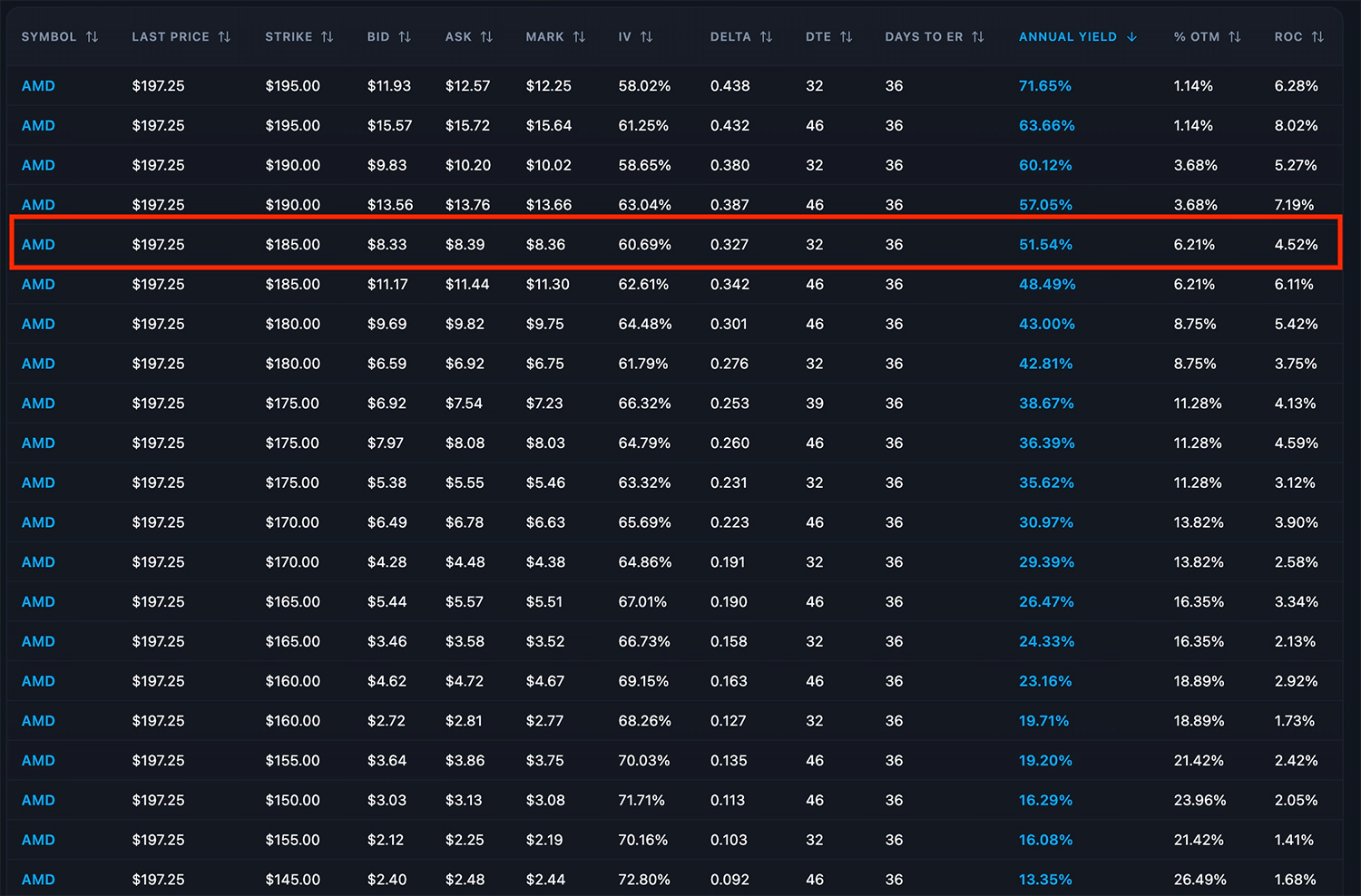
In the image above I have included the output of my options screener for AMD with 30-52 DTE.
Let’s focus on the row with an ROC of 4.52%.
Here’s where that number comes from:
ROC = Mark / Strike (expressed as a percentage)
And plugging in actual values:
- Mark = $8.36
- Strike = $185.00
- ROC = $8.36 / $185.00 = 0.0452 = 4.52%
That means for every $18,500 in capital you lock up, you collect $836 in premium.
That’s your ROC.
The downside, of course, is that collecting the additional premium means your delta is significantly higher.
How ROC Changes Across Different Strikes
| Strike | % OTM | Mark | Delta | DTE | ROC | Annual Yield | Cash Per Contract |
|---|---|---|---|---|---|---|---|
| $195 (Near-ATM) | 1.14% | $12.25 | 0.438 | 32 | 6.28% | 71.65% | $1,225 |
| $185 (Mid-Range) | 6.21% | $8.36 | 0.327 | 32 | 4.52% | 51.54% | $836 |
| $160 (Deep OTM) | 19.71% | $2.77 | 0.127 | 32 | 1.73% | 19.75% | $277 |
Above are the same three strikes we analyzed in the annual yield article. Same AMD snapshot, same 32 DTE. But now we’re looking at what you actually take home.
The $160 strike puts $277 in your pocket per contract. The $195 strike puts $1,225.
The pattern you’ll see is that ROC drops as you go further OTM because premium drops faster than the capital requirement decreases.
For example, $195 strike collects 4.4x more cash than the $160 strike while only requiring 1.2x more capital.
That’s the trade-off. More cash, but a 0.438 delta means you’re nearly a coin flip from assignment.
ROC vs. Annual Yield (When to Use Which)
| 32 DTE | 11 DTE | |
|---|---|---|
| Strike | $195 | $195 |
| Mark | $12.25 | $7.21 |
| ROC | 6.28% | 3.70% |
| Annual Yield | 71.65% | 122.69% |
| Cash Per Contract | $1,225 | $721 |
Take a look at the above potential trades.
Same stock, same strike, but two different time horizons.
Which trade is better?
Depends on what you mean by “better.”
Read that annual yield column again. 122.69%.
Sounds like the 11 DTE trade is the obvious winner, right?
However, while the 11 DTE trade has nearly double the annual yield, it collects 41% less cash per cycle.
You pocket $721 instead of $1,225, a significant haircut in premium.
This is why you need to look at both the annual rate and the ROC.
When to Use ROC and Annual Yield
ROC answers the question “What do I pocket this cycle?”
Use ROC when:
- Evaluating individual trades before entry
- Comparing cash generation across candidates
- Making capital deployment decisions (“I have $50K and three trades pass my filters, which one puts the most cash in my pocket?”)
Annual yield allows you to compare different trades with different tickers across different time horizons.
Effectively, it answers the question “What’s my rate if I was able to keep repeating this trade for an entire year straight?”
Use annual yield when:
- Comparing trades across different DTEs
- Benchmarking against buy-and-hold or index funds
- Evaluating strategy performance over time
ROC tells you which trade puts the most cash in your pocket per cycle. Annual yield tells you which one is working your capital the hardest on a time-adjusted basis.
Note: For what it’s worth, this is exactly why my screener shows both columns side by side. Toggling between two spreadsheets is a recipe for bad decisions and regrettable trades.
ROC Thresholds (What to Look For Before Pulling the Trigger)

For my trading style, ROC is a sanity check, not a primary filter.
By the time I’ve run a trade through my full screening stack, very few options remain:
- Pre-screener pass to identify stocks I wouldn’t mind owning with a 6-12+ time horizon
- 30-52 DTE filter
- Delta check
- IV vs. HV comparison
- Annual yield clears 20%
ROC is the last look before I pull the trigger.
My sanity check minimum is the ROC must be > 0.5%.
If a trade passes every other filter but ROC comes in below 0.5%, the premium-to-capital ratio is too thin. I move on.
For a full walkthrough of the risk-reward trade-offs in CSP selling, see The Pros and Cons of Selling Cash Secured Puts.
Where ROC Fits in Your Trade Screening Workflow
ROC lives at the very end of the screening funnel.
The annual yield article walked through the full five-step screening workflow. ROC slots in after annual yield as a final gut check on cash efficiency.
Before every trade, check both numbers. Annual yield for the rate, ROC for the cash.
Now that you know how DTE affects both ROC and annual yield, the natural next question is: which DTE should you actually target?
That’s exactly what I cover in How to Choose the Right DTE When Selling Cash Secured Puts.