 by
by 
Selling cash-secured puts is a strong strategy if you meet certain conditions.
But it’s not free money, and it’s definitely not for everyone.
The advantages include:
- Income on idle cash
- A lower cost basis if assigned
- Defined risk
- The ability to profit in flat markets
The disadvantages are also worth considering:
- Capped upside
- Capital lockup
- The possibility of underwater assignment
- Premium income taxed at ordinary rates versus long-term capital gains
I sell CSPs regularly and I’ll share why at the end, but I want to be upfront and say that selling CSPS is not for everyone.
This article assumes you already know what a cash-secured put is and how it works.
- If you need a refresher, start with What Are Cash Secured Puts (CSPs)? and come back here when you’re ready.
- And once you’ve weighed the tradeoffs, Cash Secured Puts: The Complete Guide is the full playbook for actually running them.
Table Of Contents
Are Cash-Secured Puts Worth It?
The short answer is yes, if you’re selling them on stocks you’ve researched, at strike prices you’d be happy owning, with capital you can afford to lock up.
The slightly longer answer is that CSPs are a tool.
Like any tool, they work beautifully in the right hands and the right conditions…
…and they’ll hurt you if you use them carelessly.
The Advantages of Selling Cash-Secured Puts

In my personal opinion, here are the primary advantages of selling CSPs:
- Income on idle cash: Your capital earns premium instead of sitting in a money market earning next to nothing
- Lower cost basis: The premium you collect reduces your effective purchase price if you’re assigned, giving you a built-in discount
- Defined, known risk: Your max loss is calculable before you enter the trade; no margin calls, no surprises
- You set the entry price: You choose your strike, you control where you’d buy; think of it as getting paid to wait for your limit order to be filled
- Profitable in flat/sideways markets: Stocks don’t need to go up for you to make money
- Time decay works in your favor: Theta erodes the option’s value every day, and as the seller, that erosion is your profit
- Emotional discipline advantage: Forces pre-commitment to a price and a plan, which reduces impulsive buying
A CSP is essentially a limit order that pays you while you wait. No brokerage on earth offers that with a standard limit buy.
Lower Cost Basis Example
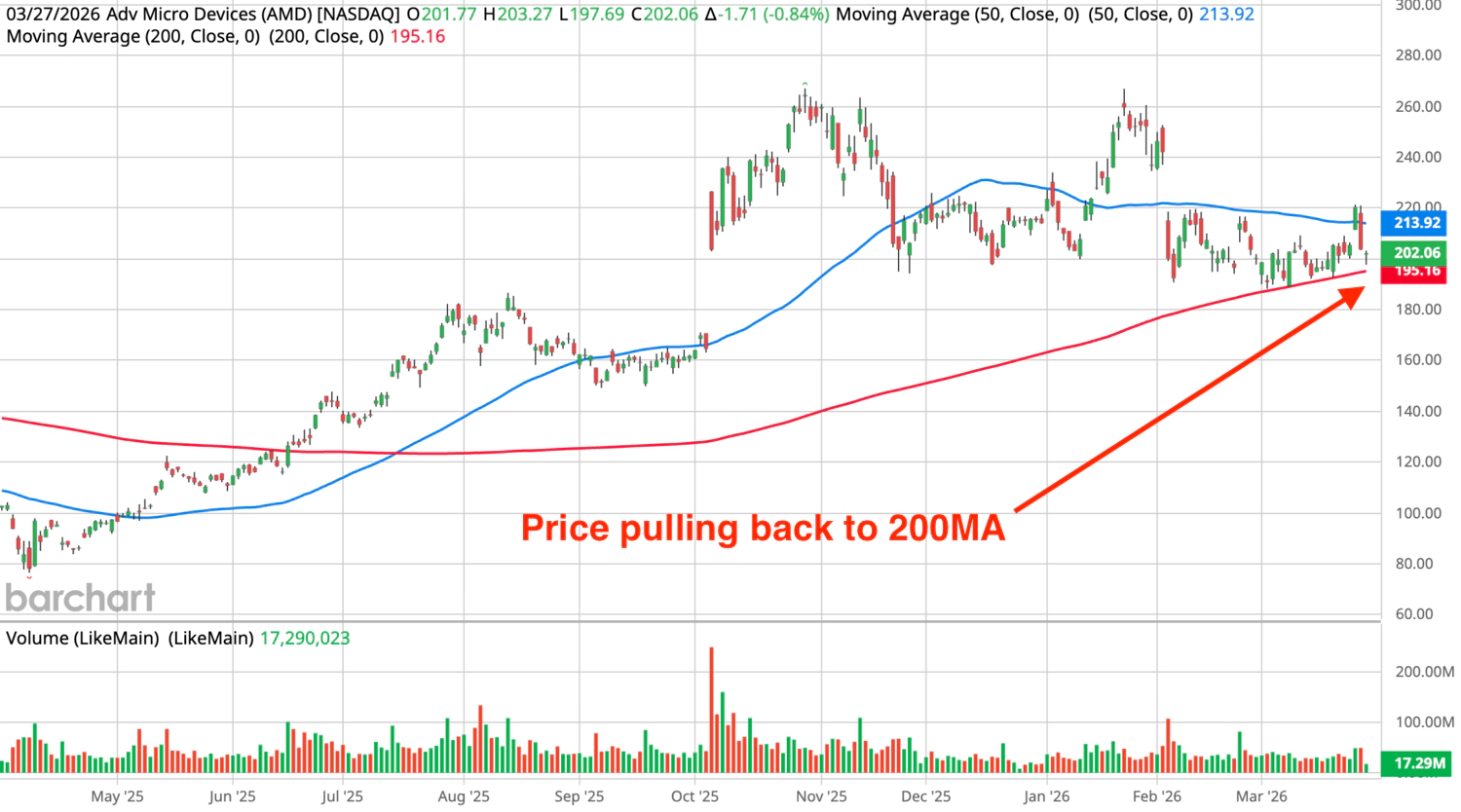
Using the same AMD position from our previous article:
AMDis currently trading at $202.06- You sell the $185 put and collect $7.27 in premium ($727 total)
- Your broker locks up $18,500 in collateral
- If assigned, your effective purchase price is $185 - $7.27 = $177.73 per share
- That’s $25.06 below the current market price, a ~12.4% discount
You either collect $727 in income (if the put expires worthless) or you buy AMD at a $25 discount to where it was trading when you sold the put.
The Disadvantages of Selling Cash-Secured Puts

Now for the uncomfortable part:
- Capped upside / missed rallies: If AMD rips to $185 to $250, you made $727 and missed a $6500+; the premium is your ceiling
- Capital gets locked up: Your collateral is frozen for the entire contract duration, and you can’t deploy it elsewhere
- Stock drops well below strike: Underwater assignment means your premium cushion barely dents a real drawdown
- Premiums can be underwhelming: Low IV environments and blue-chip stocks produce thin premiums that may not justify the capital commitment
- Short-term capital gains tax treatment: Premium income held on options under one year is taxed at ordinary income rates, not the favorable long-term capital gains rate you’d get from buy-and-hold
- Emotional traps: Chasing yield on stocks you don’t actually want to own, or panic-closing at a loss when the trade moves against you
We’ve all been tempted by a fat premium on a stock we knew nothing about.
Don’t do it. That’s how you end up owning 100 shares of something you can’t even explain to your spouse.
Capital Lockup Example
Let’s look at a different position to make this one concrete.
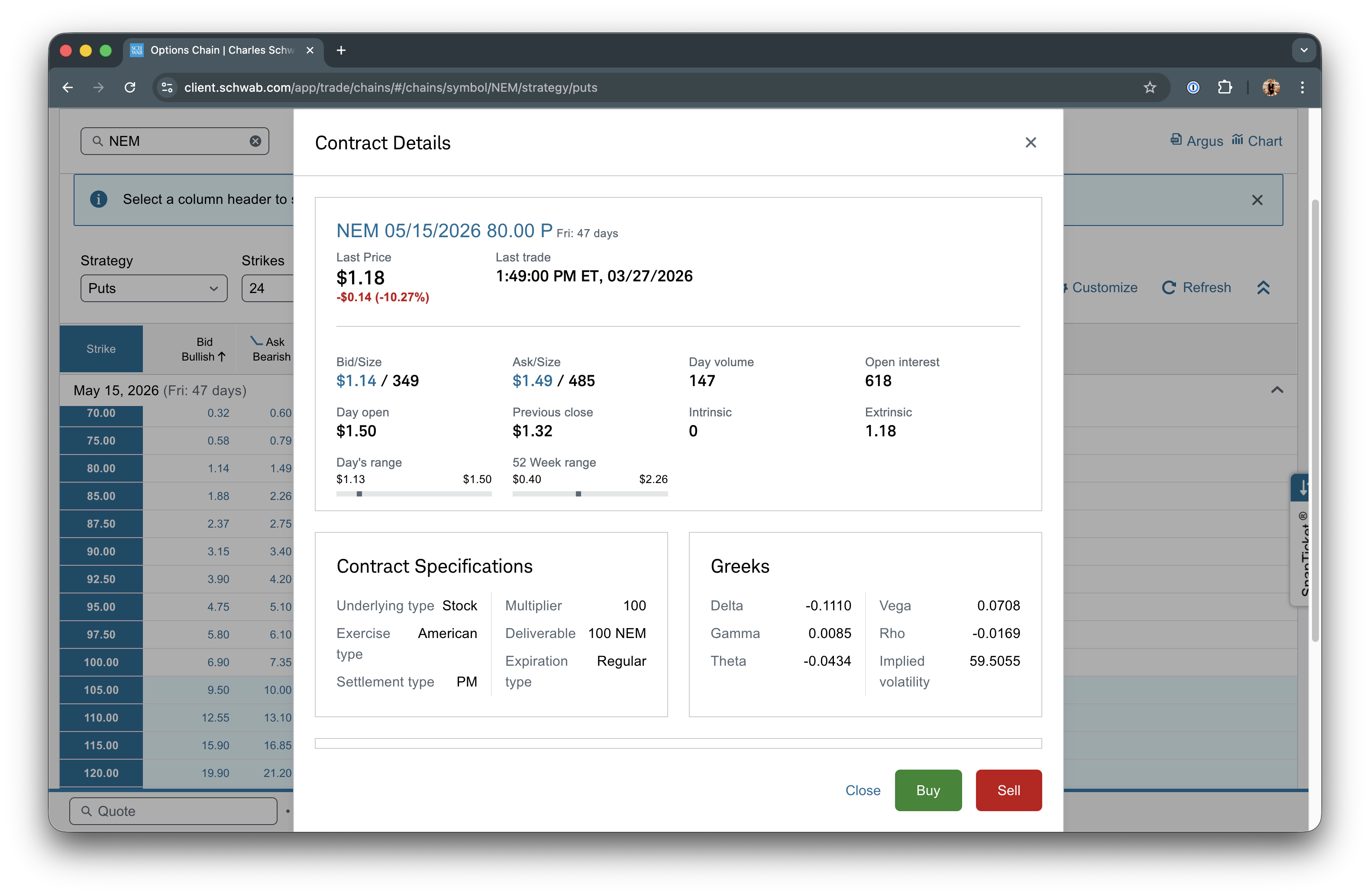
NEM (Newmont) is trading around $102. You sell the $80 put, 47 days to expiration. Delta is 0.111, meaning there’s roughly an 11% chance you’re assigned. You’re 21.6% out of the money. Safe as it gets, right?
- You collect $1.18 in premium ($118 total)
- Your broker locks up $8,000 in collateral
- That’s $2.51 per day for 47 days
- Annualized, it works out to ~12.8% (if you could repeat this consistently)
12.8% annualized sounds reasonable on paper. But here’s the reality of that trade:
- That $8,000 is frozen for 47 days — you can’t deploy it elsewhere
- If a better setup appears two weeks in, you’re stuck
- If the market dips and your watchlist lights up with opportunities, that capital is unavailable
- For a $25K account, that’s 32% of your portfolio locked into a single position earning $2.51/day
Capital lockup is the silent cost that doesn’t show up in your P&L.
The return looks acceptable in a spreadsheet.
It feels a lot less acceptable when you’re watching a better trade slip away because your cash is tied up in a low-delta put on a gold miner.
Underwater Assignment Example
This is the scenario that keeps CSP sellers up at night.
Let’s go back to our original AMD position where we sold at $185 put for $7.27.
But this time, the stock drops 20%:
AMDfalls from $202.79 to $148- You’re assigned at $185, buying 100 shares at a price far above the current market
- Your cost basis is $185 - $7.27 = $177.73
- Current value of those 100 shares: $14,800
- Your total cost: $17,773
- Unrealized loss: $29.73 per share ($2,973 total)
That $727 in premium? It offset $7.27 of a $37 per-share drop.
The math doesn’t lie. The premium is compensation for risk, but it is not a safety net.
Anyone who tells you “The premium protects you” is either confused or selling you something.
Now, if you have genuine conviction in AMD at $177.73 and you planned for this scenario, you’re uncomfortable but not panicking. You hold, sell covered calls, and let time work.
If you sold that put because the premium looked juicy and you never really researched the stock…you’re in trouble.
When Do Cash-Secured Puts Work Best?

Below are situations in which I recommend utilizing CSPs:
- Mild pullback on a stock you already want to own: You’ve done the research and you’re waiting for a better entry; the CSP pays you while you wait
- Elevated IV on a fundamentally sound stock: Higher implied volatility means fatter premiums, which means better compensation for your risk
- Sideways/range-bound market: Buy-and-hold produces nothing in flat markets, but CSPs keep generating income
- You have idle cash earning nothing: Capital sitting in a money market at 4% could potentially earn more through (disciplined) CSP selling
- You have conviction in the underlying: You’ve researched the company, you understand the business, and you’d genuinely be comfortable owning shares for 6-12+ months
When multiple conditions stack, that’s when CSPs really shine.
When Do Cash-Secured Puts Work Against You?

If one or more of the following situations hold, I would not suggest selling CSPs:
- Stock in freefall / broken thesis: If the fundamentals have changed, no amount of premium justifies catching a falling knife
- Low IV environment / thin premiums: When implied volatility is low, the risk-reward equation tilts against you; you’re taking on assignment risk for pennies
- Strong uptrend you’re missing: If the stock is ripping higher and you keep selling puts that expire worthless, you’re collecting crumbs while missing the feast
- Cash needed elsewhere / opportunity cost: If you have a higher-conviction opportunity that requires that capital, the CSP’s lockup becomes a real constraint
- No conviction, just chasing yield: This is the big one; selling puts on a stock because the premium looks attractive without genuine conviction in the underlying is how accounts blow up
Have I been tempted by a juicy premium on a stock I didn’t fully understand?
Absolutely.
Did it end well?
Take a guess.
(Hint: No, in fact, it did not end well.)
The worst case stacks multiple bad conditions at once:
- You sold a put on a stock you barely researched because the premium looked irresistible
- IV was low (so the premium wasn’t even that good)
- The stock was already in a downtrend
- And you needed that capital for another opportunity that appeared two weeks later
That’s how accounts blow up.
How Do Cash-Secured Puts Compare to Other Strategies?

If CSPs are’t right for you, here are two alternatives worth considering.
Buy-and-Hold (Buying the Stock Outright)
The obvious question first:
“Why not just skip the put and buy the stock?”
CSPs win in flat or moderate-decline scenarios because you collect premium regardless.
Buy-and-hold wins in strong rallies because you capture the full upside.
There’s also a meaningful tax consideration: buy-and-hold qualifies for long-term capital gains after 12 months, while CSP premium is taxed as ordinary income (assuming you open and close your position for a profit in under 12 months).
Credit Spreads (Bull Put Spreads)
A credit spread gives you defined risk with significantly less capital, but also caps your premium.
The trade-off is lower collateral requirement and a tighter risk profile, but no path to share ownership if the stock drops.
You can’t transition into covered calls after a spread assignment the way you can with a CSP in the Wheel.
Decision-Criteria Summary
Using the following table to help you decide which strategy is best for you:
| Strategy | Best when… | Watch out for… |
|---|---|---|
| Cash-Secured Puts | You want to own the stock, have the capital, and IV justifies the premium | Capital lockup, underwater assignment, and ordinary income tax treatment |
| Buy-and-Hold | You have strong directional conviction and a 12+ month time horizon | Full downside exposure from day one with no premium cushion |
| Credit Spreads | You want defined risk with less capital and no intention of owning shares | Capped profit, no share ownership path, and wider bid-ask spreads on multi-leg trades |
The right strategy depends on your capital, conviction, and time horizon.
There’s no universal answer.
Should You Be Selling Cash-Secured Puts?
CSPs are a strong tool if you meet these conditions:
- You have sufficient capital ($10K minimum, ideally $25K+) so one position doesn’t consume your entire account
- You’ve done your homework on the underlying stock and understand the business
- You’d be genuinely happy owning 100 shares at your strike price
- You understand the premium is compensation for risk, not free money
- You have a plan for what happens if you’re assigned
If you check all five boxes, CSPs deserve a serious look.
I sell CSPs regularly and they’re a core part of my Wheel Strategy approach.
But I never sell a put on a stock I wouldn’t want to own for 6-12+ months. That single rule has saved me from more bad trades than any technical indicator ever could.
- If you need the basics first, start with What Are Cash Secured Puts (CSPs)?.
- And if you’re ready to start screening for CSP candidates, my guide walks through finding the best CSP setups on the options chain.