 by
by 
A cash-secured put (CSP) is an options strategy where you sell a put contract on a stock you want to own, collect premium upfront, and set aside enough cash to buy 100 shares if the stock drops to your strike price.
The primary difference between a CSP and limit order is that you get paid to wait.
That premium is yours to keep whether or not you ever buy (i.e., are assigned) the shares.
If you’ve been working through our Options Fundamentals guide, you’ve already learned the theory behind options contracts, the Greeks, and how to read an options chain.
Now it’s time to put that knowledge to work.
CSPs are Phase 1 of the Wheel Strategy, the entry point where you generate income while waiting to acquire shares at a price you’ve already chosen. Phase 2 (covered calls) comes later, but this is where the Wheel starts turning.
Table Of Contents
What Is a Cash-Secured Put?
“Cash-secured” means you set aside the full amount of cash needed to buy 100 shares at the strike price. This is your collateral — it sits in your brokerage account, locked up, proving you can back up the commitment you’re about to make.
“Put” is the options contract itself. When you sell a put, you’re taking on the obligation to buy 100 shares if the stock drops to (or below) your strike price by expiration.
Effectively, you’re telling the market, “I want to own this stock at this price. I have the cash to prove it. Pay me while I wait.”
Note: Could someone sell a put without setting aside the cash? Absolutely. That’s called a naked put, and it’s a completely different risk profile and something we’ll touch on later.
We cover the CSP vs. naked put distinction in detail in a dedicated article.
For now, just know that “cash-secured” is the responsible version. You’re fully backed with no margin surprises.
How a Cash-Secured Put Works: Step by Step
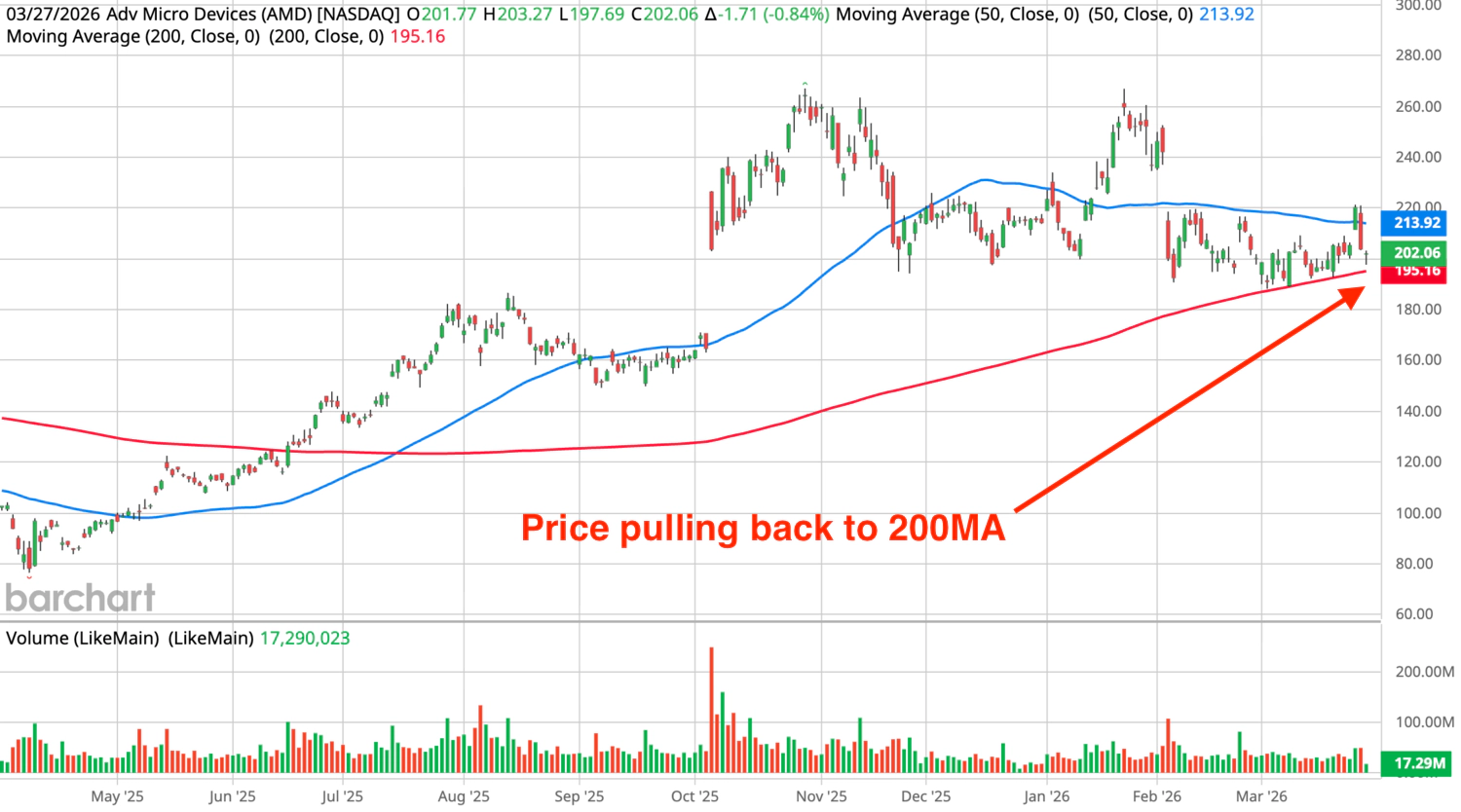
Let’s walk through a real example.
Suppose we’re bullish on AMD. The stock has pulled back to its 200MA, and we want to Wheel it.
But instead of buying 100 shares at the current price of $202.79, we want to get in lower, ideally around $185.
How do we do that?
The answer lies in the options chain:
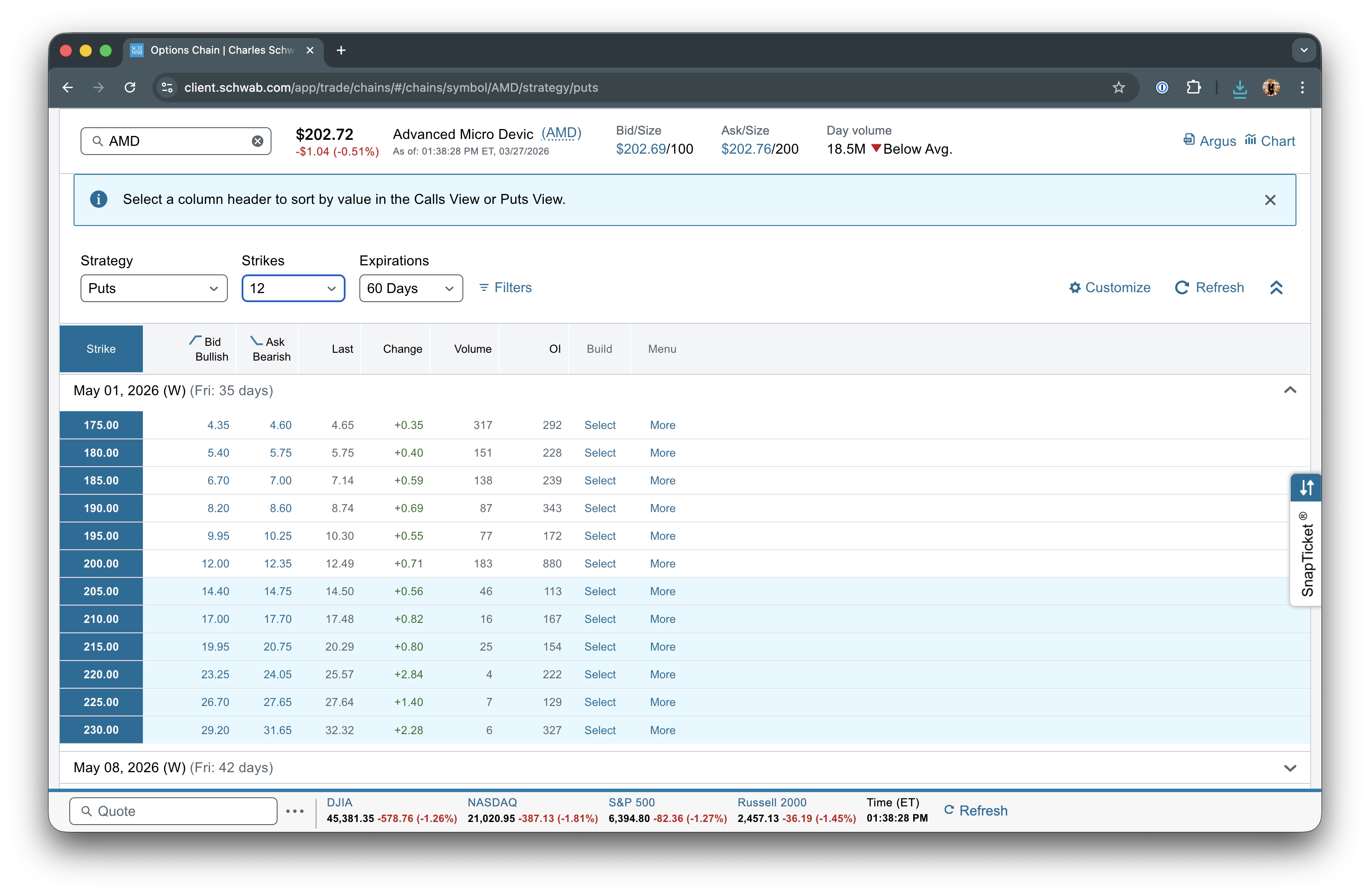
Note: If you need a refresher on reading one of these, check out our guide on how to read an options chain.
Here we’re looking at AMD puts expiring May 01, 2026. There are dozens of strikes to choose from, but we’re focused on the $185 strike since that is our target price.
Let’s drill into that specific contract:
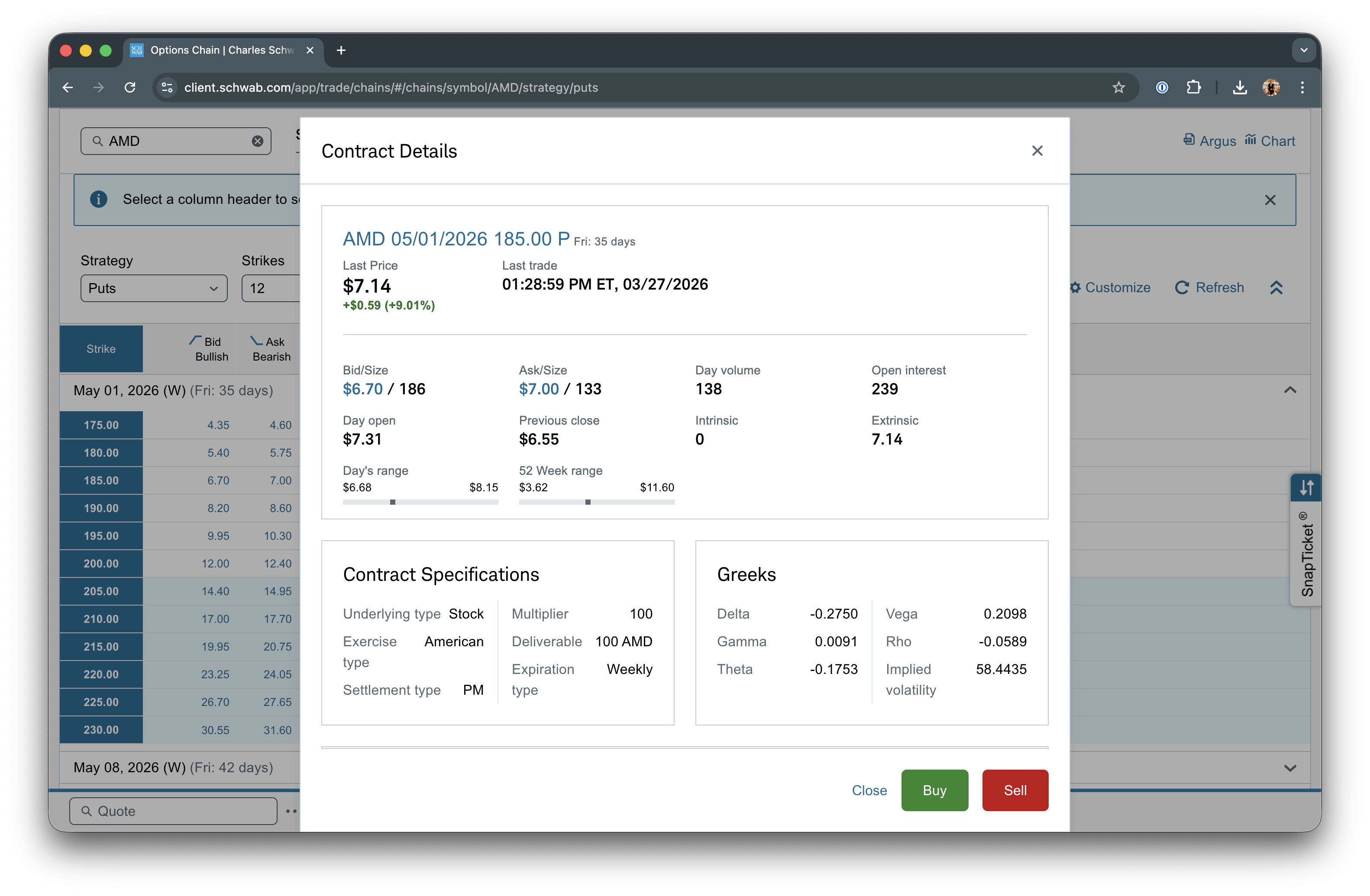
Here’s the key data:
AMDis trading at $202.79- We’re selling the $185 put (out of the money)
- Mark price: $7.27 per share
- Premium collected: $7.27 x 100 = $727
- Cash set aside (collateral): $185 x 100 = $18,500
Let’s assume this trade fills. That $18,500 is now locked in our account. Our broker holds it until the contract expires or we close the position (that’s the “cash-secured” part).
Now, three things can happen at expiration.
Outcome 1: AMD Stays Above $185 (Put Expires Worthless)
This is the best-case scenario for collecting income in The Wheel Strategy:
AMDstays above $185 at expiration- The put expires worthless (no one is going to force us to buy shares at $185 when they’re worth more on the open market)
- We keep the full premium of $727
- Our $18,500 in cash collateral is released
- We sell another CSP and do it all again
Outcome 2: AMD Drops to $185 or Below (Assignment)
This is where the Wheel shifts gears:
AMDcloses at or below $185 at expiration- We’re assigned; we’re required buy 100 shares at $185 even if the stock is trading below $185
- But we collected $7.27 in premium, so our effective cost basis is $185 - $7.27 = $177.73 per share
- We now own the shares and transition to Phase 2 of the Wheel (selling covered calls)
Note: I cover this scenario in depth in What Happens When Your Cash Secured Put Gets Assigned?
Outcome 3: AMD Drops to $165 (Significant Decline)
This is where it gets uncomfortable:
AMDdrops to $165 at expiration- We still buy at $185, cost basis $177.73
- Paper loss: $177.73 - $165 = $12.73 per share ($1,273 total)
- The $727 in premium we collected softens the blow, but it doesn’t erase it
We’re now holding a losing position. Whether that’s a temporary setback or a real problem depends entirely on our conviction in the stock (more on that below).
But here’s the important thing to remember:
In all three outcomes, we kept the $727 in premium.
We got paid $727 to place our limit order at $185. Try getting your brokerage to do that with a regular limit order.
(Hint: They won’t.)
Why Sell Cash-Secured Puts?

For Wheel traders, CSPs serve three specific purposes:
- Income while waiting: You collect premium every cycle while waiting to own shares at your target price
- Lower cost basis: The premium you receive reduces your effective purchase price if you do get assigned
- Defined risk: You know your maximum loss upfront (strike price minus premium, all the way down to zero)
Beyond the Wheel, there are other reasons traders sell CSPs:
- Generate portfolio income in a flat or slightly bullish market
- Put idle cash to work while waiting for a better entry point
- Earn a return on cash that would otherwise sit in a money market or savings account
The general philosophy behind CSP is:
Find a strike price you’d happily own the stock at, then collect premium while you wait for it to come to you.
You’re not gambling on direction.
You’re getting paid to be patient.
Now, don’t get me wrong — there is a downside.
If the stock runs higher, you miss the rally.
You keep the premium, but you don’t own the shares.
The stock goes to the moon without you.
But in the Wheel, that’s fine. Your put expires worthless, your cash is released, and you sell another CSP.
You keep collecting premium until one of these happens:
- The stock drops and you get assigned (transition to covered calls)
- The broad market turns bearish and you stop trading
- Sector rotation moves capital away from your stock
- The stock’s fundamentals shift and you move on to another candidate
For the complete breakdown of when CSPs work and when they don’t, see our deep dive on the pros and cons of selling cash-secured puts.
The Risk of Selling Cash-Secured Puts

Assignment isn’t the risk. Selling puts on stocks you don’t want to own is the risk.
That’s the single most important sentence in this article.
Remember our AMD example where the stock dropped to $165?
We sold the $185 put for $7.27, giving us a cost basis of $177.73.
But now let’s suppose the shares are now worth $165. We’re now sitting on a $1,273 paper loss. That stings.
But here’s the question that separates a temporary setback from a real problem:
Do you actually want to own AMD at $177.73?
- If yes (you did your research, you understand the business, and you believe in the long-term thesis) then this is just a dip. You hold, sell covered calls against the position, and let time do its thing.
- If no (you sold that put because the premium looked juicy and you never really looked at the fundamentals) then you’re stuck holding a stock you have no conviction in, watching it drop, with no plan.
(Hint: That second scenario is where accounts go to die.)
This is why stock selection matters more than any other variable in the Wheel.
I make a habit of telling those new to The Wheel Strategy the following:
If you have $1 to spend at ‘The Wheel Store,’ spend $0.90 on stock selection. Look at fundamentals and valuation. Understand what the company is doing. Make sure it’s a stock you’d like to own for 6-12+ months before Wheeling it and selling a CSP.
Rolling (adjusting the contract to a later expiration) can help in some situations.
And if the trade is already showing a loss, there’s a clear playbook for what to do next.
But no management technique can fix a bad stock pick.
Conviction before the trade is non-negotiable.
Cash-Secured Puts vs. Just Buying the Stock
| Scenario | Buy 100 Shares | Sell CSP |
|---|---|---|
| Stock rises sharply | Full upside gain | Keep premium only, miss the rally |
| Stock stays flat | No gain, no loss | Keep premium (profit) |
| Stock drops to strike | Paper loss from purchase price | Assigned at lower cost basis |
| Stock drops well below strike | Full downside loss | Same downside loss (minus premium cushion) |
There’s a tradeoff here you need to consider:
- Suppose
AMDjumps to $230 - The person who bought 100 shares at $202.79 made $2,721
- You made $727 and don’t own the stock
That hurts.
But in the Wheel, you sell another CSP and keep collecting premium.
The above comparison looks different depending on what the stock does:
CSPs outperform in flat and moderate-decline scenarios while stock ownership outperforms in strong rallies.
My point is this:
Liking a stock does not automatically make it a viable Wheel candidate.
You also need to factor in:
- Screening criteria (fundamentals, market cap, sector)
- Delta and theta positioning
- Whether implied volatility justifies the premium relative to historical volatility
I walk through how to apply each of these filters to the options chain in my CSP screening guide.
Sometimes the stock screens as a value stock with tremendous upside potential, no viable options exist. The premiums are thin, the IV is low, and the risk-reward just isn’t there.
When that happens, just buy the stock outright (or use LEAPs) in a separate portfolio. Hold it for a year or more and let it qualify for long-term capital gains treatment.
Key Cash-Secured Put Terms to Know
Here’s a quick reference table for the terms used throughout this article:
| Term | Definition |
|---|---|
| Strike Price | The price at which you’re obligated to buy shares if assigned |
| Premium | The income you collect upfront for selling the put contract |
| DTE (Days to Expiration) | The number of days until the options contract expires |
| Assignment | When the put buyer exercises the contract, requiring you to purchase 100 shares at the strike price |
| Expiration | The date the options contract ceases to exist |
| Cost Basis | Your effective purchase price per share after accounting for premium collected (strike minus premium) |
| Cash-Secured vs. Naked Put | A cash-secured put has full cash collateral set aside; a naked put uses margin instead |
| Mark Price | The midpoint between the bid and ask price, used to estimate fair value of the contract |
| OTM (Out of the Money) | A put is OTM when the stock price is above the strike price — meaning it has no intrinsic value |
For a full comparison of cash-secured puts vs. naked puts, see our dedicated guide.
How to Start Selling Cash-Secured Puts
A cash-secured put allows you “get paid” while you wait for a limit order to be filled.
You collect premium while waiting to buy a stock you already want to own, at a price you’ve already chosen.
If you’re assigned, you got in at a discount. If you’re not, you keep the income and do it again.
The strategy is simple. The discipline is hard. And the most important decision you’ll make isn’t which strike to pick or which expiration to choose — it’s which stock to sell puts on in the first place.
As you’ll see, stock selection is a core focus of this website.
- Ready to place your first trade? My step-by-step guide walks you through entering a CSP position from start to finish.
- And for the complete picture of how CSPs fit into the Wheel, check out the Cash Secured Puts Complete Guide.