 by
by 
When your cash-secured put is losing money, you have three options: (1) roll the position, (2) hold through expiration, or (3) close at a loss.
The right choice depends on whether your thesis on the stock is still intact, and how likely assignment is.
But before you do anything, you need to understand what that red number on your screen actually means.
Because there’s a good chance it’s “lying” to you about your true cost basis.
Most brokerages display the mark-to-market loss (what it would cost to buy back the put right now), not your actual exposure if you hold to assignment.
Those are two very different numbers.
And if you don’t know which one you’re looking at, you’ll make a decision based on a number that doesn’t reflect your real situation.
- If you’re new to cash-secured puts, start with our guide on what cash-secured puts are and how they work. This article assumes you’ve already sold one and it’s going against you.
- For the full playbook, from screening through assignment, see Cash Secured Puts (CSPs) for The Wheel Strategy: The Complete Guide.
Table Of Contents
Why Your Cash-Secured Put Is Showing a Loss (and What It Actually Means)
The number your broker is showing you is not necessarily what you’ve lost.
You might be thinking:
“Wait, so my broker is showing me the wrong number?”
Not exactly.
Your broker is showing you the mark-to-market value of the option (what it would cost to buy back the put and close the position right now).
That’s one valid way to measure your exposure.
But it’s not the only way, and I’d argue that it’s not the appropriate way to value positions when running The Wheel Strategy.
Here’s a worked example to demonstrate what I mean:
- You sold a $50 put for $2.00 ($200 total premium)
- The stock drops to $45
- Now suppose broker shows the put is currently worth $7.00 (your put gained value since the price dropped; bad for you)
- Mark-to-market loss: ($2.00 - $7.00) x 100 = -$500
- Your real cost basis if assigned: $50 - $2.00 = $48.00 per share
- Stock at $45… actual exposure: ($45 - $48) x 100 = -$300
Same position, but two different numbers. The difference is the exit path.
- If you buy back the put to close, you realize the -$500 loss. (i.e., the mark-to-market number your broker displays).
- If you hold to expiration and accept assignment, your real exposure is -$300 based on your cost basis versus the current stock price.
The broker shows the close path. Not the assignment path.
Why does the option look so much worse than the stock move alone?
The answer is that two forces are pulling in opposite directions.
The stock moved against you (bad), while time decay was working in your favor (good).
But when the stock drops fast enough, it overwhelms the time decay.
On top of that, implied volatility often expands during sell-offs, making the option even more expensive to buy back.
Most brokerages do not factor the premium you already collected into their cost basis display. So even when you’re above water on the actual trade, your broker may still be showing red.
This is the single most important thing to understand before making any decisions.
Not All Losing CSPs Are the Same

Not all losing CSPs are created equal.
Your situation falls into one of three scenarios, and each one points to a different response. Diagnose yours before doing anything.
Scenario 1: Stock May Recover
In this scenario:
- Stock is still above key support levels
- No fundamental change in your thesis (just a sector dip or broad market pullback)
- Assignment is possible but not probable
This is where holding comes in.
Scenario 2: Assignment Is Probable, Thesis Intact
This is another “happy case” situation:
- Stock is below your strike and staying there
- Your thesis on the stock hasn’t changed (you still want to own it at your cost basis)
- You’re likely getting assigned, but that’s not necessarily bad
This is where accepting assignment comes in.
Scenario 3: Thesis Is Broken
Here is where trouble starts:
- Something fundamental changed (earnings disaster, sector collapse, broken catalyst)
- You no longer want to own this stock at your strike price
- Assignment probability is high and you don’t want the stock
This is where closing or rolling comes in.
The Decision Framework (Roll, Hold, or Close)
| Action | What It Means | Best When… | Risk |
|---|---|---|---|
| Roll | Buy back the current put, sell a new one with a later expiration and/or lower strike | You want more time for the stock to recover, or want to lower your strike | You’re paying to kick the can down the road (the stock may never recover, opportunity cost, etc.) |
| Hold | Do nothing, let time decay work, wait for expiration | Thesis intact, time remaining, stock may recover | Assignment at a price you’re still comfortable with |
| Close | Buy back the put at a loss and move on | Thesis is broken and you no longer want the stock | You lock in a realized loss that might have recovered |
Above is a comparison of your three options. Let’s review each in detail.
Roll
Rolling means buying back your current put and simultaneously selling a new one with a later expiration and/or a different strike (one combined transaction).
Rolling gives you more time for the stock to recover, a lower strike (and lower risk), and additional premium collected in the process.
Note: You should always roll for a net credit (additional income). If you roll for a net debit, you’re paying for the privilege to roll, in which case you should just accept assignment.
Rolling is best when you want additional time or want to lower your assignment risk, but the full mechanics deserve their own deep dive. For now, understand that it’s a tool in your toolkit, not a default response.
Hold
Do nothing. Let time decay work. Wait for expiration.
This is the hardest option emotionally, but often the right one.
Doing nothing is a strategy. A legitimate one.
Every day that passes, time decay (theta) erodes the value of the option you sold. If the stock stabilizes or recovers, the put loses value and you keep more of your premium.
Holding is best when your thesis is intact, there’s still meaningful time until expiration, and the stock may recover. It requires discipline, not action.
Close
Buy back the put at a loss. Accept the realized loss. Free up your capital.
This is the right move when your thesis is broken and you no longer want to own the stock at your strike price.
Closing turns an unrealized loss into a realized one, but it also frees your capital for better opportunities.
The worst reason to close is panic. The best reason is clarity, and understanding there are better opportunities for your capital.
Matching Your Scenario to Your Response
| Your Scenario | Recommended Action |
|---|---|
| Stock may recover (Scenario 1) | Hold |
| Assignment probable, thesis intact (Scenario 2) | Hold / Accept Assignment |
| Thesis broken (Scenario 3) | Close or Roll |
If your thesis is intact, hold. If your thesis is broken, act.
Everything else is noise.
Real Example: Walking Through a Losing CSP
Let me show you what this looks like in practice.
In February 2026, I sold a cash-secured put on CDE (Coeur Mining). Here are the trade details:
CDE$20.50 strike put- Premium collected: $1.15 per share ($115 total)
- Real cost basis: $20.50 - $1.15 = $19.35 per share
- Sold on 2/19/2026, expiring 4/2/2026 (42 DTE)
CDEwas trading at approximately $24 when I sold the put (OTM by $3.50)- Thesis: I’m bullish on gold and mining over 6-24 months (inflation hedge, volatility environment)
If you want the mechanics behind a trade like this, here’s how to enter a cash-secured put position step by step.
And then this happened:
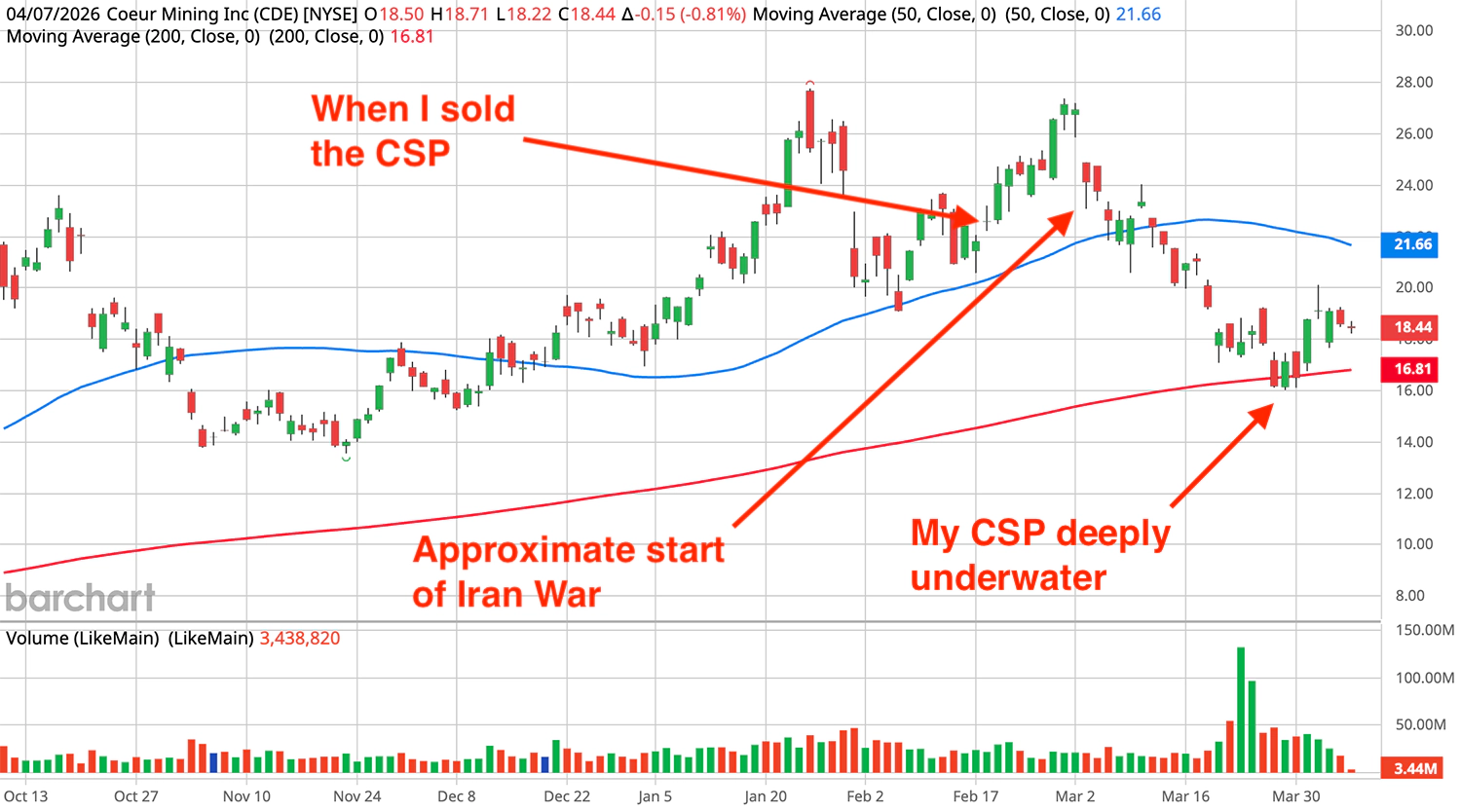
CDE dropped from ~$27.15 all the way down to ~$16.15.
The reason?
The Iran War and spiking oil prices.
It was not a great month.
But wait…didn’t I just say that gold is supposed to go up during geopolitical crisis and instability?
Usually. But not always.
When the crisis is energy-driven, oil surges on pure supply-and-demand mechanics…and because oil is priced in USD almost globally, the dollar gets dragged up with it.
Effectively, during an energy crisis, oil and USD are typically the only assets that outperform.
Institutions and hedge funds sell gold to cover riskier positions, which pushes gold prices down despite the “safe haven” narrative.
And miners like CDE get hit with a double whammy: gold prices fall and their operating costs skyrocket because mining requires enormous amounts of oil.
So, was my thesis broken?
No.
The Iran War caused short-term volatility, but it did not break the underlying thesis for gold over a 6-24 month horizon. This was a Scenario 2 situation (assignment probable, thesis intact).
I walked through all three options:
- Roll: I could have rolled down and out to buy more time. But why? My thesis was intact, and I was willing to own
CDEat $19.35. - Hold: Let the position play out. Accept assignment if it comes.
- Close: This would have locked in a realized loss on a stock I still believed in.
I chose to hold and accept assignment.
CDE at $19.35 was a price I had already decided I was comfortable owning. The market was handing me exactly the scenario I had planned for.
For what happened next (the assignment itself, the first 48 hours, and the transition to covered calls), see What Happens When Your Cash Secured Put Gets Assigned?
Mistakes to Avoid When Your CSP Is Underwater

Knowing what to do is half the battle.
The other half is knowing what not to do.
Mistake 1: Panic Closing at the Worst Moment
Why it’s tempting: The red number is screaming at you. You want the pain to stop. You want to feel like you’re “doing something.”
Why it hurts you: You lock in a realized loss that might have recovered. You sell at the worst possible moment (when fear is highest and the option is most expensive to buy back).
If I had panic-closed my CDE position when the stock hit $16, I would have locked in a significant loss on a thesis that was still intact.
At one point my CSP was -125% underwater. It would have cost me more to buy back than what I originally sold it for by a huge margin.
The red number was terrifying. But my thesis hadn’t changed.
Mistake 2: Endless Rolling to Avoid Assignment
Why it’s tempting: Rolling feels productive. You’re “managing” the position. You’re avoiding the scary word “assignment.”
Why it hurts you: You’re paying to kick the can down the road, tying up capital, missing out on better opportunities, racking up transaction fees, and, above all, the stock may never recover to your original strike. At some point, you have to accept the outcome you signed up for.
Mistake 3: Doubling Down (Selling More Puts on the Same Stock)
Why it’s tempting: “It has to bounce.” Lower your average cost basis. Make it all back and then some.
Why it hurts you: You’re concentrating risk on a losing position. If you’re wrong about the bounce, you’re now underwater on two contracts instead of one. That’s not averaging down. That’s scaling a bad decision.
(My therapist would have a field day with the psychology behind this one.)
Mistake 4: Ignoring a Broken Thesis
Why it’s tempting: Admitting you were wrong is painful. Hope is a powerful drug (we call it “hopeium” in the financial world). And there’s always a narrative you can construct about why the stock will come back.
Why it hurts you: Holding through a broken thesis turns a manageable loss into a disaster. The stock doesn’t care about your feelings. If the fundamentals have changed, the price may never recover to your strike.
The real mistake isn’t closing when the thesis breaks. It’s not closing when the thesis breaks.
Mistakes 1 through 3 are about acting impulsively. Mistake 4 is about failing to act when action is required.
This is the one mistake that actually justifies closing at a loss.
When your thesis is broken, closing isn’t panic… it’s discipline.
When Assignment Is Actually the Best Outcome
If you’ve been reading this and thinking “Assignment sounds like a bad thing”, let me reframe that:
A cash-secured put is getting paid to wait for your limit order to be filled.
Assignment means you bought shares at a discount. That was always the plan.
Your effective purchase price is the strike minus the premium you collected. In my CDE example, that’s $19.35, not $20.50.
Assignment is not a failure. It’s the other profitable outcome of the Wheel.
If your thesis is intact, assignment is the transition from Phase 1 (selling puts) to Phase 2 (selling covered calls). You now own shares you wanted to own, at a price you chose, and you start collecting premium all over again.
For the full walkthrough of what happens during and after assignment, see What Happens When Your Cash Secured Put Gets Assigned?
For a broader look at the tradeoffs of selling cash-secured puts (including the risks you should understand upfront), see The Pros and Cons of Selling Cash Secured Puts.
Every Wheel Trader Faces An Underwater CSP
If you’re reading this with a position showing red on your screen, you’re not alone.
Every Wheel trader faces this moment.
The stock drops.
The broker flashes a number that makes your stomach turn.
And you have to decide what to do.
Now you have a framework.
The traders who succeed with the Wheel aren’t the ones who avoid losses, they’re the ones who respond well when losses happen.
Diagnose your scenario. Check your thesis. Choose your response. And trust the process you built before the red showed up.
You have a plan. Use it.