 by
by 
When your cash-secured put gets assigned, the cash reserved when you sold the CSP converts into 100 shares at the strike price.
That’s it.
No alarm bells. No emergency. Just a capital rotation event.
Remember the entire premise of selling a CSP in The Wheel Strategy:
You agree to buy shares of a company you want to own, at a strike price you selected, and you collected premium for the risk you took on.
Back in April 2026, I was assigned on CDE (Coeur Mining) at a $20.50 strike.
Did I panic? No.
I’m bullish on gold and mining over the next 6-24 months (inflation hedge, volatility environment).
CDE was a stock I wanted to own. The put expired with the spot price below the strike and I was assigned.
And I didn’t mind one bit.
If you’re new to CSPs, what cash-secured puts are and how they work covers the fundamentals. This article picks up where that one leaves off, right at the moment the put gets assigned.
And if you haven’t placed the trade yet, opening the position is the step right before this one.
Table Of Contents
How Cash Secured Put Assignment Works (Step by Step)
The mechanical sequence is straightforward:
- Your put option expires in the money (stock price is below your strike price at expiration)
- The options clearing organization initiates assignment
- Your broker processes it overnight
- Next morning, the reserved cash is removed from your account and 100 shares per contract are added
No action is required from you. The broker handles everything automatically.
Here’s what changes in your account:
| Before Assignment | After Assignment | |
|---|---|---|
| Cash | Reserved as collateral | Transferred out (used to buy shares) |
| Put Position | Open | Closed (removed from open positions) |
| Shares | 0 | 100 per contract |
| Buying Power | Reduced by collateral | Unchanged (cash was already reserved) |
It’s a common misconception in The Wheel Strategy that if you are assigned after selling a CSP that additional cash will be taken from your account.
That’s not the case.
Because your cash was already set aside as collateral, there’s no surprise margin call. That’s the entire point of “cash-secured.” The money was spoken for the moment you sold the put.
Assignment typically happens overnight after expiration Friday. By Monday morning, the shares are in your account.
You’ll typically get an email from your broker similar to the following one I received after I was assigned on CDE:
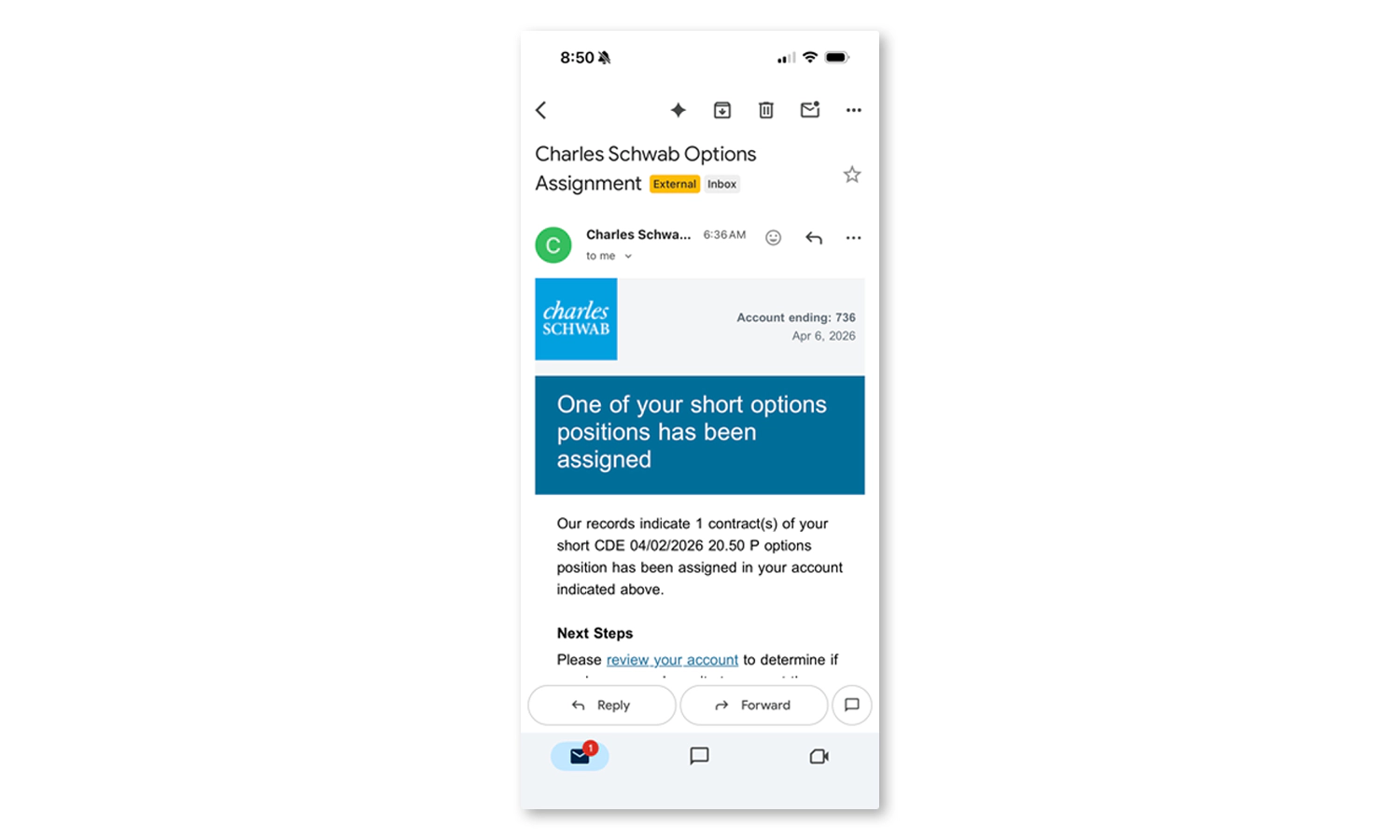
No drama. Just a confirmation that my short put was assigned and shares are in my account.
(If you were expecting sirens and a SWAT team…sorry to disappoint.)
The Emotional Side of Assignment
Assignment feels scarier than it is.
Two emotional traps catch new Wheelers almost every time.
The Panic of Seeing Red
You open your broker’s P/L display and see a negative number next to your new shares.
“I got assigned and the stock is below my strike. I’m losing money!”
Not so fast. Your broker is showing you the stock price relative to the strike price, not your real cost basis.
The premium you collected is not (typically) factored into that number.
Your actual entry point is lower than what the screen shows you.
We’ll calculate exactly how much lower in the next section.
The Regret Spiral
“I should have rolled. I should have picked a different stock. Maybe this whole strategy is broken.”
Sound familiar?
If your thesis was sound and your position sizing was correct, assignment is exactly what the plan called for. You didn’t make a mistake. You executed a strategy.
Remember, The Wheel doesn’t end at assignment. It begins at assignment.
The next phase of The Wheel Strategy is covered calls. The Wheel keeps turning.
Was I worried when CDE dropped to $19.09 after I was assigned at $20.50?
Honestly? Not really.
My thesis on gold mining hadn’t changed. My position sizing was appropriate. And every covered call I sell from here keeps pushing my cost basis lower.
That said, here’s what not to do after getting assigned:
- Panic sell your shares immediately (you’re likely locking in a loss instead of selling covered calls to recover)
- Abandon the Wheel Strategy entirely after one assignment
- Rage-sell or revenge trade into something riskier to “make it back”
Every one of these reactions turns a manageable situation into a real loss.
Assignment is temporary discomfort. Panic selling is permanent damage.
How to Calculate Your Real Cost Basis After Assignment

As I mentioned earlier, your cost basis is actually below your strike price.
Here’s the formula you can use to calculate your true cost basis:
Cost Basis = Strike Price - Premium Received
Simple. And it changes how you see your position entirely.
The Cost Basis Progression
Let’s take my CDE position as an example:
- Strike price: $20.50
- CSP premium collected: $1.15
- Real cost basis after assignment: $20.50 - $1.15 = $19.35
But it didn’t stop there. Every covered call I sell pushes the cost basis even lower:
| Event | Premium | Cost Basis |
|---|---|---|
| CSP assignment | $1.15 collected | $19.35 |
| First CC (April 6, closed same day at 50% profit) | $0.15 net | $19.20 |
| Second CC (April 7, $20 strike) | $1.70 | $17.50 |
What happens if the stock gets called away?
If CDE closes above the $20 strike at expiration, my shares get sold at $20. Since my cost basis is $17.50, I lock in a $2.50 per share profit, or $250 on 100 shares.
That $250 already includes every dollar of premium I collected along the way (the CSP, the first CC, and the second CC). The cost basis math does the accounting for you. The sale price minus cost basis equals your total profit.
Every premium collected (CSPs and covered calls alike) lowers your cost basis further.
That’s the compounding engine of the Wheel.
Apply This to Your Own Position
To calculate your own adjusted cost basis, you can plug in your own numbers to the following template:
- Your strike price: $______
- Premium collected: $______
- Your real cost basis: Strike - Premium = $______
Most brokers show your P/L based on the strike price, not your real cost basis.
This makes your position look worse than it is.
Your broker’s display might show you down $1.41 per share on CDE (current price vs. strike price). But your real cost basis is $19.35, so you’re actually only down $0.26.
Track your own real cost basis.
Don’t rely on your broker’s display to tell you how your Wheel position is performing.
What to Do in the First 48 Hours After Assignment

Here is your pre-flight checklist you should follow each time you get assigned.
Step 1: Check Your Account
Confirm the shares are there. Review your cash position and buying power. Make sure nothing looks unexpected.
Two minutes. That’s all this takes.
Step 2: Review the Stock
Is your thesis still intact? Has anything fundamentally changed since you sold the put?
If the answer is “Thesis is fine, nothing changed”, move to Step 3.
If the answer is “Actually, something changed” pause and think before doing anything else.
Ask yourself:
- What changed in the macro/broad market?
- What additional risk or volatility am I facing?
- Would you buy this stock, today, at the current strike?
Step 3: Screen for Covered Call Options
Approach this the same way you’d screen for CSPs:
- Look at the options chain
- Evaluate strikes
- Check the premium
- Review the Greeks
Don’t panic into selling a covered call just because you’ve been assigned.
There’s no rush.
A bad CC is worse than no CC.
Step 4: Sell Your First Covered Call
When (and only when) you find a strike that meets your criteria, sell it.
My CDE Timeline
Here’s exactly what I did, with real dates and numbers:
- April 2: Assigned at $20.50 (real cost basis: $19.35 after CSP premium)
- April 6: Sold a $0.30 CC, closed the same day for 50% profit, netting $0.15. Cost basis went from $19.35 to $19.20
- April 7: Sold a $20 strike CC for $1.70, cost basis dropped to $17.50
Assignment to first covered call in four days.
No panic. No drama. Just execution.
The biggest mistake you can make here is selling a covered call too aggressively (too low a strike) just to “get out” of the position.
Selling a CC with a strike below your cost basis means that if you get called away, you lock in a loss.
Patience is part of the process.
Screen for strikes above your cost basis so that if shares get called away, you exit at a profit.
How to Transition from Cash Secured Puts to Covered Calls
Assignment is the bridge between Phase 1 and Phase 2 of the Wheel.
You’re no longer selling puts to enter a position. You’re selling calls against shares you already own to collect premium while you wait.
Strike Selection Basics
When screening for covered calls after assignment:
- Always sell above your cost basis (if shares get called away, you exit at a profit)
- Target a reasonable delta (similar to how you’d evaluate CSP delta)
- Look for favorable IV vs. HV (more premium means better compensation for the risk)
How Market Conditions Affect Your Approach
Not every post-assignment situation calls for the same response.
- Sideways or mildly bullish market: This is where the Wheel works best. Sell covered calls, collect premium, repeat. The textbook scenario.
- Very bullish market: Holding shares might make more money than selling calls against them. The stock is running, and capping your upside with a CC could leave significant gains on the table.
- Bear market: Sell covered calls aggressively to lower your cost basis and reduce your exposure. Premium tends to be higher in volatile environments (which helps), but the stock may continue dropping.
In the event you’re in a very bullish market, consider treating the position as a swing trade or position trade instead of immediately selling CCs.
To exit, if the stock’s price closes below the 21EMA (swing trade timeframe) or the 50MA (position trade timeframe), sell your shares and exit the position entirely.
Alternatively, you can trail a stop loss at 5-10% below the current price.
On quality stocks with an intact thesis, patience plus consistent CC selling is the answer.
On stocks where the thesis has deteriorated…that’s a different story (and the next section is for you).
For a deeper dive on selling covered calls post assignment, see this guide.
When Cash Secured Put Assignment Goes Wrong

Assignment isn’t always smooth. Pretending otherwise would be dishonest to you.
Three scenarios account for most “bad” assignments:
- Wrong stock selection: You sold a put on a meme stock, a low-quality company, or something you had no real thesis on. The premium looked juicy. The fundamentals were garbage. Now you own 100 shares of something you never actually wanted.
- Wrong position sizing: Too much capital deployed into a single CSP. One bad assignment and half your portfolio is locked up in a single stock. Diversification becomes impossible.
- Ignoring the macro environment: Selling CSPs into a market crash or major downturn without adjusting your approach. When institutions and hedge funds start dumping positions, it drags everything down, even quality names.
For example, image you sold a CSP on a meme stock at a $40 strike, collecting $3.00 in premium because the implied volatility was through the roof.
Then the stock drops to $12:
- Cost basis: $40 - $3.00 = $37.00
- Current price: $12
- You’re down $25.00 per share ($2,500 on 100 shares)
- Covered calls near your cost basis are paying pennies (the stock is too far away from $37)
- The Wheel can’t save you here
The premium was never worth the risk.
That’s not a Wheel Strategy problem. That’s a stock selection problem.
The Decision Framework
When you find yourself holding shares after a bad assignment, ask yourself three questions:
- “Would I buy this stock today at this price?”
- “Has the fundamental thesis changed?”
- “Can I afford to hold and sell CCs to recover?”
If the answers to those questions are “No”, “Yes”, and “No”…it might be time to cut the loss and move on.
Cutting a loss is not failure. Holding a broken position out of ego is.
For a broader look at what can go wrong and how to protect yourself, see understanding risks with the Wheel Strategy.
And if a put is sinking before expiration, here’s how to handle a losing CSP position.
Assignment Is Part of the Plan
Provided you are running The Wheel Strategy per my recommendations, you were paid to buy a stock you wanted anyway.
Think about that for a second. You didn’t just place a limit order and wait. You placed a limit order, collected premium while you waited, and lowered your entry price below what you would have paid buying shares outright.
The Wheel is a system. Assignment is just one phase. Your capital didn’t disappear. It rotated from cash into shares, exactly as designed.
Now you sell covered calls. Collect more premium. Push the cost basis lower. If those shares get called away at a profit, you start the whole cycle over again.
For the complete picture of how CSPs fit into the broader Wheel Strategy, check out my comprehensive guide on cash-secured puts.