 by
by 
In my opinion, most Wheel traders should default to 30-52 DTE when selling cash secured puts. It gives you the best balance of premium, theta efficiency, and manageable overhead.
However, there’s no universally “best” DTE, and anyone who tells you otherwise is oversimplifying.
The right DTE depends on your trading style, time availability, and risk tolerance.
I personally run 30-52 DTE because it fits how I trade.
I also occasionally work in some 7-15 DTEs under very specific conditions.
I’ve tested shorter and longer ranges and landed here through experience, not theory.
Could you just pick a DTE and stick with it? Sure. But you’d be leaving money on the table (or worse, locking up capital longer than you need to).
Like everything related to trading and investing, it’s part art, part science.
Let’s dive in.
Note: DTE is one decision inside the larger CSP workflow, which I cover end to end in the big-picture CSP guide.
Table Of Contents
Why DTE Matters More Than Most Traders Realize
DTE is not just a time preference, it’s a portfolio-level decision that affects everything from your annual yield to how often you’re staring at an options chain.
The mistake most traders make is treating DTE in isolation.
They pick 30 or 45 because someone on Reddit said so, without realizing DTE interacts with everything else simultaneously, including strike, delta, IV, and capital requirements.
DTE controls more variables than most traders give it credit for:
- Premium collected per cycle
- Theta efficiency (decay rate relative to time remaining)
- Gamma exposure
- Capital lockup duration
- Trade frequency
- Annual yield
Change your DTE, and every one of those variables shifts.
If you need a refresher on how theta decay behaves across time, I covered the full decay curve in my guide on Understanding Theta: Time Decay and The Wheel Strategy.
I’m going to assume that’s familiar territory here, because the shape of that curve is the foundation for everything that follows.
The Common DTE Ranges for Selling Cash Secured Puts (and Who They’re For)
| DTE Range | Pros | Cons | Best For |
|---|---|---|---|
| Short (7-14 DTE) | Fastest theta decay, rapid capital turnover, more cycles per year | Less premium per trade (i.e., low ROC), highest gamma exposure, most management overhead, wider bid-ask spreads | Active traders with daily screen time |
| Medium (30-52 DTE) | Good premium-to-theta balance, manageable gamma, liquid options, fewer trades to manage | Capital locked for approximately 1-1.5 months on average, less theta efficiency than sub-14 DTE in the final days | Most Wheel traders (also my preferred range) |
| Long (60-90 DTE) | Highest absolute premium, lowest gamma exposure, fewest trades to manage | Slowest theta decay rate, longest capital lockup, may need to roll positions | Very passive traders seeking minimal management |
Above are three buckets that capture how most Wheel traders think about DTE.
None of these ranges are objectively wrong. The “best” DTE is the one that matches your trading style, time availability, and risk tolerance.
For what it’s worth, I land in the 30-52 DTE bucket. Not because it’s objectively “best,” but because it fits how I trade.
I don’t want to babysit positions daily, but I also don’t want my capital locked up for three months on a single cycle (your mileage may vary).
The DTE Tradeoffs Every Wheel Trader Should Understand
Choosing a DTE isn’t a single decision. It’s a set of tradeoffs that ripple across your entire portfolio.
Premium vs. Capital Lockup
Longer DTE gives you more absolute premium per trade, but your capital is tied up longer.
Shorter DTE gives you less premium per trade, but your capital recycles faster.
This is the core tension. You’re always trading dollars-per-cycle against cycles-per-year, and neither side wins outright.
For a fuller look at the capital lockup tradeoff and other structural pros and cons, see The Pros and Cons of Selling Cash Secured Puts.
How the Theta Decay Curve Affects DTE Selection
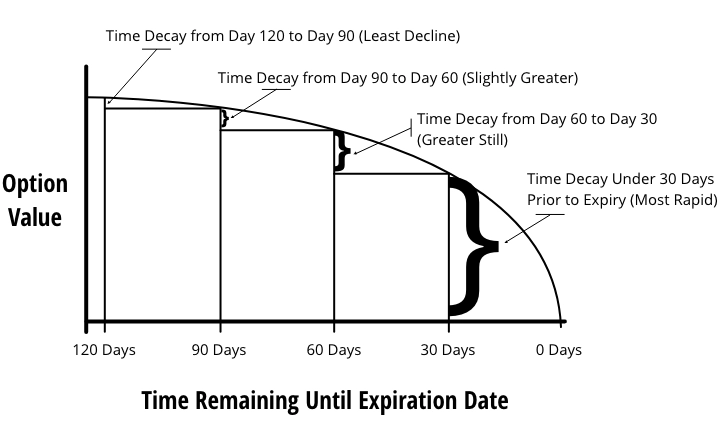
Theta decay isn’t linear. It accelerates as expiration approaches, with the steepest part of the curve occurring in the final 30 days.
This is why 30-52 DTE is the sweet spot for most Wheel traders. You’re entering right as the decay curve steepens, capturing the most efficient part of theta erosion without exposing yourself to the gamma spike that hits in the final two weeks.
For the full breakdown of how theta decay behaves at each stage, see my guide on Understanding Theta: Time Decay and The Wheel Strategy.
Trade Frequency vs. Management Overhead
Shorter DTE means more trades per year.
More trades means more time scanning options chains, placing orders, and managing positions.
That’s not a financial question. That’s a lifestyle question.
If you don’t have time to check positions daily, short DTE will punish you. Not because the strategy is wrong, but because gamma moves fast near expiration and you need to be there when it does.
Longer DTE means fewer trades and less overhead. You set a position and monitor it a few times per week.
How DTE Affects Assignment Probability
DTE interacts with delta to affect your assignment risk.
Shorter DTE with the same delta means less time for the stock to move against you, but gamma amplifies any move that does happen.
Longer DTE gives the stock more calendar days to potentially drop to your strike, but gamma is lower, so price moves are less violent.
Neither is inherently safer. They’re different flavors of risk.
Impact on Annual Yield and Return on Capital (ROC)
Both annual yield and ROC matter, and they tell different stories depending on your DTE:
- Annual yield shows the annualized rate
- ROC shows the cash collected per cycle
Shorter DTE can inflate annual yield (because the annualization factor, 365/DTE, gets larger), but produce less cash per cycle.
I covered the annual yield formula in detail in How to Calculate Annual Yield on Wheel Strategy Options.
And for the ROC formula, see my guide on How to Calculate Return on Capital (ROC) for Wheel Strategy Options.
What matters for DTE selection is understanding which metric to trust when they disagree.
DTE and Annual Yield (The Math That Actually Matters)
Annual yield can be misleading if you look at it in isolation.
Shorter DTE amplifies the annualization factor (365/DTE), which can make the yield look better even when you’re collecting less cash per cycle. This is where ROC becomes the essential complement to annual yield.
An Example of Annual Yield and ROC
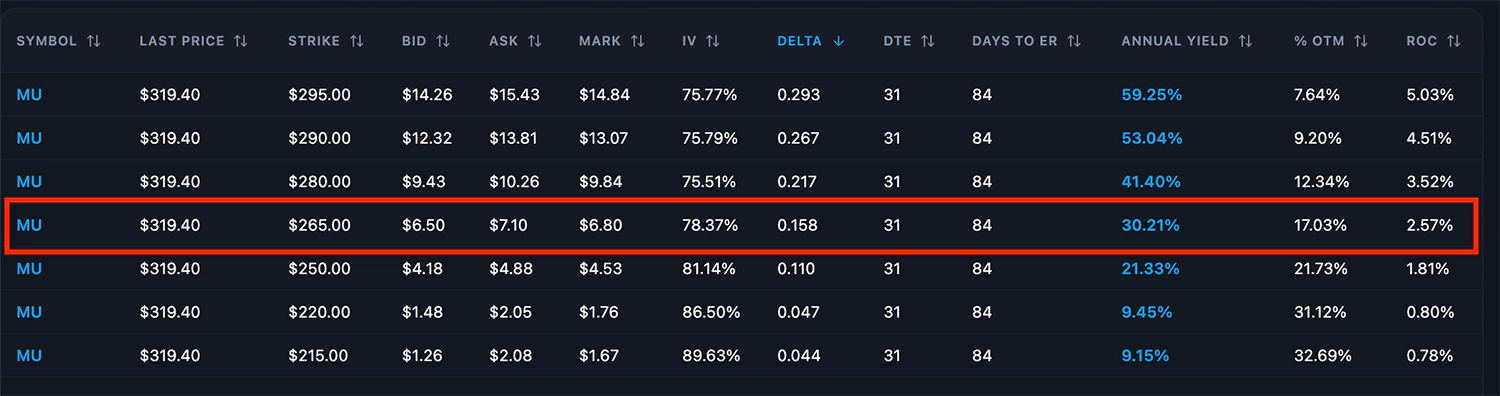
At the time I originally drafted this article, MU (Micron Technology) was trading at approximately $319.40.
I pulled two expiration dates from ThetaScanner, my recommended options scanner for retail traders, to compare the same $265 strike across different DTEs.
Here’s the 31 DTE screener:
And the 10 DTE screener:
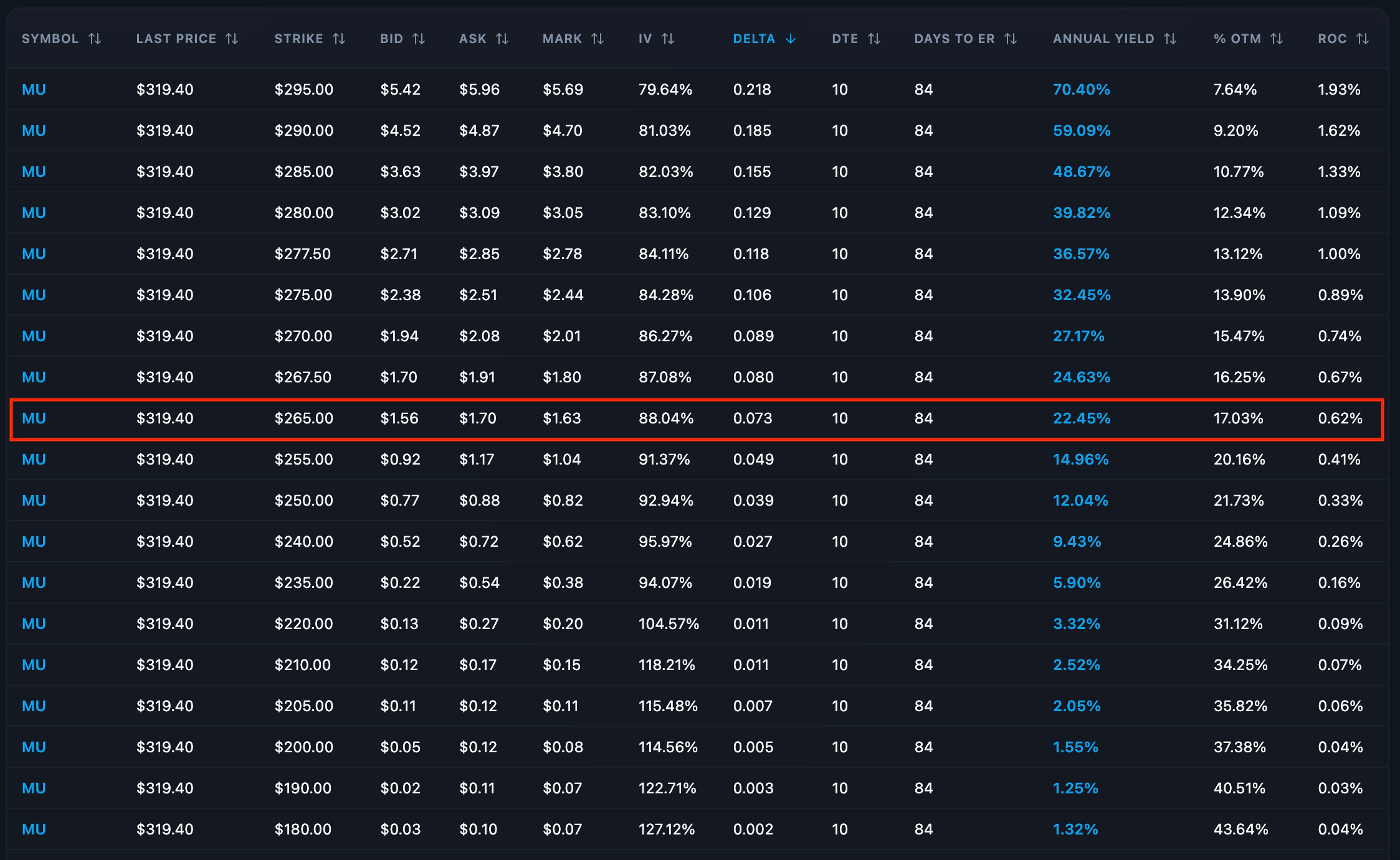
We’ll use the $265 strike for both 31 DTE and 10 DTE.
Putting them side by side:
| Metric | 31 DTE | 10 DTE | Winner |
|---|---|---|---|
| Mark | $6.80 | $1.63 | 31 DTE (4x more premium collected) |
| Delta | 0.158 | 0.073 | 10 DTE (lower assignment probability) |
| Annual Yield | 30.21% | 22.45% | 31 DTE |
| ROC | 2.57% | 0.62% | 31 DTE (4x more cash per cycle) |
In this example, the 31 DTE option wins on both annual yield and ROC.
In fact, it’s not even close.
Now take a second and scan the broader tables in the screenshots above.
Across multiple strikes, you’ll often see a more nuanced pattern: shorter DTE can show a higher annual yield on certain strikes, but the ROC is almost always lower.
That’s the trap.
The annualization math makes short DTE look better than it is. The actual cash collected per cycle does not.
How to Match DTE to Your Trading Style
Here’s what I suggest starting with:
- Active trader (7-21 DTE): More trades, more screen time, tighter position management. You’re in the options chain several times per week (if not daily).
- Passive trader (30-52 DTE): Fewer trades, less overhead, set-and-monitor approach. You check positions a few times per week and adjust only when necessary.
Personally, I’d rather place less trades, but with the trades I do place, I want them to be high conviction.
I’m okay with less capital turnover because I like to be patient and wait for quality stocks I genuinely want to own come to me with a high annualized yield and high ROC.
The question is which direction you lean, and the answer has more to do with your lifestyle than your market thesis.
| If You… | Consider |
|---|---|
| Check positions daily and want rapid capital turnover | 7-14 DTE |
| Check positions a few times per week and want balance | 30-52 DTE (my range) |
| Check positions weekly and want minimal management | 60-90 DTE |
| Have high stress tolerance and prefer active management | Shorter DTE |
| Have low stress tolerance and prefer hands-off trading | Longer DTE |
Do any of these sound like you?
Note: Account size matters too, but more for strike selection than DTE. That’s a different conversation. If you’re curious, I break it all down in How Much Capital Do You Need for The Wheel Strategy?.
The psychological fit matters more than most people think.
If you pick 7-14 DTE and can’t actually monitor positions daily, you’re not running a strategy. You’re running a hope-and-pray operation, and gamma will eventually remind you why that’s a bad idea.
Conversely, if you pick 60-90 DTE and you’re the type who checks your brokerage app twelve times a day…you’re going to drive yourself crazy watching theta drip at the pace of a leaky faucet.
Match the DTE to your temperament, not just your thesis.
A Practical DTE Selection Workflow

Here’s what I actually do:
- Build a watchlist of ~30-40 stocks I like from a fundamental and value perspective. Stock selection comes first. Always.
- Filter options chains to 30-52 DTE. This is my default range. I only deviate if something specific warrants it (earnings, unusual IV spike, or a catalyst I want to trade around).
- Evaluate each candidate on delta, IV vs. HV, annual yield, and ROC. All four matter. No single metric makes or breaks a trade.
- Check bid-ask spread, liquidity, and volume. The position must be liquid enough to enter and exit cleanly. If the spread is wide, I move on.
That’s it. No magic formula.
The default is 30-52 DTE. The exceptions are rare and specific.
If you find yourself constantly deviating from your default, that’s a sign your default might be wrong (or your discipline might need work).
For a deep dive on the screening process itself, see my guide on How to Screen and Filter Cash Secured Puts for The Wheel Strategy.
What DTE Should You Start With?
Start with 30-52 DTE.
It gives you the best balance of premium, theta efficiency, manageable gamma, and reasonable trade frequency. You can always adjust once you have a few cycles under your belt.
The DTE you choose is a decision, not a destiny.
Test it. Track it. Adjust it.
The best DTE is the one that fits your system, your schedule, and your risk tolerance, and that answer will evolve as you do.
- If you want to understand the math behind comparing trades across different DTEs and strikes, start with my guide on How to Calculate Annual Yield on Wheel Strategy Options.
- When you’re ready to actually place your first trade, my step-by-step guide on How to Enter a Cash Secured Put Position walks you through the mechanics.