 by
by 
You just got assigned on your Cash-Secured Put (CSP).
100 shares are now sitting in your account, and you’re staring at the options chain trying to figure out which strike to sell.
The one thought looping in your head:
What if I pick the wrong one and lock in a loss?
Selling above your cost basis means every called-away outcome is a guaranteed profit. That’s the whole point.
Your strike sits above your break-even. Whether the call expires worthless or the shares get called away, you win.
If you already know what covered calls are and how to sell one after assignment, this is the next decision:
- Where to set that strike relative to your cost basis
- And why above cost basis is the default
Let’s dive in.
Table Of Contents
What “Above Cost Basis” Actually Means for Strike Selection
What counts as “above cost basis”?
Any strike price higher than your true cost basis (after all premiums collected).
Think of your cost basis as a floor on the options chain:
- Every strike above that floor is an “above cost basis” strike
- Every strike below it is “below cost basis.”
Here’s the true cost basis formula as a reminder:
Cost Basis = Strike - All Premiums Collected
For the full derivation, see How to Sell Covered Calls After Assignment.
Here’s how it looks with a real position. I’m currently wheeling CDE (Coeur Mining):
- CSP strike: $22.50
- Premium collected on the CSP: $1.32
- CSP expired and was assigned to my account
- True cost basis: $22.50 - $1.32 = $21.18
- Any CC strike above $21.18 is “above cost basis”
If your strike is above your cost basis, every called-away outcome is a profit. That’s the whole idea.
But the real question becomes how much of a profit.
That’s what strike selection defines.
Why Selling Above Cost Basis Is the Default Play

Here is why many Wheel traders choose to sell CCs above cost basis:
- Every called-away outcome is a win because you’re selling shares above your break-even
- Every expiration is a win because you keep the premium and the shares
- There is no losing outcome when your strike sits above your cost basis
This aligns with how the Wheel is designed to work.
Cost basis grinding is the compounding engine. Above-cost-basis strikes keep that engine running without introducing loss risk on the exit.
Each premium you collect lowers the floor. Each cycle widens the zone of above-cost-basis strikes available to you. The flywheel accelerates.
The Below-Cost-Basis Tradeoff
Selling below cost basis isn’t wrong, it’s just a different decision with a different risk profile:
- Below-cost-basis strikes offer fatter premiums (closer to the money, higher delta)
- But if the stock rallies to that strike, you’re forced to sell at a realized loss
- It turns a paper loss into a locked-in loss if called away
That’s a valid play in specific situations, but it’s not the default.
For the full breakdown on when selling below cost basis makes sense (and when it doesn’t), refer to this article.
The Psychological Edge
Personally, I sleep better when every outcome is a win.
I’ve sat through enough cycles to know that premium-chasing below cost basis feels productive. You’re collecting more per contract. The account balance ticks up faster.
But when your shares get called away at a loss you didn’t have to take, the it can feel like you’ve been punched in the gut.
It eats at your discipline for cycles afterward.
Above cost basis removes that entire failure mode. You’re free to focus on the process instead of sweating every tick.
How to Pick a Strike Above Your Cost Basis

Here’s how I recommend picking a strike above your cost basis.
Step 1: Find Your Cost Basis on the Options Chain
Start by calculating your true cost basis (detailed above), then find the covered call strikes above that cost basis.
Every strike above it is in play (now you just need to filter the best one for you).
Step 2: Decide Your Goal (Keep Shares, Sell Shares, or Max Income)
Your goal determines your delta range, which determines your strike:
- Keep Shares: You’re bullish, you want to hold, and you’re selling CCs purely to grind cost basis
- Sell Shares: You’re willing to exit at the right price while collecting premium along the way
- Max Income: You’re actively trying to get called away and maximize what you collect on the exit
Step 3: Use Delta to Narrow Strike Selection
Your goal maps directly to a delta range:
| Goal | Delta Range | What It Means |
|---|---|---|
| Keep Shares | 0.00-0.15 | Very low risk of being called away. Lower premium, but you hold on to the stock you’re bullish on. |
| Sell Shares | 0.15-0.30 | Balanced premium income vs. risk of being called away. Near-identical delta to standard CSP selling. Targets your exit price while collecting premium along the way. |
| Max Income | > 0.30 | Maximize premium collection. High likelihood of being called away (i.e., you’re actively trying to exit). |
Note: For a full deep-dive on how delta works for Wheel sellers, see Understanding Delta.
The premium vs. profit-if-called tradeoff is built into this table:
- Closer to cost basis means fatter premium but smaller profit if called
- Further from cost basis implies thinner premium but bigger profit if called
The worked example below makes this concept concrete.
Step 4: Check Secondary Filters
Once delta has narrowed your strike candidates, you should run two quick checks:
- Chart resistance: Is there a natural resistance level that aligns with one of your strike candidates? If so, lean toward it.
- IV levels: Is implied volatility elevated (good, premiums are rich) or collapsed (maybe wait for a better setup)?
Note: See the full guide on screening and filtering the options chain for covered calls for more details.
What If There’s No Good Strike Above Cost Basis?
Sometimes the chain just doesn’t cooperate.
Premiums above cost basis are thin, delta is microscopic, and nothing feels worth the risk.
Personally, if premiums are below roughly 0.5% ROC, I either:
- Wait for a better setup: Higher IV, a new expiration cycle, or a price move that reshuffles the chain
- Accept the thin premium and keep grinding: Only worth it if the strike is far enough away that being called away is unlikely
Not every cycle produces a great trade.
The Wheel rewards patience, not activity.
Worked Example with Multiple CC Cycles Above Cost Basis
Here’s the compounding effect in action across three CC cycles on CDE, a stock I have been actively Wheeling:
| Cycle | Date Opened | Strike | DTE | Delta | Premium | Outcome | New Cost Basis |
|---|---|---|---|---|---|---|---|
| CSP | 2/26/2026 | $22.50 | — | — | $1.32 | Assigned | $21.18 |
| CC #1 | 4/20/2026 | $25.00 | 18 | 0.12 | $0.20 | Expires worthless | $20.98 |
| CC #2 | 5/12/2026 | $24.00 | 21 | 0.15 | $0.35 | Expires worthless | $20.63 |
| CC #3 | 6/5/2026 | $27.50 | 18 | — | $0.17 | Called away | $20.46 |
Note: Cycle 1 is a real, live trade. Cycles 2 and 3 are hypothetical continuations to illustrate how cost basis grinding works over multiple rounds.
Covered Call #1 (Expires Worthless)
- CC opened 4/20/2026, strike $25.00, 18 DTE (exp 5/8/26)
- Delta at entry: 0.12 (Keep Shares range)
- Premium collected: $0.20
- Outcome: expires worthless (
CDEstays below $25) - New cost basis: $21.18 - $0.20 = $20.98
The thesis is intact. Gold is still my macro play. I keep the shares and look for the next setup.
Covered Call Cycle 2 (Also Expires Worthless)
- CC opened 5/12/2026, strike $24.00, 21 DTE (exp 6/2/26)
- Delta at entry: 0.15 (top of Keep Shares range)
- Premium collected: $0.35
- Outcome: expires worthless (
CDEdrifts up toward $22-23 but stays below $24) - New cost basis: $20.98 - $0.35 = $20.63
The premium is fatter this cycle because the strike is closer to the current price. Still above cost basis. Still a win either way.
Covered Call Cycle 3 (Called Away)
CDEstarts rallying on a gold catalyst, so I select a higher strike- CC opened 6/5/2026, strike $27.50, 18 DTE (exp 6/23/26)
- Premium collected: $0.17
- Outcome:
CDErallies above $27.50, shares called away - Final cost basis: $20.63 - $0.17 = $20.46
For a detailed walkthrough, see what happens when your shares get called away.
Total P&L
Here’s the full picture:
- Total premiums collected: $1.32 + $0.20 + $0.35 + $0.17 = $2.04
- Capital gain (called away at $27.50 vs. $22.50 CSP strike): $5.00
- Total profit per share: $5.00 + $2.04 = $7.04
- Total profit per contract: $704
This is the cost basis grind in action.
Each cycle pushed the floor lower. Each cycle widened the “above cost basis” zone. Each cycle made the next CC safer and more flexible.
That’s the snowball effect. Patience compounds.
$704 on a $2,250 initial position. Not bad for a few months of selling contracts and waiting.
When to Stop Selling Covered Calls and Just Hold
Not every cycle demands a covered call. Sometimes the best move is to stop selling, step back, and let the stock run.
Here is personal framework for when to pause.
The Weinstein Stage 2 Check
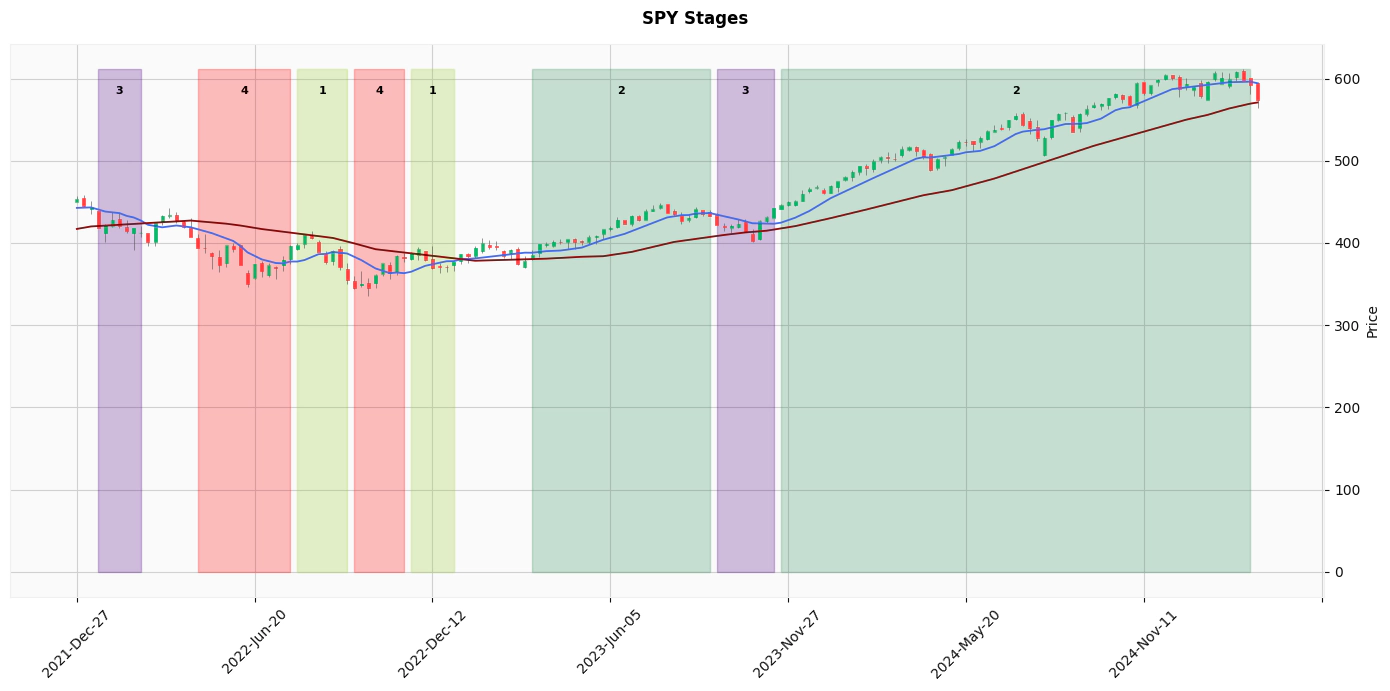
Stan Weinstein’s framework breaks every stock’s lifecycle into four stages:
- Stage 1 (Basing): The stock moves sideways, building a base
- Stage 2 (Advancing): Confirmed uptrend, price above the 30-week moving average
- Stage 3 (Topping): Momentum fades, stock moves sideways at highs
- Stage 4 (Declining): Downtrend, price below the 30-week moving average
Stage 2 is the one you care about in a storng bull market — a confirmed uptrend where price is trading above the 30-week moving average on increasing volume.
When deciding whether to simply hold a stock instead of selling CCs, I look at three levels:
- Broad market: Is the overall market in a strong, confirmed uptrend?
- Sector-related ETFs: — Is the sector (in
CDE’s case, gold miners likeGDX) also trending up? - The underlying stock: Is the specific stock in Weinstein Stage 2 (strong uptrend, above the 30-week moving average)?
When all three are firing, I consider turning off the CC phase entirely and letting the stock run.
Capping your upside during a ripping bull run is one of the most expensive mistakes a Wheeler can make.
The premium from a low-delta CC looks attractive in isolation. But if the stock runs 30% and you’re capped at 5%, that CC cost you 25% in missed gains.
Only pause when you genuinely feel the overall market and the underlying stock are very bullish.
Trailing Stops
When you’ve paused CCs, you still need to protect profits. A trailing stop does the job.
Two methods I have used in the path:
- 21EMA trailing stop: Close the position if the stock closes below the 21-day exponential moving average. More responsive to trend changes, works well for momentum-driven stocks.
- Percentage-based trailing stop (5-10%): Set a fixed percentage below the current price. Simpler to manage, less sensitive to daily noise.
Pick whichever matches your style.
The 21EMA requires you to check the chart daily. The percentage-based stop can be set as an alert and forgotten.
Either way, the point is the same: protect what you’ve built.
The Bigger Picture
The Wheel is a framework, not a cage.
Selling above cost basis. Pausing CCs when the trend is screaming. Protecting profits with a trailing stop.
These aren’t rigid rules. They’re options inside a system that adapts to the market.
If you’re selling above cost basis and the trend is strong, you’re in the best position possible.
Don’t let premium income distract you from capital gains.
Strike selection is one decision inside a much larger system. The complete covered calls guide maps the rest of the process.