 by
by 
Covered calls are Phase 2 of The Wheel Strategy. You sell call contracts against shares you own after CSP assignment, collect premium to lower your cost basis, and set a disciplined exit price.
Most traders spend all their energy learning CSPs and treat covered calls as an afterthought.
That’s backwards.
The CC phase is where cost basis grinding happens, where discipline gets tested, and where the Wheel either compounds or falls apart.
But here’s the thing that surprised me most about the transition:
Your premium income is very likely going to drop in the CC phase compared to the CSP phase.
In the CSP phase, you’re sitting in cash:
- You can screen the entire stock universe
- Find multiple stocks you’re bullish on
- And cherry-pick the fattest premium setups that fit your criteria
More viable setups means a higher likelihood of finding high-premium trades that still align with your thesis.
In the CC phase, you’re locked into the shares you own.
If IV drops on that stock, your premiums drop with it, and there’s nothing you can do but let the position play out.
Once you enter the CC phase, you will typically collect less premium per cycle than you did in the CSP phase — not because you’re doing it wrong, but because the opportunity set is narrower.
Accept the constraint, don’t fight it. Do the math. Sell above your cost basis. And keep grinding it lower.
That discipline separates the traders who thrive in the CC phase from those who get frustrated and chase premium below cost basis because the above-basis numbers “feel small.”
If you’re brand new to the Wheel, start with The Wheel Strategy: The Complete Guide for the big picture.
If you need a refresher on Greeks, IV, or how to read an options chain, Options Fundamentals: The Complete Guide has you covered.
Table Of Contents
What Are Covered Calls (and Why They Matter for the Wheel)
“Covered” means you own 100 shares of the underlying stock, and those shares are locked as collateral while the contract is open. “Call” means you’re taking on the obligation to sell those 100 shares at the strike price if the stock closes at or above that strike at expiration.
Where a CSP is secured by cash, a covered call is secured by shares.
Think of a covered call as a limit sell order the market pays you to place. If a CSP is getting paid to buy, a CC is getting paid to sell.
You’re effectively telling the market:
I own this stock. I’m willing to sell at this price. Pay me while I wait for the buyer to show up.
- CSPs are Phase 1 of the Wheel — they get you into the stock
- Covered calls are Phase 2 — they get you paid while you own it and set a disciplined exit
Assignment is the handoff between phases. The CSP leg ends, the CC leg begins, and capital that was sitting in cash is now shares working for you.
At CC expiration, three things can happen:
- Expires worthless: Stock stays below the strike. You keep the premium, keep the shares, and sell another CC next cycle.
- Shares called away: Stock closes above the strike. Your broker sells your 100 shares at the strike price overnight. You keep the premium plus any gain up to the strike. The Wheel cycle completes.
- Stock drops further: The premium softens the blow but doesn’t erase it. You still own the shares and can keep selling CCs to grind down your cost basis.
In all three outcomes, you collected premium.
The question is whether the tradeoff was worth it. And that depends entirely on whether you picked the right strike for your goal.
A Quick Note on CC Terminology
One terminology note that matters in the Wheel. CSPs get “assigned” and CCs get “called away.” Both are exercise events handled by the Options Clearing Corporation (OCC), but they describe opposite capital flows:
- Assigned (CSPs): You trade your cash for shares (i.e., shares enter your account, cash leaves)
- Called away (CCs): You trade your shares for cash (i.e., shares exit your account, cash enters)
You may hear traders use “assigned” for both, and yes, the OCC technically does use “assignment” for both sides.
But in practice, “called away” is clearer for covered calls because it describes what actually happens — your shares are called away from you.
This is not only the terminology I use on this site, but also the terminology I suggest you adopt as it helps avoid ambiguity.
For the full CC mechanics, see What are Covered Calls (CCs)?.
Why Sell Covered Calls? (Cost Basis Reduction, Income, and Disciplined Exit)

A single covered call delivers three things at once:
- Cost basis reduction
- Income on held shares
- A disciplined exit
The delta you pick tilts which of the three dominates.
Cost Basis Reduction (Delta below 0.15)
Every CC premium lowers your break-even on the shares.
This is the Wheel’s compounding engine.
For example, my current CDE position started at a $20.50 cost basis (the CSP strike) and has been ground down to $18.65 through successive premiums. That’s $1.85 per share just from collecting premium and being patient. Each cycle makes the position a little more forgiving.
Tradeoff: Uou cap your upside at the strike price plus premium collected.
Income on Owned Shares (Delta 0.15 to 0.30)
CCs generate cash flow on shares that would otherwise just sit there.
You’re already carrying the directional risk — the shares are going to move whether you collect premium on them or not. A balanced-delta CC gets you paid for that exposure.
Tradeoff: If the stock rips past your strike, you don’t participate in the rally.
Disciplined Exit (Delta above 0.30)
The CC strike is a pre-committed sell price the market pays you to set.
You’re getting paid to be the kind of disciplined seller most traders wish they could be. No emotional second-guessing at the moment of the sale.
Tradeoff: The exit is forced at the strike. You can buy back the call to remove the cap, but it’ll cost more than you collected.
How Do CCs Compare to Just Holding the Shares?
CCs win when the stock goes flat, dips, or rallies modestly.
Buy-and-hold wins only when the stock rips past your strike.
In most market conditions (flat, mildly bullish, mildly bearish), CCs have the edge.
If you genuinely think a stock is about to rip, don’t sell CCs on it — just hold the shares.
However, that rule is correct in the abstract and dangerous in practice, because timing markets is hard. My default is to sell the CC, collect the premium, and accept the capped upside as a known tradeoff.
Finally, remember the premium expectations reframe from the introduction to this article.
CC premiums will typically be lower than CSP premiums because you’re no longer screening the entire stock universe — you’re locked into the shares you own.
If IV drops on that stock, your premiums drop with it. Accept that constraint. Focus on the grind rather than chasing premium.
The Risks of Selling Covered Calls

Most Wheel traders will tell you that capped upside is the primary risk, but that’s not true.
The real risks are the ones that cost you money and mess with your head.
Being Called Away Below Your Cost Basis
This is by far the biggest risk when selling covered calls.
If you sell a CC at a strike below your cost basis and the stock rallies to that strike, you lock in a realized loss. You’re forced to sell shares for less than you effectively paid.
For example, on my CDE position with an $18.65 cost basis, selling a $17 strike and getting called away there would mean locking in a $1.65/share loss…even though the stock was “recovering.”
This usually happens when a trader chases premium on a position that’s underwater. The below-cost-basis strikes offer fatter premiums because they’re closer to the money (higher delta).
That looks attractive on the options chain.
But the premium offsets the loss. It doesn’t eliminate it.
“The premium makes up for it” is one of the most dangerous misconceptions in CC trading.
The Regret Trade (Missing a Rally)
Suppose a stock you own rips past your CC strike and your shares get called away. You miss the rest of the rally.
On my CDE position, if gold catalysts run the stock to $30 and I’m capped at a $20.50 strike, I miss $9.50/share of upside on shares I wanted to hold long-term.
A missed rally tends to trigger a cascade of “regret behavior”:
- Chasing higher-delta CCs next cycle to “make up” for the capped upside
- Revenge-trading and abandoning the low-delta discipline that made the Wheel work
- Quitting the Wheel entirely because one trade felt bad
The risk isn’t just the missed upside, it’s the behavioral cascade that follows.
A missed $500 rally feels ten times worse than a $500 realized gain feels good. That asymmetry is baked into the human brain.
Accept it. Plan around it. And don’t let one cycle’s regret rewrite the next cycle’s rules.
Stock Decline Risk
Keep in mind that you do own the stock and it can drop while you hold it.
CCs don’t introduce this risk (any stock on the market carries it if you’re buying and holding it), but they don’t eliminate it either.
The premium you collect from selling the CC softens the blow.
But premium is a cushion, not a parachute.
If a $50 stock drops 40%, a $0.30 CC premium barely dents the impact.
Stock selection remains the most important variable. Only Wheel stocks you’d genuinely want to own for 6-12+ months.
How to Sell Your First Covered Call After Assignment

Assignment is the Wheel transitioning from Phase 1 to Phase 2.
Getting assigned is not failure, it’s rotation.
But the first 48 hours after assignment is where new Wheelers do the most damage.
What NOT to Do
Three rules for the first 48 hours:
- Do NOT panic-sell the shares: Assignment is a capital rotation event, not a crisis.
- Do NOT immediately sell a CC: The chain isn’t going anywhere. Let the dust settle.
- Do NOT sell below cost basis just to “collect premium fast”: This is how you lock in a guaranteed loss if called away.
What to Do
Once the urge to “do something” has passed:
- Confirm the assignment in your broker (share count, strike, cash debit)
- Calculate your true cost basis: strike minus all premiums collected
- Check the chart and IV levels
- Scan upcoming catalysts in the next 30-45 days
- Do nothing
(That last one is the hardest. It’s also the most important.)
You are under no obligation to immediately sell a CC. The Wheel rewards patience, not speed.
The Conviction Check
Before you touch delta tables or DTE ranges, answer one question:
What is your long-term conviction on this stock?
This is the single most important filter for your first CC, as your answer determines your next actions:
- Top 10% Conviction (Keep Shares): Delta 0.00-0.15, DTE 7-14. You’re bullish, you want to hold, and you’re selling CCs purely to grind cost basis.
- Standard Conviction (Balanced): Delta 0.15-0.30, DTE 30-52. Either outcome (shares stay or get called away) is acceptable.
- Ready to Exit (Max Income): Delta above 0.30, DTE 30-52. You’re actively trying to get called away while collecting the richest premium.
On my CDE position, I ran the conviction check after assignment and confirmed my thesis that I’m long-term bullish on gold as a hedge against inflation and volatility.
And since CDE is one of the better value plays in the miner space, that meant low delta, short DTE.
I choose to keep the shares and grind.
Cost Basis Grinding in Action
Every premium you collect on both the CSP and CC phases lowers the number you effectively own the shares at.
My CDE cost basis started at $20.50 (the CSP strike). After the CSP premium and multiple rounds of CCs, it’s now $18.65.
That’s $1.85 per share in accumulated premium grinding the floor lower with every cycle.
Each premium makes the position a little more profitable, a little more forgiving, and a little harder to lose money on.
Think of it like a snowball rolling downhill. Each CC cycle adds a thin layer.
One layer is barely noticeable.
Twenty layers are substantial.
That’s the compounding engine of the Wheel. Patience compounds.
For the full post-assignment playbook with a real trade walkthrough, see How to Sell Covered Calls After Assignment.
Selling Above vs. Below Your Cost Basis

Selling above cost basis is the default play for most Wheel Traders.
Every called-away outcome is a profit. Every expiration is a win.
There is no losing outcome when your strike sits above your cost basis.
Why Above Cost Basis Is the Default
Cost basis grinding keeps the compounding engine running without introducing loss risk on the exit.
Each premium lowers the floor. Each cycle widens the zone of above-cost-basis strikes available to you. The flywheel accelerates.
On my CDE position with a cost basis of $18.65 and an original CSP strike of $20.50:
- Any CC strike above $18.65 produces a positive outcome if called away
- A strike at or above $20.50 means every dollar of accumulated premium across the full Wheel cycle is pure profit, plus any capital gains on the stock itself
In an ideal world, you shouldn’t just be targeting above your cost basis, but above your original strike.
That’s where the full compounding effect pays off.
The Psychological Edge
Personally, I sleep better when every outcome is a win.
I’ve sat through enough cycles to know that premium-chasing below cost basis feels productive:
- You’re collecting more per contract
- The account balance ticks up faster
- … but when shares get called away at a loss you didn’t have to take, it eats at your discipline for cycles afterward
Above cost basis removes that entire failure mode. You’re free to focus on the process instead of sweating every tick.
Below Cost Basis
In my opinion, there’s only one valid reason to go below:
Your thesis is intact, you’re deeply underwater, and above-basis premiums are negligible.
The premium on below-basis strikes is fatter because they’re closer to the money (higher delta). That’s the attraction. But the premium offsets the loss if called away; it doesn’t eliminate it.
If the thesis is broken, sell the stock outright.
Don’t use below-cost-basis CCs as an exit strategy. That’s collecting pennies while hoping for a miracle.
The Decision Framework
Here is my suggested decision framework for selling CCs:
- Default to above cost basis. Always. This is the starting position.
- Go below only when: Thesis is intact and deeply underwater and above-basis premiums are pathetic.
- If the thesis is broken: Exit the position. Emotionless and surgical.
The Zero Line
A word of caution: your cost basis is the zero line, not the target.
Being called away at your cost basis means every dollar of premium you collected went toward getting you back to zero — not toward profit.
Selling directly at your cost basis means you locked up capital for (if not months), collected premium across multiple cycles, and walked away with nothing to show for it.
That’s not a win. That’s opportunity cost.
To keep all accumulated premium as actual profit, you need to sell CCs above your initial CSP strike.
On my CDE position, that means above $20.50. Being called away there means the full $1.85/share in accumulated premium is mine, plus any capital gains above the original strike.
- For the full above-cost-basis playbook with worked examples, see Selling Covered Calls Above Your Cost Basis
- And for when below cost basis makes sense (and when it doesn’t), see Selling Covered Calls Below Your Cost Basis
How to Screen and Filter Covered Calls

CC screening is not the same as CSP screening.
With CSPs, you screen for new positions — stocks first, options second.
With CCs, you already own the shares. The screener’s job shifts to finding the right strike and expiration on shares you already hold.
The Conviction Check Comes First
Before opening the screener, run your long-term (6-12 months+) conviction check on the stock.
Your conviction level determines which screener configuration to use:
| Conviction Level | Delta Target | DTE Target |
|---|---|---|
| Keep Shares | 0.00-0.15 | 7-14 |
| Balanced | 0.15-0.30 | 30-52 |
| Max Income / Exit | > 0.30 | 30-52 |
The conviction check is the filter before the filter. It narrows which configuration to run before you look at a single candidate.
The CC Screener Profile
| Criterion | Value | Rationale |
|---|---|---|
| Days to Earnings | Relaxed | You already own the shares; earnings downside exists regardless |
| Annual Yield | > 20% | Same floor as CSPs |
| ROC | > 1% | Lower than the 1.5% CSP floor because above-cost-basis premiums run thinner |
| Delta | < 0.30 ceiling | For Keep Shares and Balanced levels |
The earnings filter is the biggest change from CSPs. When selling CSPs, I filter out options that expire after the next earnings date to avoid potential binary events.
For CCs, that filter goes away. You carry the downside risk whether or not a CC is open, so filtering around earnings adds little protection — it only caps upside.
The Minimum Strike Price Filter
This is the one filter with no CSP equivalent (and the most important CC-specific filter).
The minimum strike price controls whether being called away results in a profit, break-even, or loss.
Using my CDE position (original CSP strike $20.50, current cost basis $18.65):
- At $18.65 (cost basis): The zero line. Called away here means break-even. All premiums collected along the way went toward offsetting the gap between the $20.50 assignment price and the $18.65 exit. Net profit: $0.00.
- Between $18.66 and $20.49 (above cost basis, below initial strike): Partial profit. You’re keeping some of the accumulated premiums, but not all of them.
- At $20.50 or above (original CSP strike): All accumulated premiums are pure profit, plus any capital gains on the stock itself.
Where you set this floor will dramatically narrow or widen the number of potential trades your screener surfaces.
For high-conviction names where I’m long-term bullish, my practical default is to set the minimum strike at or above the original CSP strike.
I’d rather see fewer candidates than get tempted by fat premiums on strikes that cap my upside too early.
Weekly Workflow for CCs
CC screening is lighter than CSP screening because the stock selection is already done:
- After assignment: Run the conviction check. Configure the screener. Set the minimum strike price.
- Weekly: Re-run the CC screener on all open share positions. Market conditions, IV, and chain availability change constantly.
- Before selling: Verify bid-ask spreads and confirm the strike still aligns with your conviction and cost basis.
For the full CC screening workflow with screener output examples and the minimum strike price in action, see How to Filter and Screen Covered Calls.
What Happens When Your Covered Call Is Called Away

When your CC is exercised, your 100 shares are sold at the strike price, the premium is yours to keep, and you’re back in cash.
Effectively, that’s the Wheel completing one full rotation:
- Sold CSPs and collected premium
- Got assigned (cash became shares)
- Sold covered calls and collected premium
- Shares called away (shares became cash)
- Back to selling CSPs
Capital never evaporates, it only transforms between states. Cash becomes shares at assignment. Shares become cash when called away. Premium is collected at every transition.
Calculating Your Total Profit
The profit formula for the full Wheel cycle is:
Total Profit = (CC Strike Price - Cost Basis) x 100 shares
Your cost basis already includes every premium collected along the way, including every CSP premium plus every round of CC premium summed together.
After Being Called Away
After your shares are called away:
- Confirm the sale in your broker (share count should be zero, cash deposited)
- Review total P&L for the full Wheel cycle
- Reassess your thesis on the stock
Next, there are two paths forward:
- Re-enter the Wheel on the same stock: If thesis is intact and setups pass your screening criteria, sell a CSP on the same ticker.
- Deploy capital elsewhere: No obligation to re-enter the same stock. Holding cash (dry powder) is a valid position.
You don’t need to force a trade just because capital freed up.
The Emotional Side
Being called away can trigger regret, especially if the stock keeps climbing past your strike.
Remind yourself that capped upside is a known tradeoff. You accepted it when you sold the call. The premium was your compensation for the risk of your shares being called away.
The antidote to this regret is to review your P&L for the full cycle. Look at the premiums collected. Look at the profit locked in.
- You got paid
- The system worked
- Move on to the next trade and do it all over again
For the full called-away walkthrough with profit calculations at multiple strike levels, see What Happens When Your Covered Call is Exercised and Called Away?.
What to Do If Your Covered Call Is Losing Money

A CC “losing money” means the call option is more expensive to buy back than what you sold it for.
This typically happens for two reasons:
- The stock appreciated in value. The stock rallied toward or past your strike, giving the call intrinsic value. The closer the stock gets to your strike (or the further it blows past it), the more the call is worth, and the more it “costs” to buy back.
- Implied volatility spiked. Macro news, approaching earnings, or a VIX surge inflates the option’s extrinsic value. The stock doesn’t even need to move much — an IV expansion alone can make the call more expensive to close.
Most of the time, it’s both happening at once.
Either way, that red number on your brokerage screen is a mark-to-market snapshot, not a realized loss.
Your Broker Is Telling You Half the Story
Keep in mind that your broker shows mark-to-market on the CC in isolation, not the combined position (i.e., true cost basis).
That disconnect causes traders to panic-close positions that were actually profitable.
Your broker is showing the close path (what it would cost to buy back the call right now).
It’s not showing the expiration path (your actual P&L if the position runs to expiration and your shares get called away at the strike).
Your true cost basis is the number that matters, not the mid-trade mark-to-market.
Diagnosing Your Situation
Before you act, figure out why the CC is going against you:
- Stock rallied slightly, CC still OTM: Theta is still working. Hold.
- Stock above your strike, called away likely: If the strike is above your cost basis, this is a profitable outcome. The Wheel is completing normally.
- Stock running hard, you want to keep the shares: Roll up and out, or buy back the call.
- IV spiked, stock flat: Hold. When volatility contracts, the mark-to-market loss shrinks with it.
The Decision Framework
When your CC is losing money, you have four options:
- Hold: Stock is near your strike but time remains, or IV spiked on a flat stock. Theta decay is still working in your favor. Do nothing.
- Let it go (accept being called away): Strike is above cost basis. Being called away is a profit. The Wheel completes normally.
- Roll up and out: You want to keep the shares. Roll to a higher strike, later expiration, for a net credit. Always roll for a credit. If you can’t consider just letting the stock go.
- Buy back at a loss: You have high conviction the stock will keep running higher so you pay to remove the cap on upside. This must be thesis-driven, not panic-driven.
Mistakes to Avoid
Here are some common mistakes to avoid when your CC is losing money:
- Panic buying back at peak cost: Locking in the maximum realized loss on the option at the worst moment
- Confusing a “losing CC” with a losing position: The shares are appreciating by the same amount or more
- Rolling endlessly to avoid a profitable called-away outcome: Sometimes the right move is to let the shares go
- Forgetting your true cost basis: Your cost basis includes every CSP and CC premium collected across the full Wheel cycle, not just the assignment price
The key question: is being called away at your strike a profitable outcome?
If the answer is yes (strike above cost basis), there’s a strong case for simply letting it happen. The Wheel completes. You’re back in cash with a realized profit. That’s the strategy working as designed.
For the full decision framework with a real trade example, see What to Do If Your Covered Call is Losing Money.
When to Stop Selling Covered Calls and Let the Stock Run
Not every cycle demands a covered call.
Sometimes the best move is to stop selling and let the stock run.
This is counterintuitive advice for a guide about selling covered calls. But knowing when not to sell is as important as knowing how.
The Weinstein Stage 2 Check
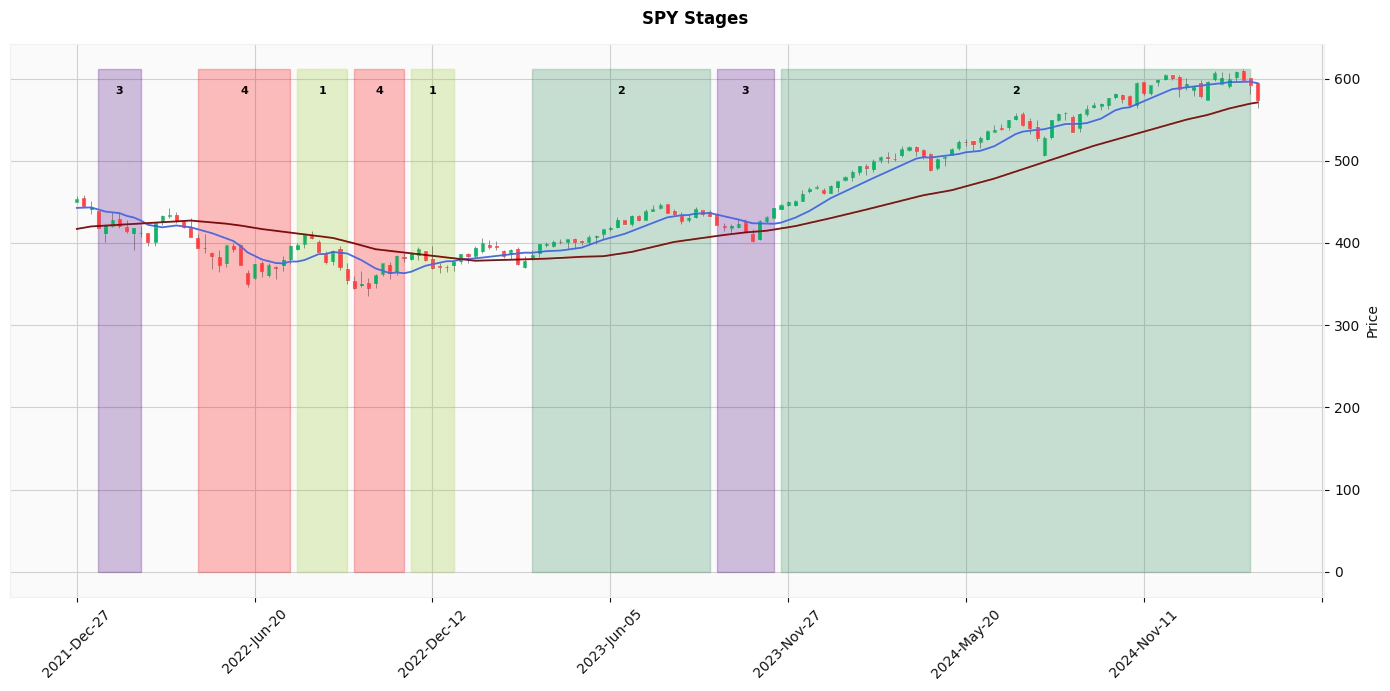
Stan Weinstein’s Stage framework breaks a stock’s lifecycle into four stages:
- Stage 1 (Basing): The stock moves sideways, building a base
- Stage 2 (Advancing): Confirmed uptrend, price above the 30-week moving average
- Stage 3 (Topping): Momentum fades, stock moves sideways at highs
- Stage 4 (Declining): Downtrend, price below the 30-week moving average
Stage 2 (Advancing) is the one you care about — a confirmed uptrend where price is trading above the 30-week moving average on increasing volume.
When deciding whether to pause CCs, I look at three levels:
- Broad market: Is the overall market in a strong, confirmed uptrend?
- Sector ETF: Is the sector the stock belongs to also trending up?
- Underlying stock: Is the specific stock in Weinstein Stage 2?
When all three are firing, I consider pausing CCs entirely.
Capping your upside during a ripping bull run is one of the most expensive mistakes a Wheeler can make.
A low-delta CC premium looks attractive in isolation. But if the stock runs 30% and you’re capped at 5%, that CC cost you 25% in missed gains. The premium you collected doesn’t come close to making up the difference.
Trailing Stops for Protecting Profits
When CCs are paused, you still need to protect profits. Two methods I use:
- 21EMA trailing stop: Close the position if the stock closes below the 21-day exponential moving average. More responsive to trend changes, requires daily chart checks.
- Percentage-based trailing stop (5-10%): Set a fixed percentage below the current price. Simpler to manage, less sensitive to daily noise.
Pick whichever matches your style and availability.
Either way, the point is the same: protect your profits.
The Bigger Picture
The Wheel is a framework, not a cage.
Selling CCs, pausing CCs, protecting with trailing stops — these are all options inside a system that adapts to market conditions.
The CC phase is where most of the discipline decisions live:
- Selling when conditions favor it
- Standing aside when they don’t
- Protecting profits when the trend is strong
Don’t let premium income distract you from capital gains.
Covered Call Quick Reference
Here’s the complete covered call playbook in one table (bookmark this and come back to it later as a reference).
| Topic | Key Insight | Common Mistake | Deep Dive |
|---|---|---|---|
| What Are CCs | Phase 2 of the Wheel — getting paid to set a limit sell order on shares you own | Treating CCs as an afterthought after CSP assignment | What are CCs? |
| Why Sell CCs | Selling a CC delivers cost basis reduction, income, and a disciplined exit | Expecting CSP-level premiums in the CC phase | What are CCs? |
| Risks | Being called away below cost basis is the biggest risk, locking in a realized loss | Chasing premium on below-cost-basis strikes without understanding the tradeoff | What are CCs? |
| After CSP Assignment | Run the stock conviction check before touching the options chain | Panic-selling shares or rushing into a CC on assignment day | Selling CCs After Assignment |
| Above vs. Below Cost Basis | Above is the default (every outcome is a win), below is a scalpel for specific situations | Selling below cost basis just because the premium is fatter | Selling Above Cost Basis and Selling Below Cost Basis |
| Screening CCs | The minimum strike price filter has no CSP equivalent and is the most important CC-specific filter | Not setting a minimum strike and accidentally surfacing strikes that lock in a loss | Screening CCs |
| Called Away | Capital rotates from shares to cash | Regret when the stock keeps running past your strike (capped upside is a known tradeoff) | Called Away |
| Losing Money | Your CC is “losing” but your shares are gaining — check the true P&L before acting | Panic buying back at peak cost | CC Losing Money |
| When to Pause CCs | If the market, sector, and stock are all in a strong uptrend, consider letting the stock run | Capping upside during a ripping bull run for a small premium | Selling Above Cost Basis |
Your Covered Call Learning Path

I designed this sequence deliberately. The concepts layer on each other, and skipping ahead means missing context that makes the later guides click.
Start at the top. Don’t skip ahead.
- What are Covered Calls (CCs)? — Start here. What CCs are, how they work, the three possible outcomes, and the delta bands that drive strike selection.
- How to Sell Covered Calls After Assignment — The first 48 hours after assignment, the stock conviction check, and how to pick your first CC strike.
- Selling Covered Calls Above Your Cost Basis — The default play. Why every outcome is a win, the compounding effect across cycles, and when to pause CCs entirely.
- Selling Covered Calls Below Your Cost Basis — The scalpel for underwater positions. When it works, when it doesn’t, and how to manage the risk.
- How to Filter and Screen Covered Calls — The minimum strike price filter, the CC screener profile, and how CC screening differs from CSP screening.
- What Happens When Your Covered Call is Exercised and Called Away? — Exit mechanics, profit calculation for the full Wheel cycle, and what to do next.
- What to Do If Your Covered Call is Losing Money — The mark-to-market reframe, broker display gaps, and the four-option decision framework.
The CC Phase Is Where the Wheel Compounds
Every premium you collect grinds the cost basis lower. Every cycle makes the position more forgiving.
The traders who succeed in the CC phase are the ones who trust the process, stick to their delta bands, and don’t let one cycle’s regret rewrite the next cycle’s rules.
My CDE cost basis went from $20.50 to $18.65 through patience and consistent premium collection. Not one big trade, just a series of small ones, each grinding the floor a little lower.
That’s how the Wheel compounds.
If you’re currently in the CSP phase, the Cash Secured Puts: The Complete Guide has the full Phase 1 playbook.
If you’re new to the Wheel entirely, start with The Wheel Strategy: The Complete Guide.
Start conservative. Stay disciplined. Keep grinding.