 by
by 
A covered call can be thought of as a limit sell order the market pays you to place. If a CSP is getting paid to buy, a covered call is getting paid to sell.
That premium you receive is yours to keep whether your shares get called away or not.
If you’ve been working through our Options Fundamentals guide, you’ve already learned how options contracts work, how the Greeks behave, and how to read an options chain.
Now it’s time to see what happens after a cash-secured put gets assigned and you actually own the shares.
If CSPs are how the Wheel Strategy starts turning, covered calls are how it keeps paying you after assignment. Assignment isn’t the end of the trade, it’s the handoff to Phase 2.
This article covers the mechanics of covered calls. For a complete review of covered calls, from your first post-assignment call to the day your shares get called away, see Covered Calls for The Wheel Strategy: The Complete Guide.
Table Of Contents
What Is a Covered Call?
“Covered” means you own 100 shares of the underlying stock, and those shares are locked as collateral while the contract is open. Your broker restricts them, you can’t sell them out from under the contract, and you can’t use them as collateral for anything else. The shares are doing the same job cash does in a CSP.
“Call” is the options contract itself. When you sell a call, you’re taking on the obligation to sell 100 shares at the strike price if the stock closes at or above that strike at expiration.
Where a CSP is secured by cash, a covered call is secured by shares.
Effectively, you’re telling the market:
I own this stock. I’m willing to sell at this price. Pay me while I wait for the buyer to show up.
That’s the entire instrument in one sentence.
The rest is just picking a strike, a delta, and an expiration that match your goal.
Note: “Buying a call” and “selling a call” are opposite trades with opposite risk profiles, despite sharing the word “call.” Throughout this article, covered call means selling a call against shares you already own.
How a Covered Call Works: Step by Step
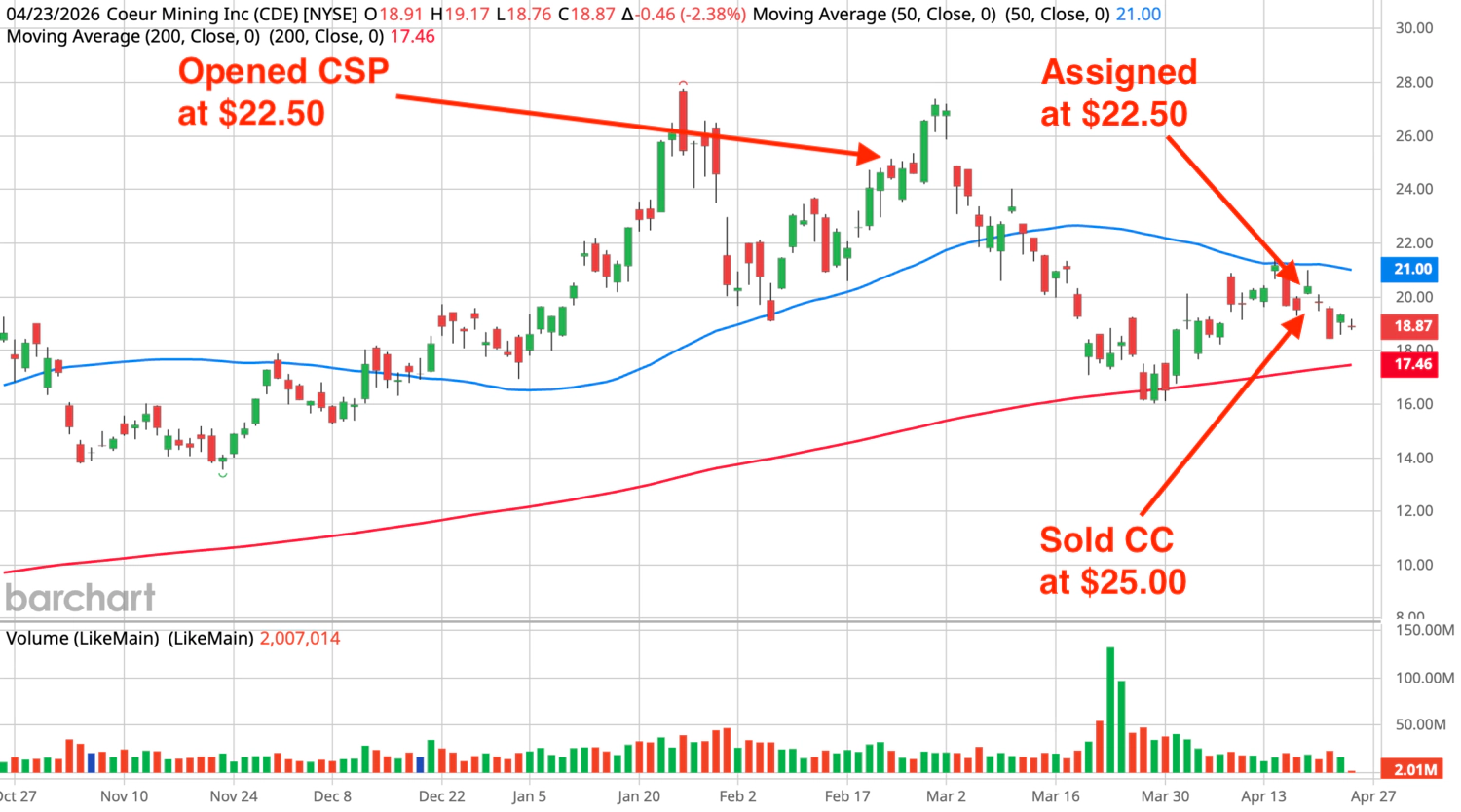
Let’s walk through a real example.
I’m long-term bullish on gold as an inflation and volatility hedge, and CDE (Coeur Mining), in my opinion, is one of the better value plays in the miner space.
Gold has been behaving like a real hedge again (central banks buying, inflation increasing, macro volatility elevated), and the miners tend to lag the metal before catching up.
Back in mid-February of this year, I sold a cash-secured put on CDE at a $22.50 strike and collected $1.32 in premium.
On 4/17/2026, the put got assigned after increased volatility in the Middle East caused oil prices to spike (miners require a lot of oil).
100 shares of CDE landed in my account at $22.50.
Now, a common misconception I see Wheel traders make is that they “assignment as failure”.
That’s not the case for how I Wheel.
Since I only Wheel quality stocks I have a long-term thesis in, I see assignment as a rotation event. Capital rotates from cash into shares.
In my case, I’m happy to own the shares of CDE. The thesis hasn’t changed. I want to keep them until gold runs.
But sitting on 100 shares of a stock is a waste of collateral if I can get paid to hold them. I’m already carrying the directional risk; the shares are going to move whether I collect premium on them or not.
That’s Phase 2 of the Wheel. That’s where the covered call comes in.
Prior trade (CSP leg)
- Ticker:
CDE - Opened: 2/26/2026
- Strike: $22.50
- Expiry: 4/17/2026
- Premium collected: $1.32 per share ($132 total)
- Outcome: Assigned
Covered call (CC leg)
On 4/20/2026 (three days after assignment) I sold a covered call against those 100 shares.
- Sold: 4/20/2026
- Strike: $25
- Premium collected: $0.20 per share ($20 total on the 100-share contract)
- Expiry: 5/8/2026
Why did I pick a $25 strike and not something closer to the current price where the premium would be bigger?
The answer is delta (which is directly tied to my conviction level).
Picking a CC Strike by Delta
Delta on a short call tells you the rough probability the option finishes in the money, which, for the seller, is the rough probability your shares get called away.
A delta of 0.15 is roughly a 15% chance of being called away.
A delta of 0.30 is roughly 30%.
Not a precise probability, but close enough for strike selection.
For Wheel CC sellers, I recommend the following delta levels:
Delta < 0.15→ “Keep shares + lower cost basis” (minimal called-away risk)Delta 0.15–0.30→ “Balanced” (more premium, meaningful chance of being called away)Delta >= 0.30→ “Max income” (high probability of being called away)
Because I want to keep the CDE shares for a longer period of time, I picked a low-delta strike at $25 and collected $0.20 per share in premium. Small premium, small probability of being called away, which is exactly what I want.
Note: Delta isn’t a perfect probability, it’s a first-order approximation. The actual called-away probability is closer to the “probability ITM” figure if your broker surfaces it. For strike selection purposes, delta is close enough and much faster to eyeball.
The delta I pick is the single biggest lever I have. Everything else (expiration, strike rounding, timing) is secondary to which band I’m writing in.
The Math: New Cost Basis and Profit If Called
Every premium I collect on CDE lowers my break-even on the shares. The CSP premium reduced my cost basis once. The CC premium reduces it again.
| Metric | Value |
|---|---|
| Original cost basis | $22.50 |
| CSP premium collected | −$1.32 |
| CC premium collected | −$0.20 |
| New cost basis | $22.50 - ($1.32 + $0.20) = $20.98 |
| Profit if called away at $25 | ($25.00 − $20.98) × 100 = $402.00 |
With the contract sold, three things can happen by expiration.
Call Expires Worthless
In this situation, CDE stays below $25 at expiration:
- Call expires worthless
- I keep the full premium of $20 ($0.20/share × 100)
- Shares still owned, cost basis now $20.98
- I can sell another CC next cycle and keep grinding the cost basis lower
- This is the ideal outcome for a Wheel seller who wants to keep the shares
Shares Called Away
Here, CDE closes above $25 at option expiration:
- Shares called away at $25
- Realized profit is $402 (from the table above)
- The Wheel cycle completes: bought at $22.50 (via CSP assignment), sold at $25, collected $1.52/share in CSP premium and $0.20 in CC premium along the way
- Honest take: I’d rather keep the shares given the gold thesis, but $402 realized is still a win (never complain about making money)
- Next step: start a new Wheel by selling a CSP on
CDE(or a different ticker)
Paper Loss Deepens
Now let’s say CDE drops significantly:
- This is where I currently sit as of this writing:
CDEtrading at $18.87, down $2.11/share from my $20.98 cost basis - My position: not worried
- The plan: keep selling low-delta CCs, keep lowering cost basis, wait for
CDEto run on the thesis - This is where the Wheel’s patience edge shows up
- I’m not forced to sell at a loss, I’m getting paid to wait
The $0.20 I just collected is a small sum on its own.
But twelve cycles of $0.20 is $2.40.
Twenty-four cycles is $4.80.
The Wheel is a compounding game, not a lottery ticket.
It rewards patience:
- A buy-and-hold investor sitting on the same $2.11/share paper loss has exactly one lever: wait for the price to recover.
- I have two: wait for recovery, and keep collecting premium on the way.
That second lever is what makes the difference.
Why Sell Covered Calls?

A single CC contract delivers income, cost-basis reduction, and a disciplined exit all at once.
The delta you pick just tilts which of the three dominates:
- Cost-basis reduction: Every CC premium lowers your break-even on the shares. This is the Wheel’s compounding logic; it’s what makes patience on drawdowns mathematically work. Tradeoff: you cap your upside at strike + premium.
- Income on owned shares: The surface-level “getting paid while holding” angle. CCs generate cash flow on shares that would otherwise just sit there. Psychologically, this can be beneficial to traders. Tradeoff: if the stock rips past your strike, you don’t participate in the rally (since you’ll be forced to sell at the strike).
- Disciplined exit: The CC strike is a pre-committed sell price that the market pays you to set. You’re getting paid to be the kind of disciplined seller most traders fail to be. Tradeoff: the exit is forced at strike; you don’t get to change your mind mid-rally (actually, that’s not entirely true — you can always buy back the CC, but it will be more expensive to do so compared to when you sold it).
Since I’m long-term bullish on CDE, I decided to go the cost basis reduction route.
Keeping my shares means picking a lower-delta strike.
A trader who wanted income on owned shares to dominate would’ve picked something closer to $22 or $23, taking a higher premium and a meaningful probability of being called away.
A trader who wanted a disciplined exit would’ve sold a $22 call on purpose, forcing an exit at a small profit, collecting the richest premium.
Same stock. Same share position. Three different trades, depending on which purpose you want to dominate.
Note Some traders sell CCs purely for income on shares they never intend to sell. That’s valid but out of scope for this article since we are applying The Wheel Strategy and it’s natural for us to transfer from cash, to shares, and back again.
The Risk of Selling Covered Calls
Capped upside isn’t the real risk of selling a covered call.
The real risks are:
- Getting called away below your cost basis
- Writing a call on a stock that rips and missing the rally
There’s also the same risk as buying and holding any stock — a macro event shock or bad company news can send the share price plummeting. That’s the risk of any stock on the market, not a CC or Wheel Strategy specific risk.
CCs don’t introduce the downside stock risk but they just don’t eliminate it either.
Risk #1: Being Called Away Below Your Cost Basis
Above and beyond, this is by far the biggest risk you need to pay attention to when selling covered calls:
- If you sell a CC at a strike below your cost basis and the stock rallies to that strike, you’re forced to sell at a realized loss
- Example: if I’d sold a $20 strike on
CDEto chase a juicier premium and the stock rallied there, I’d lock in a $0.98/share loss against my $20.98 cost basis - This usually happens when a trader chases premium by reaching for a higher-delta strike on a position that’s underwater
A below-cost-basis strike feels safe because the premium is fat and the stock is already below you.
Then the stock recovers just enough to hit the strike, and you’re stuck realizing a loss you didn’t have to take.
Now, it could be the case that a stock is deeply underwater but you still want to hold it, so you choose to sell a CC below your cost basis.
That does happen, and it is something I’ve done from time to time.
However, that is more of an “advanced” technique. You should only do that if you understand the risks. Before you try it, read up on the risks of going below your cost basis.
Note: If you just got assigned and this is your first CC, start with How to Sell Covered Calls After Assignment in The Wheel Strategy.
Risk #2: The Regret Trade (Missing a Rally)
Psychologically, this one can be hard on Wheel traders:
- You write a low-delta CC on a stock you want to keep, the stock rips past the strike, your shares get called away at strike and you miss the rest of the rally
- Example: if a gold catalyst runs
CDEto $30, I’m capped at $25 on my current CC, missing $5/share of upside on shares I wanted to hold long-term - The dollar cost of the regret trade is bounded (the difference between strike + premium and where the stock actually went)
While the dollar cost is bounded, the behavioral cost is not.
Beginners need to be prepared for how the regret trade feels (because the feeling is what drives the bad decisions that follow).
A missed rally tends to trigger a cascade:
- Chasing: Writing higher-delta CCs on the next cycle to “make up” for the capped upside
- Revenge-trading: Abandoning the low-delta discipline that made the Wheel work in the first place
- Abandoning the Wheel entirely: Rotating out of a working system because one trade felt bad
The risk isn’t just the missed upside, it’s the trader-behavior cascade that follows if you’re not emotionally prepared for it.
The Wheel works when the discipline holds. It breaks when the trader convinces themselves that this cycle is the one where they should chase.
A missed $500 rally feels ten times worse than a $500 realized gain feels good. That asymmetry is baked into the human brain.
Accept it, plan around it, and don’t let it rewrite your strike-selection rules.
Note: Where you set that strike relative to your cost basis is what decides how much upside you cap and whether the exit is profitable at all. I walk through the whole decision in Selling Covered Calls Above Your Cost Basis.
Covered Calls vs. Just Holding the Shares
One of the most common questions I receive regarding The Wheel Stragey is:
Should I even bother selling CCs? Do they beat just holding the shares?
Let’s run it across the full outcome spectrum.
Same situation as the CDE trade above:
- Cost basis $20.98
- CC strike $25
- $0.20/share ($20 total) premium
In the following table, The CC seller’s cost basis is $20.98 (both CSP and CC premium subtracted) while the buy-and-hold investor never sold the CC, so their cost basis is $21.18 (only the CSP premium subtracted):
| Scenario | Stock price at expiry | CC P/L | Buy-and-hold P/L | Winner |
|---|---|---|---|---|
| Sharp rally | $30 | +$402 (called away at $25) | +$882 | Buy-and-hold (by $480) |
| Moderate rally | $26 | +$402 (called away at $25) | +$482 | Buy-and-hold (by $80) |
| Flat | $19 | −$198 | −$218 | CC (by $20) |
| Moderate drop | $16 | −$498 | −$518 | CC (by $20) |
| Significant drop | $12 | −$898 | −$918 | CC (by $20) |
CCs lose to buy-and-hold in both rally rows (that’s the capped-upside tradeoff).
In the three non-rally rows, the CC always comes out ahead by exactly the $20 in premium collected. That $20 softens the pain of a paper loss or pads the return of a flat month.
The pattern here is clean:
- If the stock rallies past your strike, buy-and-hold wins by however much it ran past strike
- If the stock goes anywhere else (flat, mild drop, big drop) the CC wins by the premium.
Which leads to the rule-of-thumb most traders hear and badly misapply.
If you genuinely think a stock is about to rip, don’t sell CCs on it, just hold the shares.
That rule is correct in the abstract and dangerous in practice.
Timing markets is hard. In most cases it can still be beneficial to sell CCs because you probably can’t time the rip anyway.
My default action is to
- Choose my strike (and therefore my exit price)
- Know ahead of time what my profit will be (and be okay with that)
- Sell the CC
- Earn the premium
- Be patient
And if CDE rips to $30 and I’m capped at $25, that’s fine.
I collected my premium along the way and locked in a realized profit.
Now I’m back to cash, and if I can choose to sell another CSP if I want to.
How to Start Selling Covered Calls
The strategy is simple. The discipline is hard.
If you own 100 shares of a stock you genuinely want to keep owning, the decision to sell a CC comes down to three questions.
- Is this a stock I want to keep owning?
- What’s my cost basis?
- Which strike matches my goal?
Answer those three honestly (in order) and most of the work is already done.
The strike you pick follows automatically from the delta band that matches your goal:
Delta < 0.15→ Keep shares and lower cost basisDelta 0.15–0.30→ BalancedDelta >= 0.30→ Max income
The expiration follows from how often you want to manage the position. The premium you collect follows from the strike and delta you already chose.
What’s left is showing up every cycle and doing the same thing again.
- When you’re ready to systematize the strike and expiration hunt, here’s how I screen covered calls on shares I already own.
- And when you’re ready for the whole picture, see my complete CC playbook.