 by
by 
Historical volatility (HV) measures how much a stock’s price actually moved over a past period, expressed as an annualized percentage.
Let’s say you just found a stock with 60% IV and fat premiums.
You’re considering selling a CSP and collecting that premium.
But is that IV actually high for this stock?
How do you know?
Realistically, you can’t answer that without historical volatility.
If implied volatility is the weather forecast, historical volatility is the past 30 days of recorded weather.
One is a prediction.
The other is the truth.
Essentially, HV is backward-looking, based on real price data, and gives you the baseline for judging whether implied volatility (and the premiums you’re collecting) are justified by reality.
My previous article on implied volatility covered the market’s forecast (i.e., what the market expects to happen).
Now we look at the other side: what the stock actually did.
If you want the full learning path, this article is part of Options Fundamentals: The Complete Guide.
Table Of Contents
What Is Volatility? A Quick Recap
I covered volatility in depth in the Implied Volatility article, so I’ll keep this brief.
As Wheel traders, volatility is what we get paid for. It’s the size of a stock’s price swings, and bigger swings mean fatter premiums.
The key thing to internalize is that volatility isn’t inherently good or bad. It’s a measurement, like a thermometer reading. A high reading doesn’t tell you whether to be excited or worried. Context does.
What matters is whether the volatility you’re being compensated for (through premium) is justified by the volatility the stock actually exhibits.
And that’s exactly the question HV answers.
What Is Historical Volatility (HV)?
HV measures how much a stock actually moved over a past period, expressed as an annualized percentage.
It’s backward-looking, based on real price data, not market expectations.
HV is on the same scale as IV (annualized percentage), so you can compare them directly. That’s the whole point.
HV Lookback Periods (1 Month, 3 Months, 1 Year)
Not all HV is created equal. The lookback window you choose will tell you a very different story:
- 1 month (20 trading days): Captures recent, short-term price action; most reactive to sudden moves
- 3 months (60 trading days): Smooths out short-term noise; shows the medium-term trend
- 1 year (252 trading days): The long-term baseline; shows what “normal” looks like for this stock
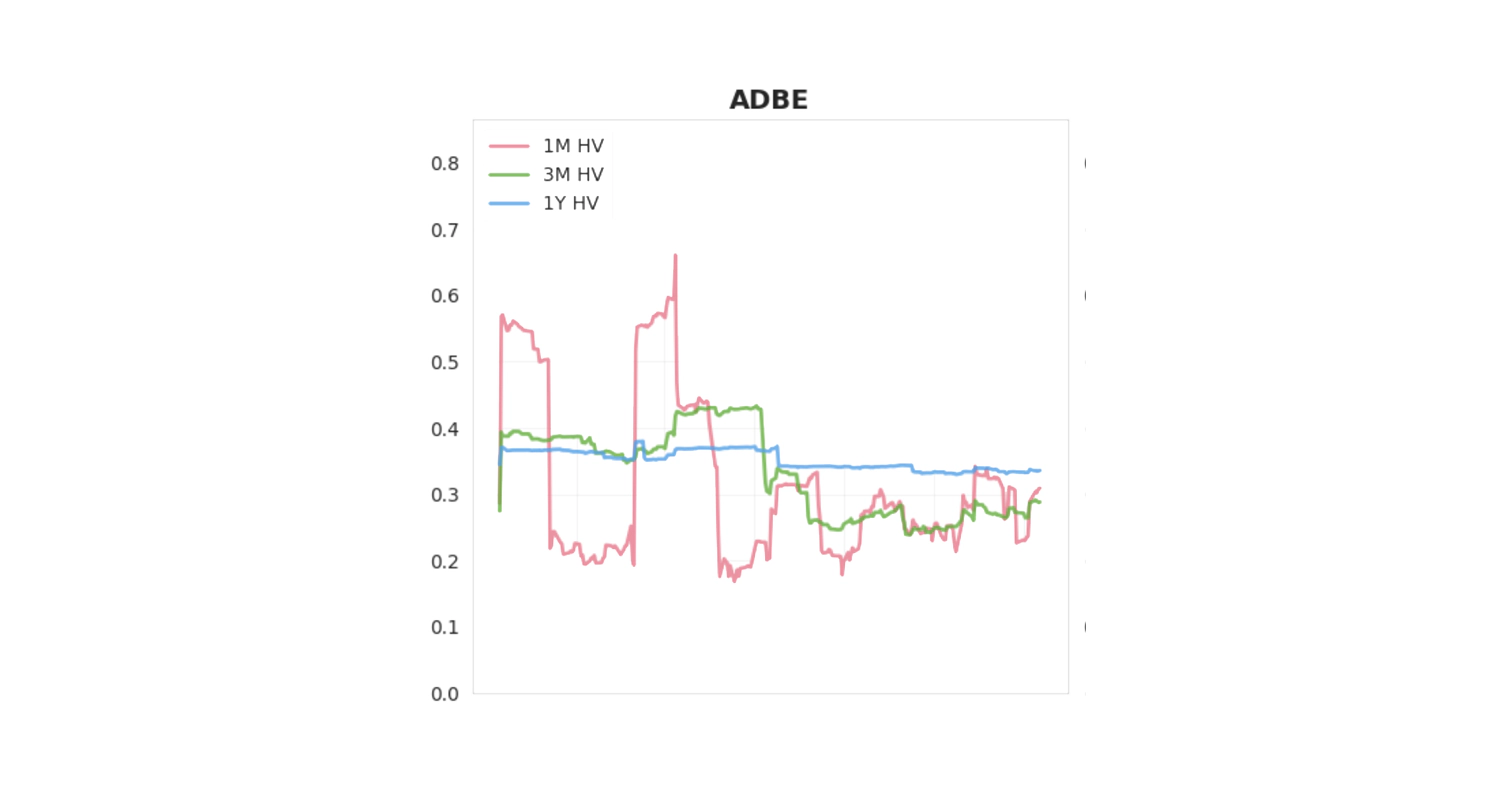
Above is what that looks like in practice with ADBE (Adobe).
Three HV lines, same stock, very different stories:
- The 1M HV (pink) swings wildly, ranging from roughly 18% to 66%. When
ADBEhad a rough week, that pink line shot up. When things calmed down, it plummeted. Reactive, borderline twitchy, like a novice trader attempting to trade 10 minute candles. - The 3M HV (green) moderates those swings, settling into a range of about 25% to 44%. Still responsive, but it takes a sustained move (not just a bad Tuesday) to shift meaningfully.
- The 1Y HV (blue) barely moves, holding steady between 34% and 38%. That’s
ADBE’s “long-term normal.” A single volatile week won’t budge it. Only a persistent shift in the stock’s behavior shows up at this timescale.
Same stock. Different windows. Different answers to the question “How volatile is this stock?”
This is why experienced traders don’t rely on a single lookback period. They check all three.
Think of it this way:
- 1M HV tells you what’s happening right now
- 1Y HV tells you what “normal” looks like
- And 3M HV sits in between, smoothing out the noise without losing the recent signal
When HV Windows Diverge (A Real-World Example)
The ADBE chart above shows a stock where the three HV lines stay relatively well-behaved. The HV periods tell slightly different stories, but they’re in the same neighborhood.
Now let’s look at what happens when a real shock hits.
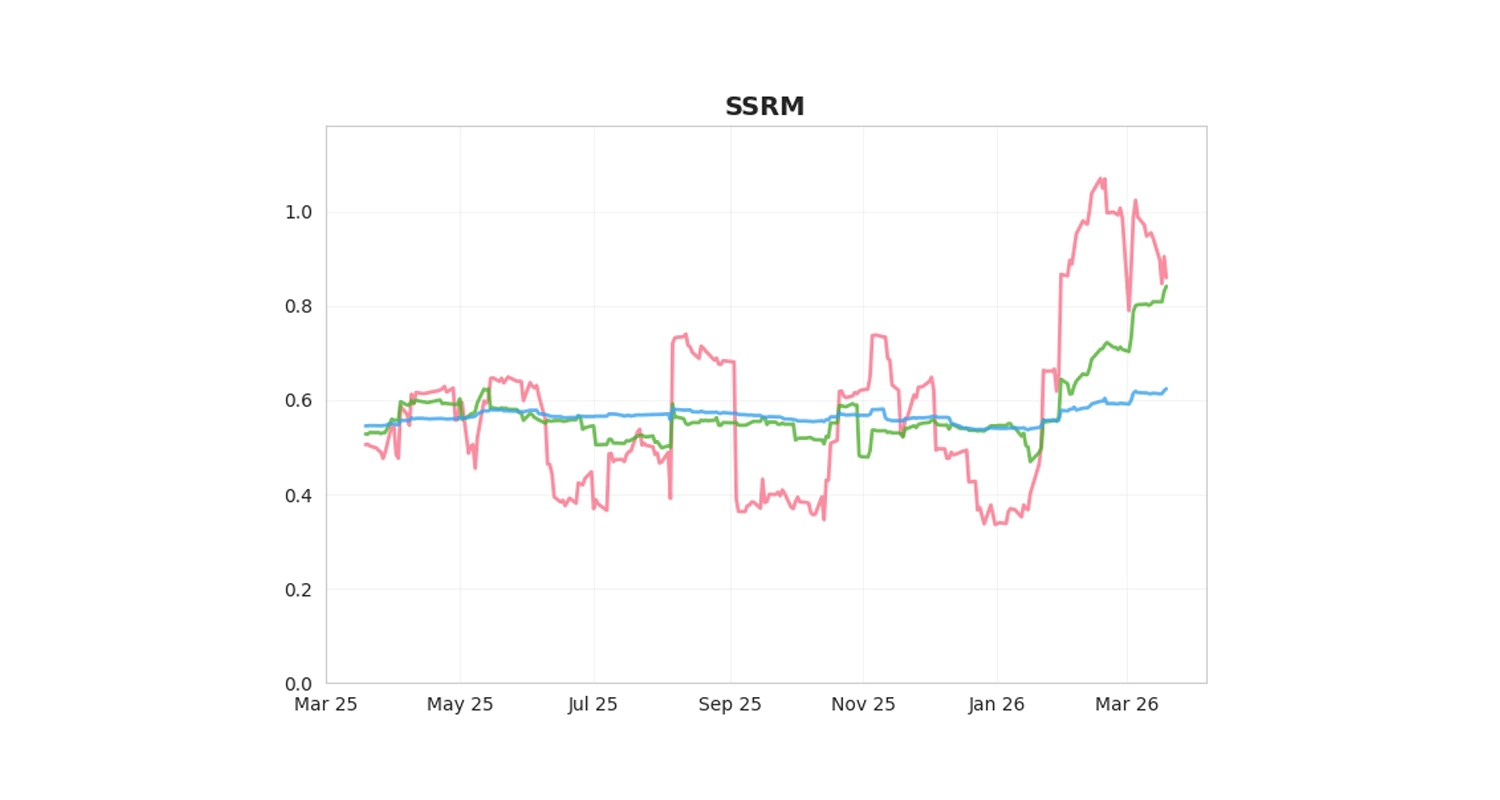
At the top of this section is SSRM (SSR Mining) with the same three HV lines over the past year.
For most of 2025 (March through December), all three lines tracked close together, hovering in the 50-60% range. Normal behavior for a mining stock.
Then around February/March 2026, something changed.
All three lines began diverging dramatically upward.
Here’s where they sit now:
| HV Window | Current Value | What It’s Telling You |
|---|---|---|
| 1M HV (pink) | ~100% | The last month has been extreme; the stock nearly doubled its typical volatility |
| 3M HV (green) | ~83% | The recent chaos is pulling up the medium-term average, but the calmer months before are still dampening the number |
| 1Y HV (blue) | ~62% | Barely budged — the long-term baseline absorbs the shock like a cruise ship absorbs a wave |
The 1Y HV went from ~57% to ~62% while the 1M HV went from ~55% to ~100%.
Same stock. Same time period. Wildly different readings depending on which window you check.
This is why you need all three.
If you only looked at the 1Y HV, you’d think SSRM was behaving mostly normally (a little elevated, nothing dramatic). If you only looked at the 1M HV, you’d think the stock was in full meltdown mode.
The truth lives in the relationship between the windows. When 1M HV is dramatically above 1Y HV, something unusual is happening right now, but the stock’s long-term character hasn’t fundamentally changed (yet).
As Wheel traders, when wee see 1M HV significantly above 1Y HV, we get curious.
We’re intrigued.
We see opportunities for fat premiums.
But we have to slow down and keep ourselves in check.
We have to ask ourselves:
“Why is IV so elevated?”
The answer to that question is the difference between cashing in on a sweet payday…
…or getting assigned on a stock that tanks 40%.
(For the curious: SSRM is a silver and gold miner, and the mining sector has been dealing with significant gold macro volatility, dollar strengthening, and bond yield pressure due to the Iran War. Essentially, similar dynamics to what I discussed in the IV article with other mining names.)
What HV Means in Dollar Terms
Abstract percentages are hard to feel. Let’s convert SSRM’s 1Y HV into something tangible:
SSRMis currently trading at $22.72- From the above chart, we know 1Y HV is ~62%
- Daily standard deviation: 62% / sqrt(252) = ~3.9%
- On a $22.72 stock: 3.9% x $22.72 = ~$0.89 per day
A 62% annualized HV means SSRM typically moves about $0.89 per day based on the past year of data.
Now you can feel the number.
That daily number is a one-standard-deviation move, meaning SSRM stays within that range on roughly two-thirds of trading days.
On the other third, it moves more than $0.89.
Some days, much more.
This is what makes HV practical. It converts a percentage that lives on a chart into a dollar amount that lives in your brokerage account.
Now here’s where it gets interesting for premium sellers.
Let’s play out two hypothetical IV scenarios for SSRM, given what we know about its HV windows (1M ~100%, 3M ~83%, 1Y ~62%).
Scenario A: Current IV at 85%
The current IV is sitting at 85%.
Your first instinct might be to think that’s high.
And compared to the 1Y HV of 62%, it is.
But look at the 1M HV: ~100%.
An 85% IV is actually below what the stock has done over the past month.
The market is saying, “Yes, we expect elevated volatility, but things are going to calm down from recent levels.”
That’s not an “oh shit” signal. That’s the market pricing in a deceleration.
Scenario B: IV (Hypothetical) at 130%
Now let’s suppose the current IV is at 130%.
Now the market is pricing in more movement than even the recent frenzy.
A current IV at 130% would be above every HV window: 1M, 3M, and 1Y.
The market isn’t just saying “things are volatile.” It’s saying “you haven’t seen the worst of it yet.”
Maybe there’s an acquisition rumor. Maybe there’s a mine disaster. Maybe gold just cratered and SSRM’s balance sheet is in question.
Whatever the reason, 130% IV on a stock with 100% 1M HV means the market expects things to get worse, not better.
That premium looks fat for a reason. And that reason might eat your account.
Same stock. Same HV. Two very different IV readings. Two very different risk profiles.
Without the multi-window HV comparison, both scenarios just look like “high IV.”
We’ll cover exactly how to use the gap between IV and HV for trade selection in the next article.
How Is Historical Volatility Calculated?

You don’t need to memorize this. But understanding the intuition helps you trust the number.
HV is calculated in three conceptual steps:
- Compute daily percentage returns to determine how much did the stock move today vs. yesterday, in percentage terms
- Take the rolling standard deviation of those daily returns over a lookback window (20, 60, or 252 days) — this captures the spread of daily moves
- Annualize by multiplying by the square root of 252 (trading days in a year), thereby converting the daily measure to an annual percentage so it’s on the same scale as IV
That’s it. Daily returns, standard deviation, annualize.
Why sqrt(252)? Standard deviation measures dispersion in whatever time unit you feed it. Feed it daily returns, you get a daily number. Multiplying by sqrt(252) scales that daily dispersion up to an annual number, which puts HV on the same scale as IV.
The sqrt(252) step is what lets you compare HV and IV apples-to-apples.
The Math Behind Historical Volatility
For the formula-curious:
- Daily return = (today’s close - yesterday’s close) / yesterday’s close
- HV = standard deviation of daily returns over N days x sqrt(252)
- Example: 20-day HV = standard deviation of the last 20 daily returns x sqrt(252)
The standard deviation step is doing the heavy lifting. It measures how spread out those daily returns are.
A stock that consistently moves 0.5% per day has a small standard deviation. A stock that swings between -4% and +5% has a large one.
You don’t need to do this yourself.
Most traders find HV in their brokerage platform or pay for a service that computes it.
As a quant investor, I compute it myself through code I’ve written…but you don’t need to.
Understanding the intuition matters. Memorizing the formula doesn’t.
(Though if you’re the type who opens a spreadsheet for fun on a Saturday night…no judgment. I’ve been there.)
Why Historical Volatility Matters for Wheel Traders

HV is the reality check on IV.
It’s like checking last month’s actual temperatures before deciding if the weather forecast seems reasonable.
Without HV, you’re flying blind on whether premiums are justified.
For example:
Could I have sold a lot more premium before I started checking HV? Absolutely. But I also would have walked into setups where the fat premium existed because the stock was about to implode, not because I found an edge.
HV gives you three practical things as a Wheel trader:
- Context for premium levels: Is IV (and the premium you’re collecting) justified by how the stock actually behaves, or is the market pricing in something unusual?
- A baseline for spotting anomalies: When the market is pricing in significantly more (or less) movement than history suggests, that’s a signal worth investigating
- A multi-timeframe view: Comparing 1M, 3M, and 1Y HV on the same stock tells you whether recent volatility is a blip or a trend
The full framework for using HV and IV together to select better trades lives in the next article.
Where to Go from Here
HV is backward-looking. It tells you what a stock actually did, not what the market expects:
- Without HV, every high-IV stock looks like an opportunity
- With HV, you can distinguish between IV that’s slightly elevated (routine) and IV that’s double the historical norm (something sketchy is going on)
That distinction is everything.
The next step is IV and HV: Using Volatility to Select Better Wheel Trades, which walks through the practical framework for using both together.
For a refresher on how implied volatility drives premium levels and how to interpret the market’s forecast, see my guide on implied volatility.