 by
by 
Let’s suppose that gold miner stock, IAG, currently has an IV of 55%.
Is that high? Low? Worth selling into?
You literally cannot answer that question without knowing what IAG actually did historically.
IV and HV together tell you whether the market is overpricing or underpricing a stock’s expected movement. That gap is what determines whether selling premium is worth it or not.
A 55% IV on IAG means nothing in isolation.
But 55% IV against a 35% HV? Now you have context. Now you have a trade decision.
If you’ve read the Implied Volatility and Historical Volatility articles, you know what each number measures individually:
- IV is the market’s forecast of future movement (priced into premiums right now)
- HV is what the stock actually did over a past period (calculated from real price data)
The trick is using them together to decide whether a trade is worth taking.
I run this IV and HV framework before every Wheel trade.
Let’s dive in.
Table Of Contents
What Does the Gap Between IV and HV Tell You?
Let’s again consider IAG and assume it has a current IV of 55%.
Is 55% IV high?
Low?
Worth selling into?
As I alluded to in the intro of this article, you cannot answer that without context. The raw IV number is meaningless on its own. What matters is the gap between IV and HV, because that gap tells you whether the market’s forecast is overshooting or undershooting the stock’s historical reality.
When IV is greater than HV, the market expects more movement than the stock has historically shown. This movement may potentially favorable for sellers, but ask why before jumping in. Elevated IV can imply options are overpriced relative to historical reality (i.e., an opportunity for premium sellers like us).
When IV is less than HV, the market expects less movement than the stock has historically shown. You’re not being adequately compensated for the actual movement the stock tends to make. This situation is unfavorable for sellers.
IV Crush and the Gap
When IV is significantly above HV, that gap tends to collapse over time. IV mean-reverts back toward HV.
This is the connection to IV crush:
- The IV/HV gap gives you a way to gauge how much crush potential exists
- The bigger the gap (IV above HV), the more room IV has to compress, and the more extrinsic value evaporates from the options you sold
That compression is money in your pocket for Wheel traders.
Worked Example With IAG
| Scenario | IV | HV (20-day) | Gap (IV - HV) | What It Means for Sellers |
|---|---|---|---|---|
| IV > HV | 55% | 35% | +20 | Market overpricing movement vs. historical reality (favorable, but investigate why) |
| IV < HV | 25% | 40% | -15 | Market underpricing movement vs. historical reality (thin premiums, elevated real risk) |
Let’s look at two hypothetical scenarios with IAG (IAMGOLD) to see how the IV/HV gap can change our trading strategy:
- Scenario 1:
IAGat IV 55% / 20-day HV 35%- IV is pricing in significantly more movement than
IAGhas shown historically - Gap of +20 points
- Favorable for sellers (with due diligence on why IV is elevated)
- IV is pricing in significantly more movement than
- Scenario 2:
IAGat IV 25% / 20-day HV 40%- IV is pricing in less movement than
IAGhas actually been making - Gap of -15 points
- Unfavorable for sellers, premiums are thin relative to the stock’s actual behavior
- IV is pricing in less movement than
Same stock. Completely different trade decisions. The gap made the call.
What Are IV Rank and IV Percentile?

The IV/HV gap tells you whether IV is high relative to recent movement.
But is IV high relative to itself?
Different question.
That’s what IV Rank and IV Percentile answer:
- 50% IV on a gold miner like
IAGmight be elevated - 50% IV on a volatile biotech might be below average
The raw number tells you nothing without knowing what’s normal for this specific stock.
IV Rank vs. IV Percentile
| Metric | What It Measures | Sensitive To | Best For |
|---|---|---|---|
| IV Rank | Where IV sits in its 52-week range | Extreme highs and lows (one spike can skew the range) | Quick “is IV elevated?” check |
| IV Percentile | What % of days had lower IV | The full distribution of IV over the year | More reliable read on whether today’s IV is genuinely unusual |
Here’s a quick (and simplified) breakdown on IV Rank vs. IV Percentile:
- IV Rank: Where current IV falls between the stock’s 52-week high and low IV on a scale of 0-100. High rank means IV is near the top of its recent range.
- IV Percentile: Addresses what percentage of trading days in the past year had IV lower than today. Also on scale of 0-100. High percentile implies IV is higher than it’s been on most days.
IV Rank and IV Percentile measure different things and can give different readings on the same stock.
How IV Rank and IV Percentile They Can Diverge
Imagine IAG had a single massive IV spike to 90% six months ago during a company-specific event, but IV otherwise ranged between 30-50%.
Now suppose the current IV is at 48%, while the 52-week IV range had a low of 28% and high of 90%.
Running the numbers:
- IV Rank: (Current IV - 52-week Low) / (52-week High - 52-week Low) = (48% - 28%) / (90% - 28%) = 20 / 62 = 32%. Looks moderate because that single spike to 90% stretched the top of the range, making 48% appear mid-range.
- IV Percentile: If IV normally sat between 30-50% and only breached 48% during that one brief spike, then 48% is higher than roughly 80% of trading days. IV Percentile reads 80%. Actually elevated.
Same stock, same moment, two different readings. IV Percentile caught what IV Rank missed because a single spike distorted the rank.
Practical Thresholds
Here are my suggested starting points for IV Rank and IV Percentile (both use a 0-100 scale):
- Above 50: Elevated, worth looking at for selling premium
- Above 70: Rich premium territory
- Below 30: Thin premiums, consider waiting for a better entry
These are guidelines, not rules. A stock with an IV Rank of 45 but a strong IV/HV gap might still be a good trade. Use these alongside the gap, not instead of it.
The Practical Approximation
The problem here is that many (if not most) retail platforms do not show IV Rank or IV Percentile directly.
But there is an easy way around that.
My favorite approximation is to compare current HV across multiple timeframes (1-month, 3-month, 1-year).
If 1M HV is significantly above 3M and 1Y HV, the stock is in a heightened volatility regime. Similar signal to a high IV Rank, no specialized tools required.
This is the approach we use in the real-world examples later.* And the best part is, as long as you have access to a stock’s historical closing prices, you can easily compute the HV.
How to Combine IV and HV for Better Trade Decisions
Now we put it all together.
The IV/HV Decision Flowchart
Here’s the flowchart we’ll be following through the rest of this section:
Start
  │
  ▼
Is IV > HV? ── No ──► SKIP
  │
 Yes
  │
  ▼
Is 1M HV elevated vs. 3M/1Y? ── No ──► WAIT
  │
 Yes
  │
  ▼
Why is IV elevated?
  │
  ├─ Routine catalyst ──► SELL
  │
  └─ Company red flag ──► SKIP
Bookmark this page and keep it handy for when you are analyzing Wheel setups.
Step 1: Check the IV/HV Gap
Start by asking if IV is above HV:
- IV significantly > HV: Favorable. Proceed to Step 2.
- IV roughly equal to HV: Caution. Premium looks fat but the stock is actually moving this much historically. Proceed to Step 2 with tighter criteria.
- IV < HV: STOP. You’re being underpaid for the actual movement. Skip this trade.
Step 2: Gauge Whether Volatility Is Elevated
Now you need to compare HV across timeframes (1M vs. 3M vs. 1Y). Is the stock in a heightened regime, or is this business as usual?
- 1M HV significantly above 3M/1Y: Elevated regime. IV is likely inflated too. Good crush potential. Proceed to Step 3.
- 1M HV in line with 3M/1Y: Business as usual. Premiums may be adequate but no special edge. Proceed cautiously.
- 1M HV below 3M/1Y: Quiet period. Premiums are likely thin. Consider waiting.
Step 3: Investigate WHY IV Is Elevated
- Routine catalyst (earnings uncertainty, sector rotation, general market fear): Acceptable. Sell premium if you’d own the stock at the strike price.
- Company-specific red flag (fraud, bankruptcy risk, regulatory action): STOP. High IV is justified by existential risk. Walk away.
This flowchart produces three outputs: sell, wait, or skip.
Four Quadrants of IV and HV (With Examples)
| Quadrant | IV | HV | Gap | Verdict |
|---|---|---|---|---|
| The Sweet Spot | High | Low | IV » HV | Sell option (with due diligence) |
| Justified IV | High | High | IV ≈ HV | Cautious sell (be careful) |
| The Desert | Low | Low | IV ≈ HV | Wait, premiums too thin |
| The Trap | Low | High | IV « HV | Skip, you’re being underpaid |
Each combination of high/low IV and HV creates a distinct setup. Here’s how to read them, using IAG as the running example:
1. The Sweet Spot: High IV / Low HV
IAGat IV 55% / 20-day HV 35%- Market overpricing movement relative to historical reality
- Best setup for selling premium, with rich premiums and room for IV to crush back toward HV
- This is the “sell” signal (after due diligence)
2. Justified IV: High IV / High HV
IAGat IV 55% / 20-day HV 52%- IV is high, but the stock is actually moving that much historically
- Fat premium reflects genuine risk, not mispricing
- Proceed with caution: tighter strike selection, smaller position sizing
3. The Desert: Low IV / Low HV
IAGat IV 25% / 20-day HV 22%- Calm stock, calm market pricing
- Premiums are too thin to typically justify the capital commitment and opportunity cost
- Wait for volatility to expand before selling
4. The Trap: Low IV / High HV
IAGat IV 25% / 20-day HV 40%- Market underpricing actual historical movement
- Worst setup for sellers. You’re collecting a small premium while the stock’s actual movement can easily overwhelm it
- Skip entirely
If you can only memorize one row, make it The Trap. That’s where the expensive lessons live.
The Pre-Trade Volatility Checklist
Run this before every Wheel trade (it takes 60 seconds:)
- IV/HV Gap check: Is IV above HV? (Positive gap = favorable, negative gap = skip)
- Gap magnitude check: How big is the gap? (Bigger gap = more edge and crush potential)
- HV regime check: Compare 1M HV vs. 3M and 1Y HV. Is volatility elevated or business as usual?
- “Why?” check: Why is IV elevated? (Routine catalyst = acceptable, company-specific danger = walk away)
Don’t shoot yourself in the foot. Take sixty seconds and answer these questions before you open a position.
Applying the Framework to Real Mining Stock Trades
We’ve been using IAG as our running example. Now let’s expand to four gold mining stocks: CDE, IAG, SSRM, and NEM.
Same sector. Same macro exposure. Very different volatility profiles.
The Macro Backdrop
The Iran war (which started around February 28, 2026) spiked oil past $100/barrel, reigniting inflation fears. The Fed held rates at approximately 3.5-3.75% and revised its dot plot to just one cut in 2026.
Gold initially surged to an all-time high (approximately $5,246) on safe-haven demand, then sold off roughly 6% as rising yields and a stronger dollar outweighed geopolitical risk. Gold mining stocks gave back their 2026 gains.
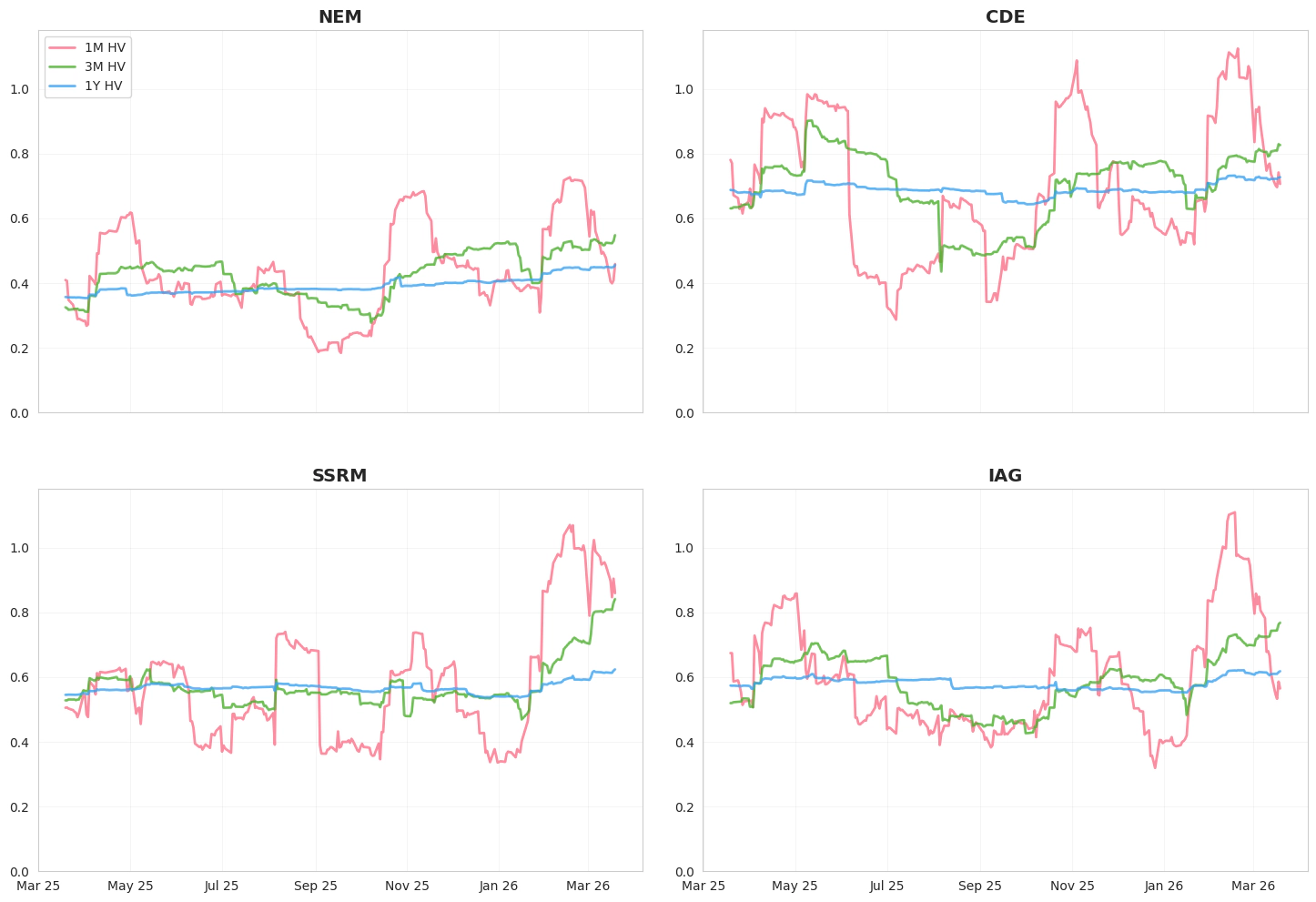
This is the backdrop driving the volatility shifts in the chart below.
What the Chart Reveals
All four stocks show a sharp 1M HV spike in late February and early March 2026. That’s the Iran war effect hitting the entire gold mining sector simultaneously.
But the magnitude of each stock’s reaction and its pre-war baseline are what make the volatility stories different.
CDE is the “always volatile” archetype. 1M HV regularly spikes to 0.8-1.0 throughout the year (June ‘25, September ‘25, November ‘25), and those are CDE-specific swings, not macro events. The Iran war spike to approximately 0.85 on 1M HV barely stands out against CDE’s normal behavior. 3M HV sits around 0.75, 1Y HV around 0.72. Elevated HV is CDE’s baseline.
IAG shows a stock-specific spike to approximately 0.85 on 1M HV in August-September ‘25 (unrelated to the Iran war), then settled back. The Iran war pushed 1M HV to approximately 0.9. 3M HV sits around 0.6, 1Y HV around 0.55. A moderate baseline with occasional spikes.
SSRM was calm for most of the year, with 1M HV hovering around 0.4-0.6. Then the Iran war hit and 1M HV exploded to approximately 0.95, the largest spike on the chart. This is the “regime change” example: a stock that was quiet suddenly becoming the most volatile in the group. 3M HV sits around 0.8, 1Y HV around 0.58.
NEM is the steadiest of the four. Earlier fluctuations were mild. The Iran war pushed 1M HV to approximately 0.7, elevated for NEM but still the lowest spike of the group. 3M HV sits around 0.55, 1Y HV around 0.42.
Running the Checklist on Each Stock
Note: The HV values below come directly from the chart. IV values are illustrative but realistic for gold miners in this environment. They are not exact market quotes.
IAG
- 1M HV ~0.9 (Iran war spike), 3M HV ~0.6, 1Y HV ~0.55
- HV regime: clearly elevated (1M » 3M » 1Y)
- If IV is running around 65-70%, IV is below 1M HV but above 3M and 1Y HV
- The gap to 1M HV is narrower than
SSRM’s, and IV comfortably exceedsIAG’s longer-term baselines — so this leans more “Justified IV” than “Trap” - The Iran war is a known macro catalyst, not a company-specific red flag
- Verdict: cautious sell if you’d own
IAGat the strike — tighter strikes and smaller sizing are appropriate given IV still trails 1M HV
CDE
- 1M HV ~0.85, 3M HV ~0.75, 1Y HV ~0.72
- HV regime: only slightly elevated (1M above 3M/1Y, but not dramatically…
CDEalways runs hot) - If IV is ~75%, it’s roughly in line with 3M HV. No real gap to exploit
- Verdict: no special edge — skip unless you specifically want
CDEexposure
SSRM
- 1M HV ~0.95, 3M HV ~0.8, 1Y HV ~0.58
- HV regime: dramatically elevated (1M is nearly 2x the 1Y HV, the biggest regime shift of the group)
- If IV is ~70%, 1M HV > IV. The stock is moving more than the market prices in
- Yes, IV at 70% is above the 1Y HV of 58%, which looks attractive. But the framework checks IV against recent HV first, and right now
SSRMis whipping around more than premiums compensate for. That’s “The Trap,” not “The Sweet Spot.” - Verdict: skip or wait. Once the Iran war spike fades and 1M HV settles back toward the 58% baseline, then 70% IV against ~58% HV becomes The Sweet Spot. But not yet.
NEM
- 1M HV ~0.7, 3M HV ~0.65, 1Y HV ~0.42
- HV regime: elevated (1M above 3M, both above 1Y)
- If IV is ~55%, IV is below 1M HV. IV hasn’t fully caught up to the recent spike
NEM’s steady nature means premiums will remain moderate even in elevated periods- Verdict: wait for the HV spike to settle, then revisit
The Takeaway
Same sector. Same macro backdrop. Four completely different volatility stories:
CDEbarely noticed the Iran war (it’s always volatile)SSRMwas transformed by it (regime change)IAGandNEMfell somewhere in between
That’s why you need the framework, not just “Is IV high?”
If you just checked raw IV on all four, you might have sold puts on every single one. The framework separated the cautious sell (IAG) from the skip (CDE, SSRM) from the wait (NEM).
That kind of filtering is worth 60 seconds of your time.
Common Volatility Mistakes When Selecting Wheel Trades
These four volatility mistakes sit alongside the broader Common Options Trading Mistakes to Avoid for The Wheel Strategy.
Here are four mistakes I consistently see with options traders running The Wheel.
1. Selling Puts Just Because IV Is High
- High IV alone tells you nothing. If HV is just as high, the market isn’t overpricing anything.
CDE’s IV looks juicy, but HV is right there with it. You’re not getting an edge, you’re getting compensated for real risk.- Always check the gap before assuming fat premium equals opportunity.
2. Ignoring the HV Regime
CDEat 75% IV sounds high, but if HV has ranged from 60% to 100% over the past year, you’re selling into business-as-usual territory. That’s fine if you can find a strike you’d like to own CDE at, but typically this should make you cautious.- Compare 1M vs. 3M vs. 1Y HV to see whether the stock is genuinely in an elevated regime or just being itself.
3. Over-Relying on One Metric
- Each metric tells you one piece of the story, none of them give you the full picture by themselves.
- The framework exists because you need the IV level, HV across timeframes, the gap between them, and the “why” behind the elevation.
NEMmight look boring on IV alone, but the full framework tells you whether it’s a wait or a skip.
4. Confusing the IV/HV Gap Direction
- IV < HV means the market is pricing in less movement than historical reality. You’re being underpaid.
- Sellers want IV > HV: The market overpricing movement relative to what the stock has actually done.
- If
IAG’s IV drops below HV after a volatile period settles, that’s a signal to wait, not sell.
Where to Go from Here
IV and HV together give you context that neither provides alone:
- The gap tells you whether the market is overpricing or underpricing movement.
- The HV regime tells you whether volatility is elevated or normal
- And the “why” check keeps you from walking into traps
Run the checklist before every trade. It takes 60 seconds and saves you from trades that look good on the surface but aren’t.
Most of your edge comes from the trades you don’t take. The discipline to say “Not this one” is what separates consistent income from random premium collection.
- This article is part of the Options Fundamentals series. Head back to the complete guide for the full learning path.
- From here, the next piece of the puzzle is bid-ask spreads and options liquidity, which determines how cleanly you can actually enter and exit these trades.
- And when you’re ready to put volatility to work selling puts, the Cash Secured Puts guide walks you through it end to end.