 by

A company beats on earnings. It beats on revenue. And the stock falls the next morning.
If you’ve watched that happen and decided the market is irrational, I have bad news.
The market was reading something you weren’t.
An earnings report tells you what a business already did, for a quarter that’s already over. The market trades what happens next.
Two signals tell you what happens next:
- Analyst revisions
- Forward guidance
Revisions are where Wall Street thinks the numbers are heading. Guidance is where management says they’re heading. Together they’re the windshield. A beat on last quarter is just the rearview mirror.
It also matters more on the Wheel Strategy than almost anywhere else, because the strike you sell a cash secured put at is a forward commitment. It’s a standing offer to own the business through the months ahead, not the quarter behind.
Table Of Contents
Why the Market Prices the Future, Not the Past
In my stock selection framework, this is the fourth and final pillar:
- Valuation
- Profitability
- Growth
- Upward Revisions/Forward Guidance (you are here)
Valuation asked whether the price is right. Profitability asked whether the business is any good. Growth asked whether it’s getting bigger.
Every one of those looks at what a company has already done, or what it’s worth today.
This pillar is the only one that looks forward.
A stock price is the market’s best guess at every quarter still to come, discounted back to today.
So when a company reports, the actual results are old news the instant they cross the wire. What moves the stock is how those results change the guess about the future.
That’s why you can’t pick a Wheel stock off a track record alone. A wall of past earnings beats tells you the company has been executing. It tells you nothing about whether it’s about to stop.
To read the future, you work through three things in order:
- Why last quarter’s beat is already priced in (the rearview mirror)
- Which way analysts are moving their forecasts (the first forward signal)
- What management says is coming (the second forward signal)
Then the mystery from the top of this article solves itself.
The Rearview Mirror: What an Earnings Beat Actually Tells You

Every quarter, a public company reports two headline numbers:
- Its earnings per share
- And its revenue for the three months just ended
Each gets measured against the analyst consensus — the average of what Wall Street expected. Come in above it and the company “beat.” Below it, it “missed.”
You don’t need a Bloomberg terminal to see this. Open almost any analysis tool and it’s right there.
On TradingView, pull up a stock and scroll to the bottom of the symbol page. The markers under the chart flag each quarter’s beat or miss at a glance.
So far, so useful. Here’s the catch.
Beating earnings is a low bar.
Over the last five years, roughly 78% of S&P 500 companies beat their EPS estimate in a typical quarter, according to FactSet.
Three out of four. That’s the expectations game at work.
In the weeks before a report, companies and analysts quietly walk estimates down to a number the company is confident it can clear.
So the bar gets set low, the company steps over it, and the headline reads “beat.”
(Now you know why “tops expectations” shows up in nearly every earnings headline you’ve ever read.)
And all of it, whether it’s a beat or a miss, describes a quarter that’s already finished.
You can pull up a company that beat EPS and revenue eight quarters running, and not one of those green checkmarks tells you what next quarter looks like.
That’s the rearview mirror. It’s real and it’s factual, but it’s behind you.
On the Wheel, behind you isn’t where your risk is. You can’t sell a put on last quarter. The strike you commit to is a bet on the months ahead. And this is exactly where the next two signals point.
The First Forward Signal: Which Way Analysts Are Moving

So who are the people who decide what the expected earnings are?
They’re sell-side analysts; researchers at investment banks and brokerages whose full-time job is modeling a single company’s future. Each one publishes a forecast for revenue and earnings, quarter by quarter, year by year.
Average all their forecasts together and you get the consensus. That’s the expectation a beat or miss is measured against.
But the consensus isn’t fixed. Analysts update their forecasts as new information arrives — a product launch, a supplier’s results, a shift in demand.
When an analyst raises a forecast, that’s an upward revision. When they cut it, a downward revision.
And revisions rarely happen alone.
- Analysts watch the same data and tend to move in the same direction within days of each other
- A single upgrade is a data point; a cluster of them is a trend
- The trend is the signal
A steady stream of upward revisions means the professionals who study this company full-time are getting more optimistic, and it happens often before the stock price catches up. It’s independent confirmation of your thesis, from people with no reason to cheerlead.
A steady stream of downward revisions is the opposite: a warning that the forward picture is rotting, even if last quarter looked fine.
Example Analyst Guidance
Open a tool such as Seeking Alpha, type in a ticker, and go to Earnings, then Earnings Revisions. It lists exactly how many analysts revised EPS and revenue up versus down over the last three months. Free, public, no subscription required.
Let’s take a look at Micro (MU):
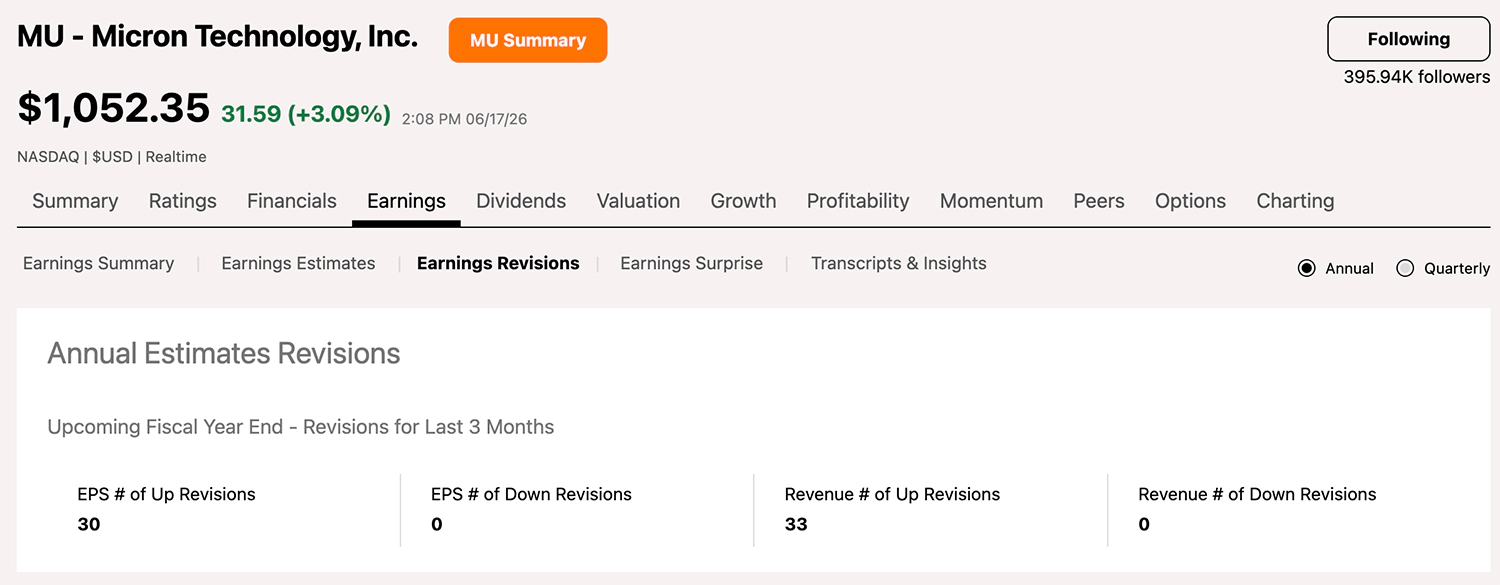
Read the top row:
30 analysts revised EPS up. Zero revised down. 33 revised revenue up. Zero down.
That’s unanimous.
Every single analyst covering Micron moved their numbers higher, and not one moved them lower.
The entire Street is getting more optimistic at the same time.
Now the mirror image. LULU: Lululemon, the athletic-apparel brand you almost certainly know:
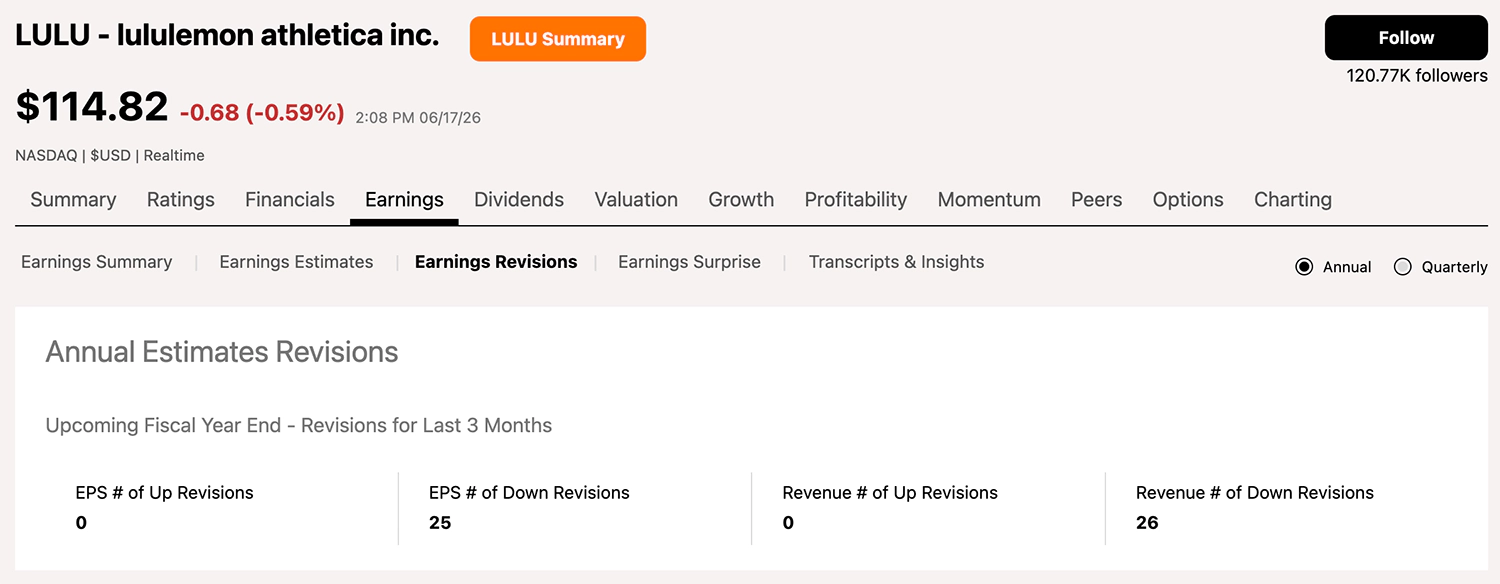
Zero EPS revisions up. Twenty-five down. Zero revenue revisions up. Twenty-six down.
A clean sweep in the wrong direction. It’s a familiar, quality-tier company, yet the analysts who model it are marking it down across the board.
What Revisions Means To You
Micron’s wall of green and Lululemon’s wall of red are revision momentum in its purest form.
One business has the forward wind at its back; the other is walking into it.
This connects straight back to the growth pillar. Remember Micron’s forward revenue growth from the growth article — that big next-year number sitting far above its trailing pace?
This is why it’s so high. That forward number is built from analyst estimates, so when 30 of them revise up and none down, it climbs.
The growth article showed you the number. The revisions show you which way it’s moving to get there.
It’s also the “positive analyst revisions confirming the trajectory” I keep coming back to in value stocks vs. growth stocks.
(One honest caveat: these counts are a three-month snapshot from the day I pulled them. They’ll read differently by the time you see this because revisions never stop moving. That’s rather the point.)
For a Wheel trader, that’s a forward second opinion you didn’t have to generate. When revisions line up with your read on the business, the odds tip your way. When they fight a great-looking track record, you dig before you sell the put.
The Second Forward Signal: What Management Is Telling You

Analysts forecast from the outside. Management forecasts from the inside…but then the message is spread with a megaphone.
That’s forward guidance.
Alongside the backward-looking results, a company issues its own expectations for what’s coming: revenue, earnings, sometimes margins, for the next quarter and often the full year.
It shows up in the earnings press release and, in more detail, on the earnings call. That’s the hour where executives walk through the quarter and field analyst questions.
You find it the same way you found everything else. The day a company reports, its guidance is all over the news coverage. The full earnings-call transcript, where the real detail lives, gets published on sites like Seeking Alpha under Transcripts, free to read.
Guidance comes in a few flavors, and each is its own signal:
- Raised: Management sees things accelerating
- Maintained: Steady, roughly as expected
- Lowered: The outlook is softening
- Withdrawn: Management no longer has enough visibility to commit to a number, which is rarely a good sign
Guidance is the freshest, most authoritative read on the future that exists coming straight from the people who see the orders, the costs, and the demand before anyone outside the building does.
And it sits upstream of everything in the last section. When management guides on the call, analysts go back to their models the next morning and revise to match.
Guidance moves first. The revisions follow. The forward number that feeds any screen (including mine) shifts because of it.
So the two forward signals work as a chain: guidance is the source, and revisions are the market digesting it.
A soft outlook for a single quarter can be noise; a cut to full-year guidance is heavier. It says the weakness runs deeper than one bad quarter, with the whole year repricing.
On the Wheel, guidance is management telling you, in plain language, which way the windshield points over the exact stretch of road you’d be driving if you got assigned.
Why a Company Can Beat and Still Fall

Picture a company reporting its quarter.
EPS comes in above consensus. Revenue comes in above consensus. On the rearview mirror, everything is green. Without doubt a clean double beat.
Then management gets on the call and guides full-year revenue below what the Street was modeling.
The stock opens lower the next morning and keeps sliding for a week.
Did the company lie? No.
Did it have a bad quarter? Also no. Double beat, remember?
What happened is that the beat was already priced in, and the lowered future was not.
Remember the expectations game. The market expected a beat, so the beat changed nothing. The guidance cut was the new information, and the market repriced the stock to the worse trajectory the moment it heard it.
- The beat was the rearview mirror
- The guidance was the windshield
- The stock follows the windshield
It runs the other way, too.
A company can miss the quarter, then raise guidance or paint a strong outlook, and it can rally on the spot. The miss is behind it; the better future is ahead.
Here’s a summary table you can reference:
| Guidance raised | Guidance held | Guidance cut | |
|---|---|---|---|
| Beat the quarter | Strongest move up — past and future both confirm | Muted — the beat was already expected | The beat-and-fall — green numbers, red stock |
| Missed the quarter | Can rally on a miss — the market buys the better future | Weak — nothing offsets the miss | Worst case — past and future both rolling over |
The two cells that surprise people are the off-diagonal ones. Beat-and-cut sends a stock down; miss-and-raise sends it up.
Both are the same lesson: the market trades the windshield.
How violent the move is depends on the stock. A cheap, low-expectations name can shrug off a soft outlook. A high-flier priced for perfection has no cushion so when its guidance disappoints, there’s nothing under the price to break the fall.
For a Wheel trader, this is the case against selling a put into an earnings report on a name you haven’t vetted on the forward picture. A guidance cut can drop you well below your strike overnight, and “but it beat EPS/revenue” won’t get your capital back.
Exactly how to handle an open position through an earnings date — hold, close, or roll — is its own decision. I’ll cover that on its own. For selection, the rule is simpler: know which way the forward signals point before a stock ever earns a spot on your list.
Backward Confirms, Forward Decides
A track record of beats isn’t worthless. It tells you a company has been executing. That’s real, and it’s the backward half of the picture.
But execution only counts if it’s expected to continue. That’s the forward half, and it’s what revisions and guidance measure.
You want both halves pointing the same way.
A company with a history of beats, a wall of upward revisions, and steady or rising guidance has its past and its future agreeing. Wall Street and management are both leaning the same direction. That’s a trajectory you can underwrite.
A history of beats paired with downward revisions and softening guidance is the dangerous one. The rearview mirror may look great, but the windshield fills with brake lights.
This completes the four-pillar framework:
- Valuation asked if the price is right.
- Profitability asked if the business is good.
- Growth asked if it’s getting bigger.
- Revisions and guidance ask the one the other three can’t: is the trajectory confirmed, and pointing up?
When all four line up, you’re reading the future from four independent angles instead of guessing.
Don’t Underwrite the Future on a Picture of the Past
An earnings beat tells you what a business already did. Analyst revisions and forward guidance tell you what it’s likely to do next.
On the Wheel, where your strike is a forward commitment to own the business for months, the forward signal is the one that protects you.
Checking a stock’s revision counts on Seeking Alpha and skimming its latest guidance in the transcript takes ten minutes. The data is public and free, and nothing is stopping you.
Now do that every week, across hundreds of names, and then weigh the forward read against valuation, profitability, and growth before a single put gets screened. That’s the actual work.
The proprietary screening behind WheelMetrics Pro incorporates revisions and forward guidance into its scoring, so the forward signal is already baked into a name before you open the chart.
Don’t focus on the past. Trade the trajectory.